Aruban Dreams (Part 1)

DSC03897

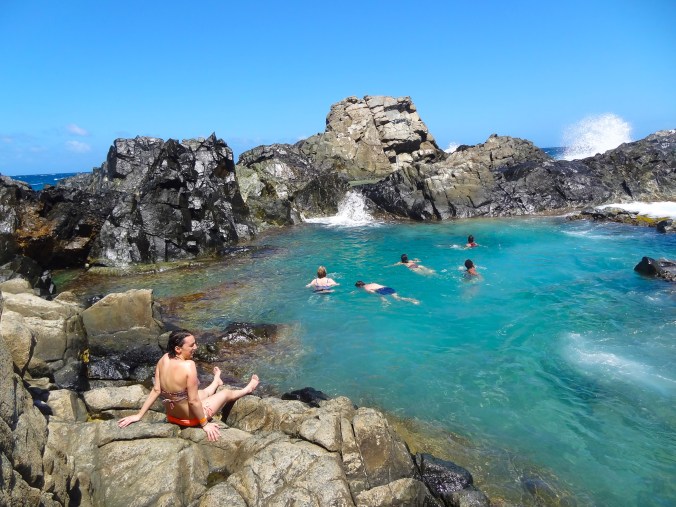
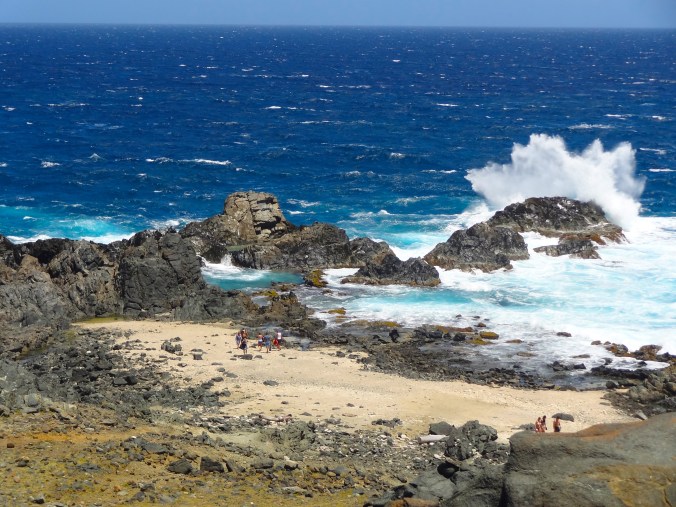
Conchi Natural Pool, Aruba.

A friend and I meandered down much closer to the equator last week to the Dutch isle of Aruba. The trip was my New Year’s Resolution and a chance to indulge my isle-o-philia. All I can say is that if every resolution was this amazing to fulfill, more people would make good on them instead of pooping out three weeks into the New Year. Enough of resolutions to lose weight or exercise more. Bah! People should make pleasurable and dreamy resolutions instead. Remember that for next year.

Our first island adventure was the most perilous undertaking of our week-long trip. We decided to visit the island’s one national park (Arikok National Park) to explore a natural ocean pool and then some caves.

The pool was our first destination. It’s located on the coastline, formed by a ring of high rocks that keep out the waves. Periodically, a wave overtops the rocks and fills the pool with more water. It’s known for good snorkeling, and an upper pool flows into the main pool via a small waterfall. Most people travel there by reserving a Jeep or 4×4 ATV. My friend and I? We decided to walk.

I had read somewhere that it only took a half-hour to hike from the park entrance to the pool. My friend and I didn’t need no stinkin’ 4×4 to get us there. That’s what feet are for. Besides, we wanted to get a feel for what the island is really like.

Heh heh. What the island is like is a desert. Hot. With no shade from the equatorial sun. And there are rattlesnakes. But I am getting ahead of myself.

At the park visitor center the attendant told us it actually takes an hour-and-a-half to hike to the pool. (I figured out later that the info I had read started from a different location – the Shete Entrance.) Plus, we would be walking up a 600-foot mountain on the way there.

My friend and I looked at each other, a bit taken aback. But we are healthy 50-something-year-olds from Minnesota. Above average, and all that. We decided we could do it. We were wearing athletic shoes and sunscreen. Our water bottles were full. We were ready to roll.

Then he told us the pool was closed due to high waves.

My friend and I looked at each other again. This was a more serious setback. But we decided we had come this far, we might as well go see the pool. I encouraged my friend to still bring her swimsuit, just in case conditions were really better at the pool than the attendant thought.

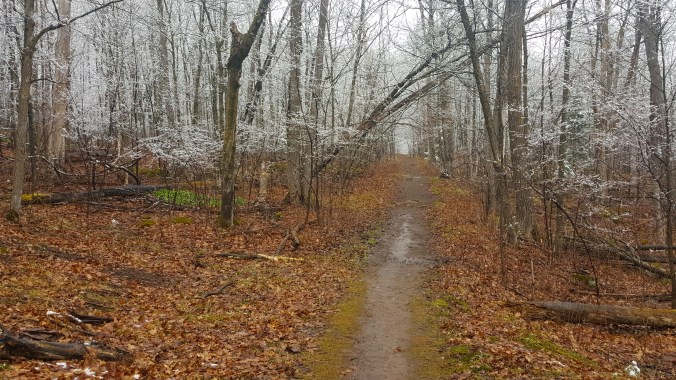
Off among the cacti we went. Unlike what the park map shows, there is no separate hiking trail from the Jeep trail, so we had to make way for all the lazy people who opted for motors. Almost all of them stopped and asked us if we were okay, subtly gloating that they were riding and we were walking. We assured them we were fine. We smiled and waved them on their way.

DSC03888

The “trail” to the pool.

Halfway up the mountain we met a family on their way down. The top of the mountain was as far as they got, and they decided that was enough. Especially after they saw the rattlesnakes (one was alive and rattling a warning four feet away from the family’s mom, the other was dead in the road).

I could feel my friend looking at me questioningly again, but I ignored her, determined not to let a few rattlesnakes deter us.

The view from the top of the mountain was great. It was easy to see how necessary the park is for preserving wild natural space on the 20-mile-long island – houses crowded everywhere but within the park’s borders.

The rest of the trail followed a sloping plateau and then made a steep drop to the ocean. Soon, we were able to see our destination, which made the rest of the hike easier — plus the fact that no rattlesnakes crossed our path.

As we neared the steps leading down to the pool, we could clearly see people swimming in it. Yes, waves were overtopping the protective rocks and washing into the pool, but it didn’t look like a life-threatening situation.

DSC03890My friend and I changed into our suits, thankful that we brought them and that we’d soon be going for a swim. We clambered over the rocks and slid down an algae-covered formation into the pool with half a dozen other people.
It was heaven, punctuated by anxious moments when a wave would wash into the pool. My friend got thrown around a bit by one wave, but I was luckier.

While we were swimming, my mind jumped ahead to the hike back out. I wasn’t looking forward to spending another hour-plus tromping through the desert. All my foot-powered bravado seemed to melt away into the sea. When one of our poolmates mentioned to us that he and his girlfriend had a Jeep with room for two more, I was the first to take him up on the offer.

My friend looked at me again, this time in thankful wonderment. I suspect she couldn’t believe that I changed my mind about the whole foot-powered thing. But heck, we were on vacation, not a forced death march.

So thank you, Bobbie and Samantha from New Jersey, for driving us back out to our car. Along the way, we saw another duo of women walking, and of course, we felt sorry for them. We joked that we should stop and ask them if they were okay.

And Then There Were Two: An Update on the Status of Isle Royale’s Wolves

isrowolvesrolfpeterson

The remaining wolf pair on Isle Royale. Photo by Rolf Peterson.

Last week I attended a public meeting by the National Park Service to hear about their preferred plan to deal with the declining wolf population on Isle Royale, a remote island-sized park in Lake Superior.

If you’re a long-time reader of this blog, you may recall the story I wrote about the issue in 2015. At that point, there were three wolves left on the island. Now there are only two.

The deformed wolf mentioned in my last story is nowhere to be found (presumably dead) and the other two wolves, who may or may not be its parents, are still alive.

Researchers have discovered that they are a male and female wolf who are related to each other in several incestuous ways. (Hard to avoid this when you live on an island.) They are father and daughter, but also half-siblings. And they are old for wild wolves — six and eight years old. As such, it’s not likely they would have any (more?) ultra-incestuous offspring.

During the meeting, the park service staff discussed four alternative plans of action they are considering. Their preferred plan calls for the introduction of 20-30 wolves starting next fall/winter over a span of three to five years. It’s known in the Environmental Impact Statement as Alternative B.

The other alternatives involve taking no action, introducing a smaller number of wolves over a period longer than five years (20 years), and taking no action now but allowing for the option of action in the future.

Under Alternative B, the park service plans to capture packs of wolves, if they can, and to release them ASAP together on the island. They will collect wolves from the Great Lakes area, and ones that are not habituated to humans and are already used to eating moose for food. They want the wolves to spend as little time in holding pens as possible so that they don’t become habituated to them. Initially, the park service will provide moose carcasses (from Isle Royale) for the wolves to eat, but then will leave the wolves to fend for themselves. They will monitor them (with radio collars, etc.) to see how they are doing.

The fact that the park is considering messing with wolf introduction is a big deal. Normally, they are a “hands-off, let-nature-take-its-course” organization. But the wolves are so important to the island’s ecosystem and to controlling the moose population, that public pressure and human-caused global environmental changes have made the park willing to change its philosophy.

When I commented on this issue back in 2015, for nature-purist motives I was against any action. But now since it seems like the wolf population is indeed doomed, and it’s not likely that wolves will wander over to the island from the mainland on an ice bridge during the winter (especially right now as I am writing this and it’s 50-frikin’ degrees in February!), I am okay with the idea of introducing wolves.

What I am not so okay with is introducing the new wolves while the two existing wolves are still living on the island. At the meeting, when someone asked this question, the park biologist dismissed the concern, saying the existing wolves would have a survival advantage over the new wolves because they already know the island’s terrain, etc.

But come on, what chance do two old wolves have against 20-30 young whippersnapper wolves? I fear they will be shredded to pieces by the newcomers. I think it’s kind of inhumane to introduce the new ones while the old ones are alive. But for some reason, the park service is hot to do the introductions ASAP.

Another question that was dismissed at the meeting is whether the park would alter its plans for introducing the wolves if an ice bridge to the mainland was in place. The biologist said that wolf experts have told them the wolves would likely stay on the island.

I question this as well. The park service plans to get the wolves from MN, WI or Michigan. If I was a wolf, and my family and I were taken from our home not that far away (wolves can easily travel 40 miles in a day), dropped somewhere new, and there was a way to escape and go back home, I sure as heck wouldn’t stay there. Studies of wolves introduced in other situations found that they do travel away from the site of introduction toward their site of origin.

One would think the park service would want to ensure that the introduced wolves would stay in place by not introducing wolves if there was an ice bridge, but apparently not. This could be a waste of time and expense to taxpayers.

Another comment that was dismissed, and this time I’m glad it was dismissed, was the idea that people be used to control the moose population on the island instead of wolves. This would involve hunting, of course. Hunting on Isle Royale is currently prohibited by federal law. But also, I’d just rather not have the top predator on the island be humans instead of wolves. There are plenty of other places where people can hunt. And I can only imagine how hard it would be to haul a moose carcass over those island ridges. It was hard enough to haul my own carcass over them when I hiked!

Okay, enough of my ranting. If you’re interested in commenting on the plan, the deadline is March 15. And if you’d like to learn about Isle Royale’s wolves in a fun way, please read my novel, “Eye of the Wolf.”

Just Your Average Winter’s Day Walk and Squirrel Attack

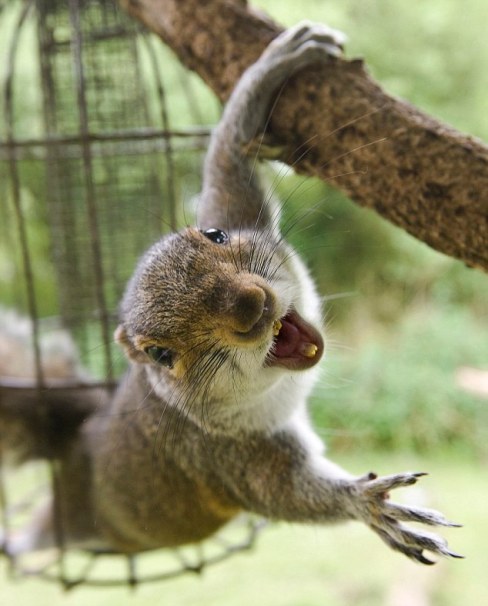
attack-squirrel

Image credit: DailyMail.com

My daily noon dog walk yesterday began like many others. Buddy and I took off down my street, heading toward the woods. Snow was falling with a few inches accumulating on the ground. As we neared the intersection at the end of my street with the forest beckoning beyond, I noticed what looked like a pile of brownish-gray leaves on the curb.

Buddy immediately perked up, and before I knew it, he was running at the leaf pile. His retractable leash played out its full fifteen feet, and my shoulder jerked in its socket as Buddy kept trying to run at the leaf pile, which had unfurled into the form of a gray squirrel.

I have learned the hard way that when it comes to my dog and squirrels, the health of my shoulder muscles is more important than trying to save the squirrels from his hunting instincts, so I let the leash go. By this time, Buddy was behind the squirrel, which came running out into the snowy intersection.

One would think that the squirrel would run anywhere but toward another threat (me). But this squirrel headed right at me, my dog on its heels. The squirrel hopped through the snow sluggishly. Whether this was because of the snow depth or because there was something wrong with it, I couldn’t tell.

As the squirrel came closer, its course stayed true — right toward me. I remembered a time when I was young and a wild squirrel climbed up my leg to get my peanut butter sandwich.

I spread my legs a bit wider to discourage the squirrel from any leg-climbing ideas. Did it think I was some sort of stumpy tree? The squirrel kept coming, passing directly between my boots. Buddy was a few feet behind, his leash dragging through the snow.

Uh-oh. Buddy was headed directly between my legs, too. He is a very tall, eighty-pound dog. I lifted up one leg so he could pass under.

Then I heard the tires of a vehicle slowly crunching through the snow. I looked away from Buddy and saw a white pickup truck approaching. More chaos. Just what we needed!

The squirrel continued its sluggish trajectory to a tree in a neighbor’s yard. In the meantime, I was able to grab Buddy’s leash and command him to “Leave it!” (As in leave the squirrel alone.) The command actually worked. He stopped and I grabbed up the slack in his leash, holding him tight and out of the truck driver’s way. The squirrel was now high in the tree.

The driver, seeing that all was under control, eased into the intersection. Beneath my scarf I began laughing at the scene that must have confronted him. Through his frosty window, I saw that he was laughing, too.

We waved at each other and he continued on his way.

The Lighthouse Tour That Wasn’t

mi-is-lighthouse-detour-009

Michigan Island in the Apostle Islands National Lakeshore in Lake Superior. Note the waves crashing on the dock.

This weekend I revisited the Apostle Islands National Lakeshore in Wisconsin, in hopes of getting a look inside one of the lighthouses.

mi-is-lighthouse-detour-002

The gunmetal grey sweetwater sea that is Lake Superior.

I awoke at 5 a.m. (which for me, who likes to sleep late, is not as easy as it sounds), drove two hours in the rain to meet my friends and catch a boat, and spent an hour or so staving off seasickness on a roiling Lake Superior, only to hear the boat’s captain say they couldn’t dock at the lighthouse because it was too wavy.

But we could take distant pictures of the lighthouse. So that’s all I’ve got for you!

As our consolation prize, the captain ferried us to nearby Stockton Island, where we romped for a while before returning to Bayfield on the boat. I’ve been to Stockton Island three times now (see story from last year), so some of its magic has dimmed with repetition. But I confess that wandering around on Julian Bay (on the non-windy side of the island) was like experiencing a break in the space-time-weather continuum. The water was warm, the sky blue, and eagles coasted lazily on the calm breeze.

mi-is-lighthouse-detour-017

A bear track? Or a bare track? Julian Bay Beach on Stockton Island.

Afterwards, we walked to the boat dock to catch our ride back, not caring that we missed a lighthouse tour.

mi-is-lighthouse-detour-013

Saving the Whales (and Dolphins): Adventures in Scotland, Part 5

038

Director Kevin Robinson (left) and Theo (right). The ham in the middle is Jack Borrett.

When I was researching things to do in Scotland, I was intrigued to discover the Cetacean Research & Rescue Unit in Gardenstown, next door to our temporary Scottish home of Crovie.

I contacted the “unit” by email before our trip and asked about the opportunity to learn about what they do. We were welcomed to visit. Although it took a few tries to connect once we were in Scotland (due to vagaries in weather and schedules), we found director Dr. Kevin Robinson and research assistant Theofilos Sidropoulos (Theo for short) in their office on the shores of the Moray Coast one afternoon and they were nice enough to talk to us for over an hour.

Let me set something straight. You may have misread the name of the unit as the “Crustacean Research & Rescue Unit.” No, they do not rescue hapless mollusks. They research and rescue cetaceans, which are whales, dolphins, and porpoises.

Kevin founded the organization over twenty years ago. He explained that he got his start in the field by working in Inverness for a marine mammal organization. He saw the need for another organization that focused more on marine mammal strandings, and the Cetacean Research & Rescue Unit was born. The Unit is a nonprofit organization that tracks the population of the farthest northern pod of dolphins in the world in the Moray Firth. They do this through scouting trips and by taking photos of the dolphins and identifying them by their dorsal fins. Despite dire predictions at first, Kevin said the dolphin population in the Firth is thriving.

SCOTLAND! 039

Gardenstown, Scotland.

The unit also conducts research. Kevin explained that their latest quest was to take skin mucus samples from minke whales. The samples can then be genetically analyzed. To take such a sample, the researchers must get close enough to a whale to reach it with a pole that has the sampler attached to the end. They need only touch the whale with the sampler (no skin pricks or pain involved), but that was proving easier said than done at the time of our conversation. Also, Theo is a student at Edinburgh University and said he was researching the effects of climate change on the environment and marine mammals.

And, of course, they respond to reports of strandings. They provide 24-hour veterinary response for sick, injured and stranded marine mammals. Kevin said that unfortunately, most of the stranded animals don’t make it. But it’s nice to know that someone is looking out for them.

In our wide-ranging conversation, we also learned the organization focuses on environmental education as well. They educate school children about marine mammals and present papers at scientific conferences, and the like. They even have a Facebook page.

IMG_0921

The sign on the path between Crovie and Gardenstown. One takes their lives in their hands at every passing. And it seems the sign has seen its share of rockfalls (or bullets!)

And if, like me, you have a secret desire to save the whales, you can do so by volunteering for the unit during the summer (May-Oct.). As long as you are able-bodied enough to get out in a boat and to walk along steep coastal paths, you’re in! Kevin mentioned that a woman in her seventies volunteered for them and for other organizations around the world. She ended up coming back to them for a second time when she was in her eighties because she so enjoyed her first experience. There are still openings available for this year.

The unit is working to raise funds for a new boat to help with their conservation work and to replace their aging vessels. Click here to donate. Their goal is to raise the funds by the end of July, so please act fast if you are so inclined. They are about three-quarters of the way there.

We left their office with a better understanding of life in the waters of the Moray Firth. Kevin and Theo were also nice enough to direct us to where we could see puffins and seals locally. (And we did!) I think it would be totally fun to come back there someday as a volunteer. We’ll see if the fates will allow for that.

Next up – Visiting Edinburgh in an hour-and-a-half!


Stalking the Wild Puffin, and Seals on a Conveyor Belt: Adventures in Scotland, Part 4

007

Puffins at the Bullars of Buchan.

One of the reasons my friend and I went to Scotland in June was for the chance to see puffins before they left their breeding grounds. My friend studied these seabirds when she was in graduate school, and she wanted to see them again. Me too. As you may already know, I have a thing for birds.

SCOTLAND! 064

Troup Head gannets.

Our first try involved a short trip from our cottage at Crovie Village to Troup Head, a nature reserve less than a mile away. The reserve is home to a gannet colony, but puffins are sometimes sighted there, too. I had only seen one gannet in my life (in Newfoundland, sort of by accident). I was thrilled by that, so you can imagine how overwhelming it was to see so many gannets on Troup Head, they were impossible to count. And the view from the cliffs is stunning!

SCOTLAND! 058

The view from Troup Head.

But, no puffins. The next day, we ended up visiting the director and staff at the Cetacean Research and Rescue Unit (who I will write more about next) in Gardenstown, the town next door to Crovie, and mentioned our plight. They recommended we try the Bullars of Buchan, a former fishing village on the coast on the way to Aberdeen. We also wanted to see seals, and they recommended the estuary of the River Ythan in the town of Newburgh, not far from the puffins.

004

The Bullars of Buchan.

So off we went. OMG, the scenery at the bullars was as spectacular as the scenery at Troup Head. The village is set atop a headland that features a collapsed sea cave that forms a “pot” about 100 feet deep. The seabird colony was home mainly for gulls but my sharp-eyed friend did find some puffins. And a few were close enough to photograph with our low-tech cameras. Score!

Next to find the seals. You’d think they’d be in a nature preserve, too, but they’re not. To find them, drive through the town of Newburgh and follow the Beach Road. You can park right near the estuary. A short walk through the dunes finds you at the river mouth. We were expecting to see a seal colony on land, but what we got was more like a watery conveyor belt of seals.

008

Grey seals in the River Ythan.

The tide was flowing upriver. The seals were floating, somewhat evenly spaced, from the sea into the river. Their black heads bobbed past those of us watching from shore with clockwork regularity. Seal head dots everywhere – weird but amazing. Sometimes one would dive, no doubt after a fish, and then resurface farther up river. I suppose when the tide reverses, the seals just float back out into the ocean. We watched for a long time, mesmerized.

Other natural wonders we saw were of a more geologic kind. We hiked a good ways. One trip found us along the coast on the way from the town of Cullen to Portknockie, home of the famous, craggy and triangular Bow Fiddle Rock (see image at the end of this post). I can’t help but think it would make a great scene for an album cover. Too bad I’m not a musician!

001Another hike found us on the Great Glen Way above Loch Ness, making our way through primeval forests and gorse hedges with mountains in the background for accompaniment. I never got to see Loch Ness on my ill-fated European trip when I was ten, so I was especially glad to make it there.

Every place where I travel that has an aquarium, I try to visit. I “collect” aquarium visits like some people collect refrigerator magnets from their travels. In planning our trip, I was excited to discover that Macduff, a town not far away from Crovie, had a small aquarium focused on marine fish. The children in Scotland were still in school, and I was heartened to see several busloads of them gaining a greater appreciation for the sea while we were there. Although the Macduff Aquarium is small, they do a great job on interpretation.

The next day, we got a greater appreciation for marine mammals and the local people who are trying to protect them when we visited with the Cetacean Research & Rescue Unit – to come in the next installment!

IMG_0950B

Marie at Bow Fiddle Rock.

Monarch Mania

20160521_125303

Any minute now the first monarch butterflies will wing their way into the northland on their annual migration. Thanks to the first-ever Duluth Monarch Festival this weekend, I learned that the butterflies that return to Minnesota aren’t the ones that left in fall for Mexico, but are their offspring that grew up in early spring somewhere in the southern U.S.

If they aren’t the butterflies that left here, how do they know to return? How can an insect that weighs about the same as a paperclip survive the long flight? These are just some of the intriguing questions that surround monarchs.

On the street where I grew up, milkweed (the monarch caterpillar’s favorite plant food) flourished in a vacant lot kitty-corner from our house. I had a little round wire mesh insect container where I would grow the caterpillars into butterflies indoors. I can’t recall exactly how I learned to do this, but suspect my older brothers taught me. I raised dozens, fascinated by the transformations the caterpillars went through in becoming the beautiful black, orange and white butterflies that are so distinctive and a joy to see.

My attachment to the creatures even extended to the schoolyard. On one of my first days on the kindergarten playground, a boy killed a monarch caterpillar. I thought he was the cruelest person on the planet, and begged him not to kill it because, “These are the ones that make butterflies!” Other than that, I lacked the communication skills to tell him why I was so upset. I ended up burying the caterpillar underneath a pile of playground pebbles. Now I understand his actions were just the casual cruelty of boys (and because he had probably never raised caterpillars), but for the rest of my grade school career, I shunned him as The Boy Who Kills Caterpillars.

DSC02677

A monarch caterpillar on a milkweed plant.

Playground killings aside, the monarch population has dropped significantly over the years due to habitat loss, pesticide use, and a wacky climate — to the point that the fall migration to Mexico is in danger of disappearing. The last two years have had the lowest counts in history. Instead of taking up 18 hectares of roosting forest in Mexico (1996), the butterflies now only take up 2-4 hectares.

One relatively painless way to learn more about the plight of the monarch is to read “Flight Behavior,” a novel by Barbara Kingsolver.

The monarch festival I attended is one effort to help this beleaguered bug, and the organizers hope to make it an annual event. The goal was to educate citizens about monarchs and to help people become involved in restoring monarch habitat. One of the speakers was Prof. Karen Oberhauser from the University of Minnesota. She said an estimated two million more milkweed plants are needed for the monarch population to stabilize. To that end, a local group (Duluth Monarch Buddies) was giving away milkweed seeds. Milkweed plants and other butterfly-friendly plants were available for sale.

They were also encouraging people to sign up to be monarch larva (caterpillar) monitors. The Monarch Larva Monitoring Project is a citizen science effort where volunteers track how many monarch eggs and caterpillars are in a local milkweed patch. How I would have loved to do this when I was a child! Heck, I intend to do it now. Monitors visit their sites once a week and enter observations onto a data sheet. The goal is to better understand the health of local monarch populations and how they change over time.

I picked up a packet of milkweed seeds. I can’t wait to plant them and do my small part to save the monarchs. Take that, Boy Who Kills Caterpillars!

Trail Cam in the Office

TrailCam

True story. This happened in my office last week.


We’re caught
inside the camouflaged box that’s mounted on a pole
in our office.
Eyes wide, coffee cups in hand
we walk down the hallway
feeling like someone is watching.

What strange natural rituals
will the camera catch —
Mating habits of the white-collar worker?
Dominance displays of the office alpha female?
A furtive mail boy stealing candy from a desk?
The shy engineer emerging from a conference call?

I suspect all the mother wolves who have had their birth dens invaded,
all the nesting birds who just want to feed their young in peace
would enjoy the sweet revenge
of these photos.

©2016  Marie Zhuikov

The World’s Largest Freshwater Sandbar

Barkers & WI Point 047

Even though Wisconsin Point on Lake Superior is not truly part of “the world’s largest freshwater sandbar,” it’s still pretty.

It’s a common local point of pride in Duluth to say that Minnesota Point (a.k.a. Park Point) and Wisconsin Point form the “World’s Largest Freshwater Sandbar.” I am sorry to burst the community bubble but . . . NOT.

Way back so many years ago I can’t even find it on the Internet, Duluth sent a delegation of kayakers to Lake Baikal in Russia. They returned with tales of a sandbar or two on this freshwater lake that were even larger than MN/WI points. Maybe I was the only one who listened then because local tourism organizations and media outlets continued to refer to our sandbar as the “world’s largest.”

A couple of years ago (2014), I decided to fact-check the claim because I was editing a government report that repeated it. Lo and behold, I found a provincial park in Canada that claimed the same thing (Sandbanks Provincial Park).

I also asked several scientific types who are in the know about such things and received a response from a researcher at the University of Minnesota Duluth’s Large Lakes Observatory. Prof. Ted Ozersky did some Google Map comparisons and found that Jarki Island at the northernmost tip of Lake Baikal sports a sandbar that is 18 kilometers long. MN/WI points are 16 km long.

He also found a series of long sandbars on Proval Bay along the eastern shore of Lake Baikal that collectively stretch for 40 km.

So, in the document I was editing, I changed the wording to MN/WI points as comprising “one of the largest freshwater sandbars in the world.”

The issue arose again just last week when a fellow blogger made the “world’s largest” claim in his post. Why? Because he saw it elsewhere on the Web.

I figure it’s high time to get definitive news out on the Web that, alas, Minnesota and Wisconsin Points ARE NOT the largest freshwater sandbar in the world. Even the park in Canada has downgraded their claim to say instead that they have the “world’s largest baymouth barrier dune formation.”

In short, it’s okay to say that MN/WI points are the largest freshwater sandbar in the country, or one of the largest freshwater sandbars in the world, but not “THE largest freshwater sandbar in the world.”

Class dismissed.

A Lake Superior Cruise

I stopped freelance writing a few years ago, choosing instead to focus on writing fiction and poetry. (And this blog!) I was tired of hiring out my brain for somebody else’s use, since that’s what I do all day at work already. Thankfully, I also no longer had a financialLSMagazineMay16 need to freelance, so I made the conscious decision to stop.

That worked well until about a year ago, when I took a cruise on Lake Superior aboard the Wenonah, the ship that took me on my first trip across the lake.

The cruise dredged up old memories. I considered blogging about them, but once I started writing, I realized I had a story I could sell, dang it!

Alas, I succumbed to freelancing, but at least the story was one I truly wanted to write. I know, poor me. It’s a good problem to have.

My story was recently published in Lake Superior Magazine. It’s a superb magazine — pick up a copy and check it out! (Page 14.)

They also published a couple of my photos. But I have gobs of other photos I took that day, which I thought I would share with you. Please enjoy this virtual cruise along Lake Superior’s North Shore.

DSC02270

The Wenonah at Silver Bay Marina.


DSC02290

The tip of Gold Rock, site of a shipwreck in 1905 that claimed a life.

DSC02298

That turquoise water looks like the Caribbean, doesn’t it? I wouldn’t jump in though. It’s a bit nippy.

DSC02303

Coming around Split Rock Lighthouse. Not many people get to see the lighthouse from a mariner’s view.

DSC02310

A more classic view of the lighthouse.

DSC02322

People frolicing with gulls on an island off Silver Bay.

DSC02327

Piles of taconite pellets waiting to be shipped south to be made into steel.

DSC02333

The taconite plant in Silver Bay, although it looks more like a cloud factory. Perhaps it’s not beautiful, but it’s part of the cultural landscape of this area.

DSC02275

The rugged coastline of Lake Superior’s North Shore.