The Year in Blogging, 2017

20170422_100312

This was my favorite image from 2017. I took it at the beginning of the March for Science, which happened in Duluth, Minn. I call it “Standing Strong for Science.”

My fifth year as a blogger has come to a close. I hear in the blog-o-sphere that such longevity is unusual. Most bloggers only maintain their efforts for a year or two. What can I say?  I keep doing it because I keep coming up with stories to tell and places to visit. I don’t have any goals other than sharing my stories. Well, there might be a bit of book promotion in there, but I try to keep that to a minimum. Oh, and there’s also that time I tried to save my job, but more about that later…

In 2017, my blog saw the most traffic so far. It had over 4,500 visitors and over 6,100 views. I’m sure part of that is because there’s more content so my blog shows up in more searches, but I’d also like to think it’s because people find what I have to say of interest and of use.

I’m sure if I was active on more social media channels, I could up those numbers. But upping numbers is not my goal, it’s just a nice side-benefit of telling stories.

Here are the most popular stories for the year:

# 1 Why Sea Grant is a Kick Ass Program (And Not Just Because I Work There) – This was my plea for people to contact their congressional representatives to save the federal program that employs me. The post got shared widely among my colleagues and friends, and guess what? It worked! We all still have our jobs with an organization that works to study and protect one of our most basic requirements of survival: water.

Not only was this post the most popular for 2017, but for the entire time I’ve been blogging.

Congress ignored the President’s budget cut for us, and even gave us a little bit of a raise. It’s nice to know that your country values you. Alas, the president has zeroed out our budget once again for next year, but I’m not freaking out because the Sea Grant leadership suspects that congress will keep us in the budget as before.

Anyway, thank you for the support you all provided!! It means a lot.

#2 Iams Dog Food Alert!—This story didn’t take off right away like the Sea Grant one did. Its popularity is unfortunately based on the fact that many dogs other than mine have had bad reactions to the sneaky changes this company made in the recipe of their dog food. This is one story I wish wasn’t popular, but more and more people keep finding it though searches. I am glad the story is providing them with answers, but sorry that their dogs are having problems.

#3 Minnesota Singer/Songwriter Jacob Mahon – This is a short post that I whipped out in about 10 minutes after seeing a new Duluth-based musician. I suspect part of its appeal is that it was short and to the point, plus the guy is good! The story was shared by several people, which helped lead to its popularity. Go Jacob!

#4 and #5 The Lake, it is Said, Never Gives Up Her Dead and Remembering Black Sunday in Duluth – I group these two together because they are about the same topic, and because they follow each other in popularity. Fifty years ago, three of my cousins drowned in Lake Superior. The stories are about the incident and a special ceremony that was held on the lake in their honor and to remember the people who tried to rescue them. They serve as a reminder of how powerful this lake can be.

#6 Challenge: Describe Your Community in One Word – This story, which I wrote in 2014, describes the efforts of myself and a friend to find one word that describes the people who make up Duluth, Minnesota. I’ve noticed that this story pops up in a lot of searches, especially from the Philippines. I suspect there’s a school teacher there who is giving his/her students the assignment of coming up with one word for their city or country. My blog has probably been plagiarized for many a school paper, but that’s okay with me!

Thank you for meandering with me, and Happy New Year wherever you may be . . .

A Bunch of Cool Things I Learned at the World Conference of Science Journalists

20171028_111639

About a week ago, I returned from the World Conference of Science Journalists, which was held in San Francisco. Although the coolest thing was seeing that there are so many of us doing science journalism in so many countries (more than 1,300 attended from seventy-three countries) — some of whom are the type who wear DNA double helix earrings — I learned many other interesting things during the five days of sessions.

Here are the highlights:

  • In writing a profile about a scientific woman, remember that, “If you wouldn’t say it about a male scientist, don’t say it about a woman scientist.” This applies to factors like cooking prowess, childcare arrangements, familial relationships, etc. This should go without saying, but apparently, some journalists don’t know this yet!
  • The current anti-science political climate makes our profession more important than ever. (Ron Winslow, National Association of Science Writers).
  • The term “climate disruption” is preferable to the term “climate change.” (John Holdren, Harvard).
  • “I love science because it can improve the human condition. The current absence of trust in science threatens this.” (Susan Desomond-Hellmann, Gates Foundation). She also said that skepticism of science is okay. Denialism is not. Science journalists and scientists need to re-establish confidence by being credible.
  • “Our oceans are our lives.” (Rashid Sumaila, University of British Columbia). Sixty percent of the world population lives within sixty km of the coast. Fifty percent of the oxygen we breathe is generated by the ocean.
  • Most of the extra heat generated by climate change is going into the ocean (93%). (Malin Pinsky, Rugters University). He also said that ocean animals are moving ten times faster than land animals to new areas in response to climate changes.
  • Some solutions to overfishing: use algal oil in animal feed instead of fish oil. Consume lower on the food chain. (Julie Thayer, Farallon Institute).
  • The arctic is a hotspot for ocean acidification. Unfortunately, with climate disruption, it’s also where most of the fish are moving in general. (Rashid Sumaila, University of British Columbia).
  • There’s a relationship between climate disruption and human violence. (Solomon Hsiang, Berkeley). It can take fifteen years for economic recovery to start happening after only twelve hours of a hurricane. Hurricane Maria undid twenty-six years of economic development in Puerto Rico. “The only thing more destructive is a nuclear bomb.”
  • It would only take three hours for the water supply for the reservation near Standing Rock in the Dakotas to be impacted by an oil spill, given the current location of the Dakota Access Pipeline. (Phil McKenna, InsideClimate).
  • UC Berkeley has twenty-nine libraries, and some have interesting specialties. There’s a “no-technology” one (put those phones away!) There’s one where it’s okay to talk. There’s one for meditation. There’s even a “food-is-okay” one.
  • There’s a way to verify carbon dioxide emission levels of different countries. It’s called the Orbiting Carbon Observatory. (Inez Fung, UC Berkeley). The levels of U.S. emissions are lower than those of China and Europe.
  • A lack of wild fish can have harmful impacts on us humans, including slavery and an increase in HIV. See the full story on my work blog, here. (Justin Brashares, UC Berkeley).

Louis Jenkins’s Favorite Poem

20170926_191607

Louis Jenkins reads at Zenith Book Store in Duluth, Minn.

Laconic prose poet Louis Jenkins gave a reading at a book store last week in Duluth.  He’s one of my favorite local writers (even though he lives in a Minneapolis suburb now instead of Duluth), so I went. I think of him as Duluth’s Earnest Hemingway. He has that larger than life quality and talent. A chance encounter with him once even inspired a poem out of me. (See “Two Poets in the Cereal Aisle.”)

The Poetry Foundation website describes Jenkins’s poems as having “a tight focus on the mundane particularities of ordinary existence, using deliberately flat language to comic and often heartbreaking effect.”

The last time I went to one of his readings years ago, I left my cell phone on. My children were home with a babysitter, and I wanted to be available. I told the sitter only to call me in an emergency. Right when Jenkins was reading a poem, my phone went off. I was in the middle of the crowd and everyone looked at me. I was too mortified even to turn off the sound; I just fled the room with my ringer intermittently blaring.

The call was not an emergency. After mildly chastising the inexperienced babysitter (I am a Minnesotan, after all, we can’t afford to get all riled up), I sheepishly returned to the reading, waiting until the crowd was applauding to cover my entrance.

At last week’s event, you can bet I turned that sucka OFF. Jenkins read from his new book, “In the Sun, Out of the Wind.” Afterward, he took requests for readings from his other books and he answered questions.

One memorable question came from my friend and partner in crime, Sharon. She asked which poem of his was his favorite. His response was, “The next one.” He went on to explain: “Sometimes you think, ‘I got pretty close with that one,’ and those are the good ones. Other times you wonder, ‘Why in the heck did I write that?’ ”

Another person asked him what he thought of living in the Twin Cities. “Bloomington’s a lot like Duluth,” he said. “It’s only got one good restaurant.”

The topic of actor Mark Rylance came up. In case you haven’t seen the Tony awards lately, Rylance is the actor who, for the last two Tonys he’s won, recites a Louis Jenkins poem instead of giving an acceptance speech. Rylance and Jenkins even did a play together based on Jenkins’s book, “Nice Fish.”

Although age has taken its inexorable toll, Jenkins still has a twinkle in his eye when he reads, and his wit is unmistakably intact. I felt privileged to see him once again, and to sit through the entire reading this time.

Hemingway’s Cats

61002_452570391475917_416832289_n

A descendant of Hemingway’s polydactyl (many-toed) cats sits sleepily in a box on the front porch. My son took this photo.

I read in the New York Times recently that the multi-toed descendants of Ernest Hemingway’s cats at his house in Key West, Florida, all survived Hurricane Irma. The house fared well, too.

DSC02211

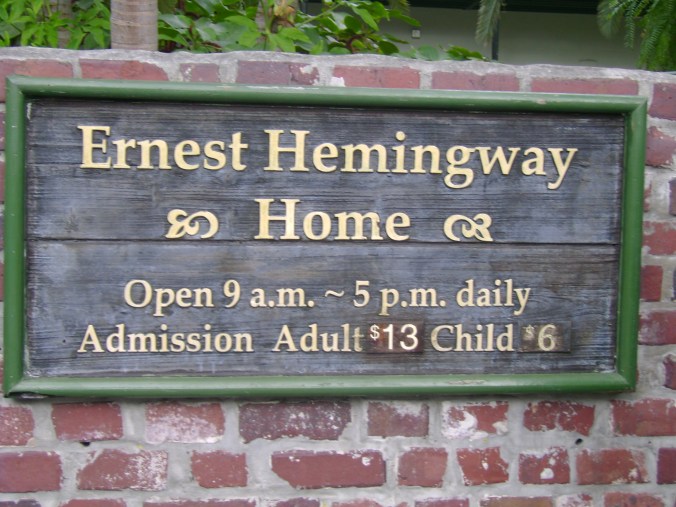
Hemingway’s home in Key West, Florida.

My youngest son and I visited Hemingway’s house about five years ago. We delighted in seeing the cats, which lounged around in the yard and in the house. One was even sleeping on Hemingway’s bed, below a painting on the wall that depicted the house surrounded by cats.

DSC02203

DSC02207

I am glad to hear that everything is okay there.

DSC02210

Hemingway’s writing studio above the pool house.

DSC02198

Okay, so I’m Being Lame

fountain-pen-on-paper

I think it’s lame when bloggers write about how they don’t have anything to write about. Or they start off a story by apologizing for not writing in a while. Seriously, I don’t think anyone notices they’ve been gone (well, maybe their stalkers notice – grin).

I believe bloggers should just write a story when they have an idea and get on with it. Stop apologizing first!

But here I am saying that I haven’t written in a while and that I don’t really have much to write about. I do have an idea for a book review, but I haven’t finished the book yet. So, I’m in a holding pattern of sorts. Maybe I’m gathering strength for the next four years of blogging?

Anyway, I’m still alive, still out here. Just living life, enjoying the last of a fleeting summer, and waiting for my meandering thoughts and feelings to gel into something worthy.

Author Interview on “Minnesota Reads”

20170803_081113

Lisa Johnson, multitasking radio goddess.

I had the good fortune to be in the radio studio last week with Lisa Johnson, host of KUMD’s Minnesota Reads show. We talked about the “Going Coastal” anthology project and Lake Superior Writers, the local writing group that produced it.

I had to leave home for the interview during the time of morning I’m usually just sitting down to eat breakfast. And here Lisa is, multitasking between radio songs, flipping switches, keeping records of what played, and then calming down enough between all that to sound incredibly composed on the air.

I don’t know how she does it! Plus, she reads a lot of books every month for her show about Minnesota authors. Here’s a link to my seven-minute interview. Enjoy.

Fun with Apostrophes

DSC04196

As a writer, I care about the written word. I care about proper grammar. While I have been known to dangle a preposition at the end of my sentences, I usually try to do what’s proper, especially in my writing for hire.

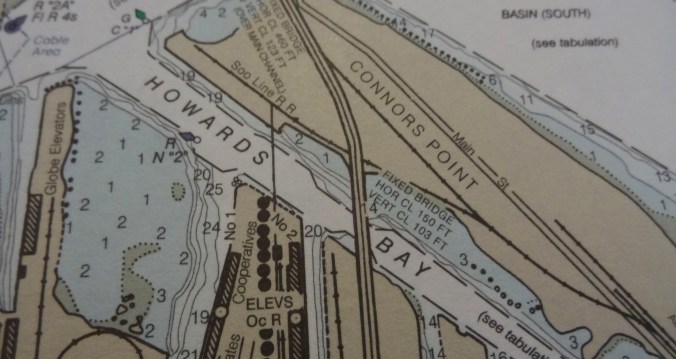
I had an instance this week where I wanted to confirm the name of a bay in the Duluth-Superior Harbor. Someone who works for an agency in another state asked me to review a web site about this bay, which is the subject of a federal cleanup project because it’s contaminated. My office coworker is also helping with the project by providing engineering advice.

The title of the web page was first thing I noticed. It was called “Howards Bay,” which just screams out for a possessive apostrophe, doesn’t it? (Howard’s Bay.) Unless, of course, the bay was named after someone with the last name of Howards vs. the first name of Howard.

I’ve run across instances before where proper grammar for place names flies out the window because some mapmaker hundreds of years ago labelled places incorrectly on local maps. As such, writers like myself are required to grit our teeth and perpetuate the mistake because what’s on the map has become the actual factual name for those places. One example is the St. Marys River, which empties out of Lake Superior and into Lake Huron. It makes me cringe every time I write it, but there’s no possessive apostrophe in that name due to a mapmaker’s error.

Hoping against hope that wasn’t the case for Howards Bay, I investigated. I looked on the internet. I found that newspaper stories about the bay gave Howards an apostrophe. I found that many government documents (but not all) did not. I asked friends if they knew which form was correct, and received helpful suggestions about where else to check. I looked it up on the U.S. Board of Geographic Names website. It had “no data available” about this name.

Along the way, I discovered that that state of Wisconsin (where Howards Bay is located) has a state Geographic Names Council. Who better to ask? So I sent them an email. While I was awaiting their reply, I learned more about the organization. They seem mainly formed to approve new names for lakes and other geographic features.

They have a list of rules for new names. Among them is one that says, “newly acquired proper names for geographic features shall not be designated with ” ‘s ” or “s”, indicating possession, following the name. For example: Mott Lake, rather than Mott’s Lake or Motts Lake.”

Geez, I wish they would have had that rule in place when Howards Bay was being named!

The next day, I received the geographic names councilperson’s reply to my apostrophe question. Here’s what he said: All of our records that I have been able to find have no apostrophe for Howards Bay. I’ve attached a state sediment sampling document as evidence. I cannot give a more definite answer to the “official” name but I would say that the consistency in our records would point to this being the correct spelling.

In the meantime, with my dogged grammatical passion, I had asked the state cleanup project manager for Howards Bay the same question. He said: The apostrophe question has come up before.  I have not been able to determine which version is correct and occasionally catch myself using both. For consistency, the project team chose to perpetuate the mistake and go with the original name shown on maps, i.e. “Howards.”

Aaargh! Why are we at the grammatical mercy of ancient map makers? I say that modern writers should rise up and free themselves from this typographical tyranny! Add the apostrophe “s” and may the mapmakers be dammed!

Who’s with me?

____________________________________________________________________________________________

**Update** August 9, 2017

A friend of mine asked a research librarian with the Superior Public Library the origin of the name of Howards Bay (also called Howards Pocket). She said it’s named for John D. Howard who held an interest in a sawmill on Connors Point. He died in 1891.

So there really should be an apostrophe because it is Howard’s Bay. Darn those mapmakers! And there should be an apostrophe in Connors Point, too, but I’m not even going to go there. 🙂

The Joys of “Going Coastal”

thumbnail_IMG_8808

Six of nine “Going Coastal” authors. From L to R, Evan Sasman, Maxwell Reagan, James Brakken, Judy Budreau, Marie Zhuikov, Eric Chandler. Image by Ryan Swanson.

I’ve been working a lot lately to promote a new anthology of Lake Superior short stories, called “Going Coastal.” I’m finding that promoting a book written by a bunch of other authors versus a book written just by myself is a lot more fun. Having others to share in the workload of doing readings and events is well, way less solitary, and I enjoy helping to promote their writing careers.

We just had an event at a new local bookstore this week. A superb description of it can be found in “Ennyman’s Territory,” a local arts and culture blog written by Ed Newman. His story also includes a link to a recent review of the book.

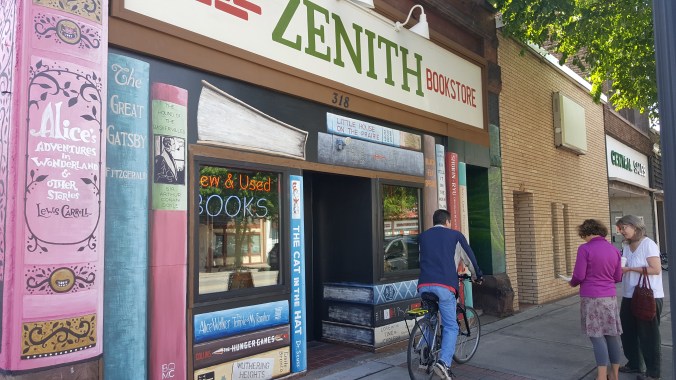
And if you are ever in the Duluth area, stop by our newest independent book store, Zenith Books. If you love to read, you’ll feel right at home there.

20170701_104542

DSC04153Crop

Zenith Book Store owners Angel and Bob Dobrow with a copy of “Going Coastal.”

Free Books!

Going Coastal

If you’re active on Goodreads, a book giveaway is currently open for “Going Coastal.” This book is a collection of short stories about Lake Superior. Authors hail from northeastern Minnesota and northern Wisconsin. (A story by yours truly is included.)

The stories were chosen by a panel of judges during a contest offered by Lake Superior Writers last year. Lake Superior Writers is a nonprofit group with over 200 members that supports the artistic development of writers and fosters a vibrant literary arts community.

“If you like lighthouses, ships, beaches, ghosts, road trips up the shore, history, storms, agates, islands, family drama, and the mystical power of water, you’ll enjoy this book,” said Marty Sozansky, board chair of Lake Superior Writers.

Like the horizon blurs between sky and water, reality and fantasy merge in these tales of human struggle on the edge of one of the world’s largest lakes. Click here to enter the giveaway and the chance to win one of two copies. The giveaway is open until June 24, 2017.

If you don’t win, you can always purchase the book for $12.95 at Fitger’s Bookstore in Duluth and online through North Star Press, Amazon.com, and Barnes and Noble. Sales support Lake Superior Writers.

It’s Christmas on Easter!

20170416_155329

A book project I’ve been working on for about a year-and-a-half is complete! Copies of the book arrived this weekend, so I feel like it’s Christmas even though it’s really Easter.

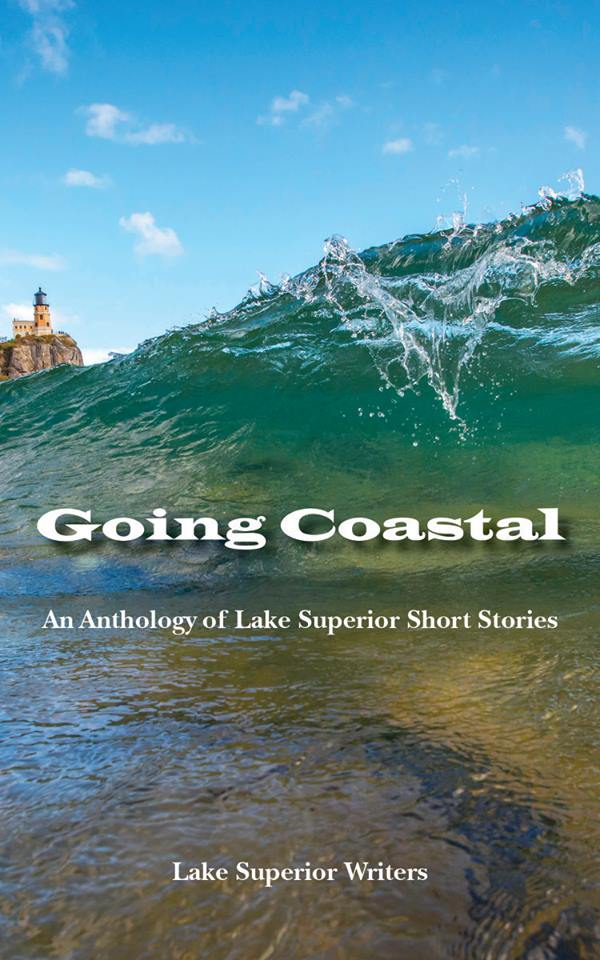
The book is called “Going Coastal.” It’s an anthology of Lake Superior-inspired short stories written by nine local (northeastern MN and northern WI) authors, including myself. My story, “Water Witch,” is the first short story I’ve ever written, so I feel honored that it’s included.

All of the writers are members of Lake Superior Writers, a local nonprofit group that “supports the artistic development of writers and fosters a vibrant literary arts community.” Proceeds from book sales support this group.

The idea for the anthology started with a conversation I had with the manager of a bookstore in Duluth.  She asked me what I was working on and I told her “short stories.” She said, “You know what customers come in and ask me for? Short stories about Lake Superior. I have to tell them I don’t have any.”

**Bing** Lake Superior Writers has an annual contest. What if we made the contest theme this year about Lake Superior? And what if we were able to find a publisher for the stories? And what if the book could be sold in this bookstore? (And others, of course.)

I’m a board member of the group and brought the idea up at a meeting where we were discussing the contest. The other board members thought it was a great idea, too. And a project was born. After the contest was over and the judges had chosen the winning stories, I started contacting publishers about the project. Several were interested, but I ended up going with North Star Press, the publisher of my novels.

The name of the writing contest was “Going Coastal,” and the board thought that was also a good name for the anthology, and so did the publisher, so it stuck. Then came the need for a cover image. I’m on Facebook probably way more than is healthy for me, and I recalled seeing an image there by a local photographer who often gets into Lake Superior to take his photos. His stunning photo showed the iconic Split Rock Lighthouse seemingly swamped by a large Lake Superior wave. Perfect!

I worked with the authors to edit their stories, and then needed to decide how to organize them in the anthology. I offered the other board members the opportunity to help with this task (which was new to me) but they said I could have the “honor.”

Shoot – how was I ever going to decide? Well, a couple of the stories had Native American themes in them. Some were more mystical than others. A couple focused on ships. A couple others were about rocks. One was about a lighthouse. Another was about a family drama and had a super strong ending. Some stories were short, others were long.

I finally decided to organize them along themes, but I also kept story length in mind and tried to switch that up for variety. Figuring out the story order was as much an art as writing one of the stories itself, and was a fun exercise. I hope it worked.

If you like lighthouses, ships, beaches, ghosts, road trips, history, storms, agates, islands, family drama, and the mystical power of Lake Superior, you’ll enjoy this book.  It costs $12.95 and is available from North Star Press, but also Barnes and Noble and Amazon, which have it as an e-book, too. Take a read!

Anthology authors are Theresa Allison-Price of Superior; James Brakken of Cable; Evan Sasman of Ashland, Johnna Suihkonen of Lakeville; and Judy Budreau, Eric Chandler, Phil Fitzpatrick, Maxwell Reagan and me of Duluth.

We’re having a book launch sponsored by The Bookstore at Fitger’s on Sat., April 29 from 4-6 p.m. in the August Fitger Room on the third floor of Fitger’s Mall (600 E. Superior St., Duluth). There will be free appetizers from The Boat Club Restaurant and a cash bar. Each author (except for one who can’t make it) will read from their story.

Come on out and keep that Christmas spirit going through April!