Houseboating in Voyageurs National Park: Off to a Rocky Start

The gorgeous sunset our first night on Rainy Lake at the Oveson Island traditional site.

When the Rainy Lake Visitor Center was dedicated in Voyageurs National Park in northern Minnesota, I was there. That was maybe about thirty-five years ago. My mother wanted to attend, and she asked me to go with her. I’m not sure why she wanted to attend except that she liked national parks and perhaps this was her way of feeling connected to a local one.

A peg-legged Voyageur at the Rainy Lake Visitor Center dedication, 1987.

The ceremony was interesting and came complete with a man dressed up as a French voyageur – one of the intrepid fur traders who plied the waters by birch bark canoe in the 16th to 19th centuries. I know I have photos of the ceremony – I’ll peruse my old albums to see if I can find any to include with this post.

This is just a long way of saying that, although I was part of the park’s beginnings, I had not visited it much, if any, since.

Russ and I had a desire for an overseas vacation this summer, but I, as the major trip planner, just couldn’t muster much enthusiasm for the effort it would require. I think I’m still recovering from all the travel we did last year in the “post-COVID” frenzy.

So, we thought of trips closer to home. Houseboating on Rainy Lake in Voyageurs popped into my head.  There used to be billboards advertising the houseboat companies on a local major highway and I always thought it would be fun to try.

The idea appealed to us because it would be like being in the wilderness, except with comfortable beds, a refrigerator, and no need to paddle (except for fun) due to the houseboat’s motor. We have some experience driving boats. It sounded perfect! Plus, we’d get to know the park better.

With enthusiasm, we began planning and invited Russ’s grown son Garrett along on the four-night, five-plus-day trip.
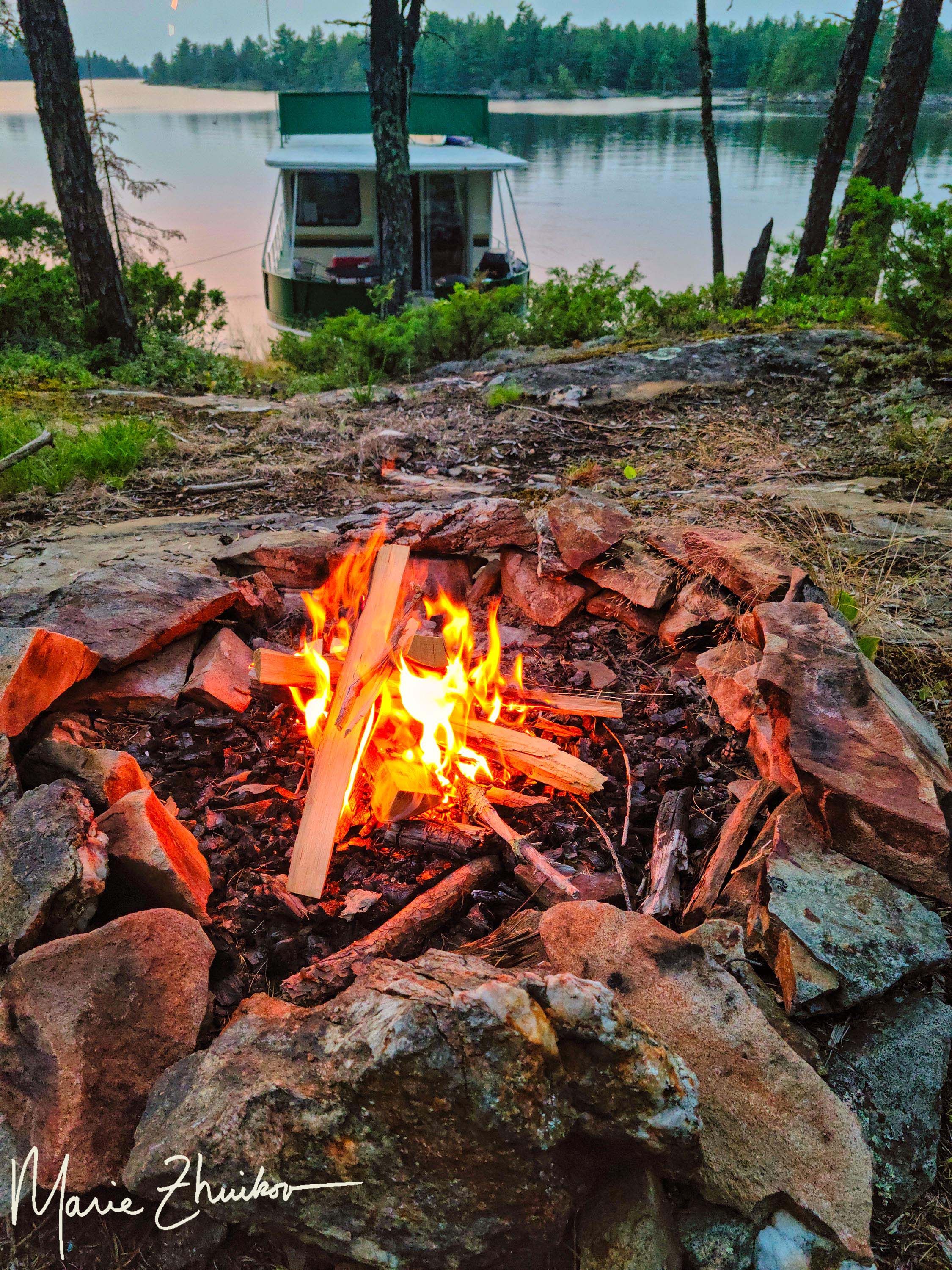
Campfire our first night on Oveson Island, Voyageurs National Park.

After we arrived at the houseboat base just outside International Falls, Minnesota, we loaded our gear onto the watercraft, a 42-foot Minnitaki, which sleeps two to six people. From the dark paneled interior, it looked like the boat was built in the mid-1980s. Some of the houseboats feature hot tubs, but we did not feel the need for one of those. We were being decadent, but not THAT decadent.

We were required to rent a small motorboat to tow along behind us in case of emergencies. The motorboat is also useful for exploring or fishing. We also bought 3 bundles of firewood. We brought our own paddleboards and a kayak, which easily fit on the top level of the houseboat.

We were oriented to its somewhat complicated workings by one of the staff, who also piloted it out of the harbor and made sure we were comfortable driving it before he was picked up by another staff person in a motorboat and we were left alone.

It felt rather like when I was cast adrift on a paddleboard for the first time. However, this was a 42-foot, a much more expensive craft! I was glad we opted to pay the hull insurance the company offered.

The weather was sunny with a wind at about 6 mph. That might not seem like much wind, but in a boat shaped rather like a huge bathtub, it was a lot. We all took turns driving and were surprised by how hard it was to keep a straight course. The boat comes equipped with computer navigation and the lake comes equipped with red and green buoys. We just needed to keep the red buoys on our right and the green ones on our left so that we did not run aground. Easier said than done.

After zigzagging across the lake for about 8 miles, we were ready to moor for the night. Rainy Lake features designated houseboat sites on land where the boats need to be tied up for the night by 6 p.m. No driving boats in the dark is allowed, nor is anchoring.

Walk the plank! How we got off the houseboat and onto land.

The first designated site we wanted was already occupied so we chose a “traditional” site on a nearby island. We weren’t sure of the island’s name because it wasn’t listed on our chart, but we figured out later it was Oveson Island. Traditional sites don’t have houseboat signs and they are a bit more primitive than the designated sites.

We tied the houseboat to three trees as instructed and walked down the skinny wooden gangplank to explore the small site, which came with a fire grate. It looked much like any wilderness campsite with rocks and pine trees.

After a scrumptious steak dinner thanks to the houseboat’s gas grill, I explored the island. A well-worn trail led away from our campsite. I was surprised when it ended at a well-built privy. I was like, “What the heck?!”

A trail from the privy led to a boardwalk and a small picnic area. Next to that were several buildings painted a light green. Interpretive signs along the way informed me this was the Oveson Fish Camp, built by Harry Oveson and occupied during summers from 1959 to 1985. Harry fished for whitefish and walleye.

Oveson Fish Camp, Voyageurs National Park.

An icehouse, a fish processing shed, and Harry’s house make up the camp. There’s also a large dock so boaters can visit.

Besides being a fisherman, Harry was a jack-of-all trades. He was an inventor, ham radio operator, mink farmer, home flipper, and an avid reader and bird watcher. I figured out later that I am acquainted with his nephew, Tony, who still lives near the park. Harry’s descendants operate a lodge on Pelican Lake, about an hour’s drive away.

Excited by my discovery, I scampered back to the houseboat. When I arrived, I told the guys that I found something, but I didn’t tell them what. They followed me down the trail, curiosity piqued.

I stopped proudly at the privy and said, “I found a privy!!”

They looked unimpressed until I laughed and pointed down the boardwalk where they could see the rest of the fish camp buildings. They were more impressed by this. (It’s the wilderness. Sometimes, you need to make your own entertainment.)

We spent the rest of the evening exploring the camp and later had a campfire at our site. At sunset, a single loon stationed itself off our stern in the small bay. It wailed a few times, making the wilderness ambiance complete.

A lone-tree island I paddled by on my SUP.

We also heard noises nearby that sounded like people having a party. Garrett thought it might be geese. Later, it began to sound more like geese to me, but not Canada geese. I wasn’t sure what they were.

The night sky was filled with gobs of stars – Voyageurs National Park was just recently certified as an official Dark Sky Park, so it’s protected from light pollution.

Our sleep on the boat was restful except for the thumping of the motorboat against the stern. We hadn’t read the part in the boat manual yet about tying the motorboat up on shore for the night, but you can be sure we did that the following night. That turned out to be a very good thing!

In the morning, I enjoyed my mug of hot chocolate outdoors on the back porch of the boat while wearing my fluffy light blue bathrobe. I have never worn a bathrobe in the wilderness, and this felt especially luxurious.

The weather forecast called for sun, heat, and twice as much wind as the day before. Given the difficulty we had steering the boat, we decided to stay put. The wind was expected to die down the next day.

We spent our time paddling around the island in our kayak and paddleboards. Garrett and I saw a bald eagle, a single loon that I was pretty sure was the same one from the previous evening, and a regal pair of trumpeter swans. These must have been making the mysterious geese-like sounds we heard the night before.

The day was restful – full of reading, games, conversation, and eating. I watched a red squirrel drink from a puddle. I investigated the otter scat – full of crayfish parts – that littered the shoreline rocks. The sunsets both nights were beautiful – the sun made into an orange and then huge red ball in the sky from haze from wildfires in Canada. The loon parked itself off our stern again, giving its mournful wail. It sounded lonely. I called back to it a few times to give it some semblance of company.

Garrett and the trumpeter swans

However, the night was not restful. Around midnight, the wind switched so that it was directly behind us, causing our houseboat to bang into the shoreline rocks. Russ got up and retied our lines, but it was too late; our boat was wedged sideways on a rock ledge. After his effort, much of the bumping sounds stopped, but we had visions of a hull breach and our trip possibly being over. Once again, I was thankful we bought that hull insurance.

We’d have to radio the houseboat base the next morning and let them know the bad news. I mulled this over while listening to the loon, who had begun calling again.

Was our trip over? If not, how did we get out of this fix? Read the next installment, coming soon!

The Apostle Supper Club: Love and the 60s

The shag carpet wall in The Apostle Supper Club.

Russ and I meandered down to St. Paul for a family gathering a few weeks ago. We brought a gift card with us that my cousin had given me to the Apostle Supper Club. When she had given it to me, Duluth still had an Apostle Supper Club. It used to be in the rotating top of the Radisson Hotel. However, they closed without notice and before we could use the card. We’d been there a couple times before and were looking forward to dining there again. It looked like St. Paul was our only other option.

The Apostle touts itself as “a 1960s Palm Springs-inspired supper club, piano lounge, and tiki bar” located in the heart of St. Paul. It also has a fireplace lounge in the back, which is where we were seated.

The décor is what struck us first – full of 1960s colors of orange, red, brown and yellow. While the front part of the club where the bar is has windows, the rest of the place has the dark, no-window supper club vibe. Cushioned chairs were scattered about and the tables were bedecked with those small lounge lamps. The fireplace lounge sports a freestanding circular yellow-gold fireplace surrounded by matching comfy chairs.

But the best part of the décor was what I found on my way to the bathroom: a wall of shag carpet! Done in yellow, brown, red and orange, of course. I had to run my fingers through it and make sure that Russ saw it before we left. The Duluth restaurant was well-decorated, but it did not have a shag carpet wall.

Our dinner was excellent. For an appetizer, we shared the broiled crab and artichoke dip, which was served with grilled baguette and veggies. We savored those nice big chunks of crab. My main course was red curry striped bass – a pan-seared bass fillet served on a bed of crispy sesame rice with red coconut curry sauce and a radish salad. The fish was cooked just right, with crispy skin and a flakey center. I’m not a big fan of radishes. I couldn’t really tell that the salad had any radishes in it, which was a good thing for me.

The red curry striped bass.

Russ’s entrée was the rigatoni arrabbiata with a spicy roasted tomato sauce, garlic, white wine and whipped basil ricotta. He said the sauce was excellent. You can add various meats to the dish, but Russ was fine without them.

We topped the meal off with espresso crème brulee. I’d never had that particular type of crème brulee before and it was truly memorable – a coffee and cream confection!

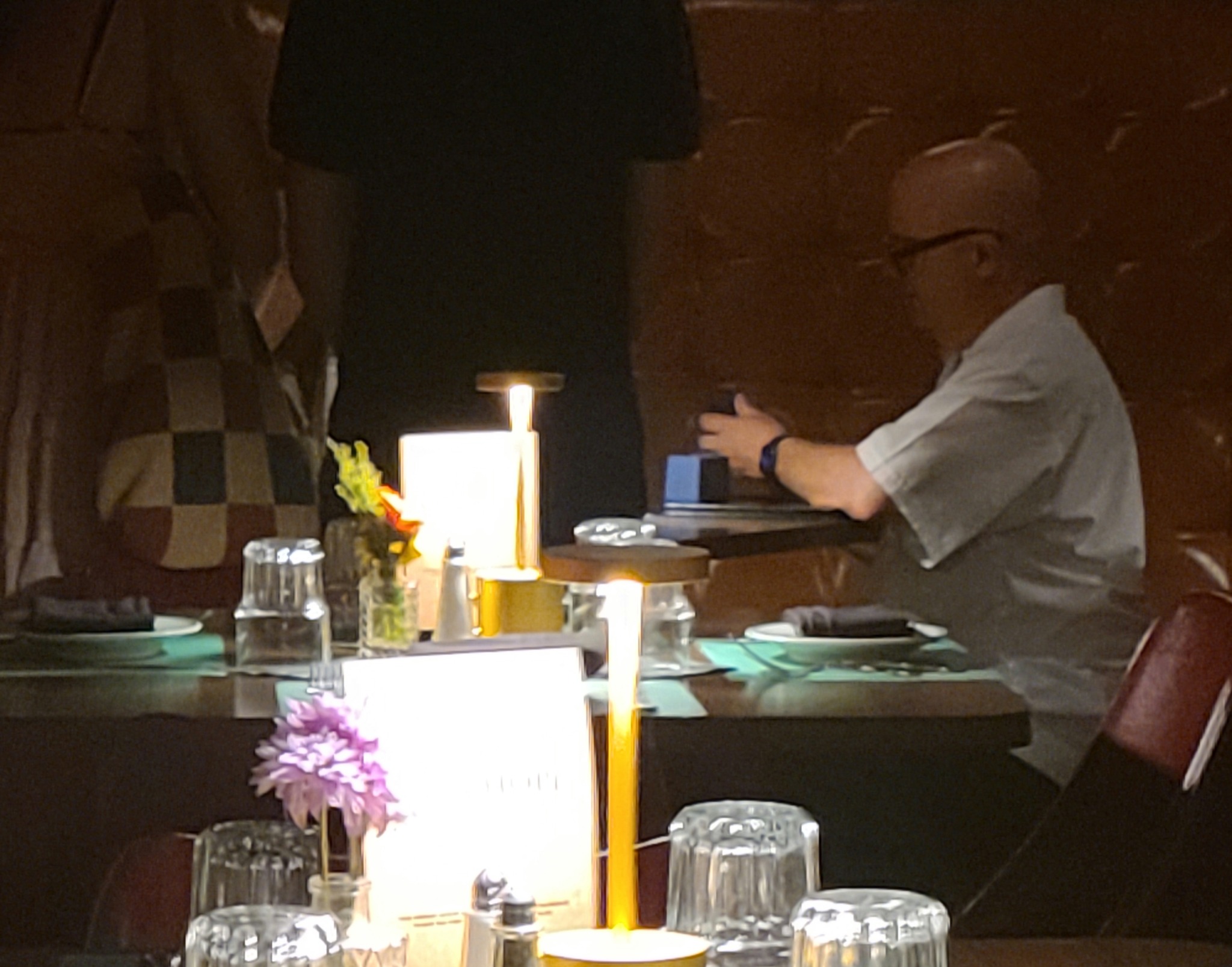
During our meal, some hubbub ensued at a table in a dark corner of the fireplace lounge. Two people arrived bearing a dozen roses, which they presented to a woman at the table who had been dining with a man. Then one of the rose-bearers broke out into song. We couldn’t really hear what is was, so we spent some time speculating whether this was a birthday celebration or something more romantic.

Our speculation was put to rest when the man at the table got down on one knee and presented the woman with a ring box. She said, “Yes!”

The proposal, in progress.

I tried to get a photo of this occasion, but alas, the two performers were standing in my way. This was the best I could do.

Russ and I remarked that we seem to attract marriage proposals whenever we go to the Twin Cities. The last one happened at the Como Conservatory when we visited it for a poinsettia show.

If you live in the twin cities and would like to be engaged, Russ and I are available for hire, ha ha!

While we will miss The Apostle in Duluth, we’re glad to know that it’s still done right only a couple of hours away should we have a yearning for a supper club experience.

UPDATE: The Supper Club is closing the end of May 2025. I guess we’ll need to find someplace else for a supper club vibe. 😦

Learning About Bears in the Apostle Islands

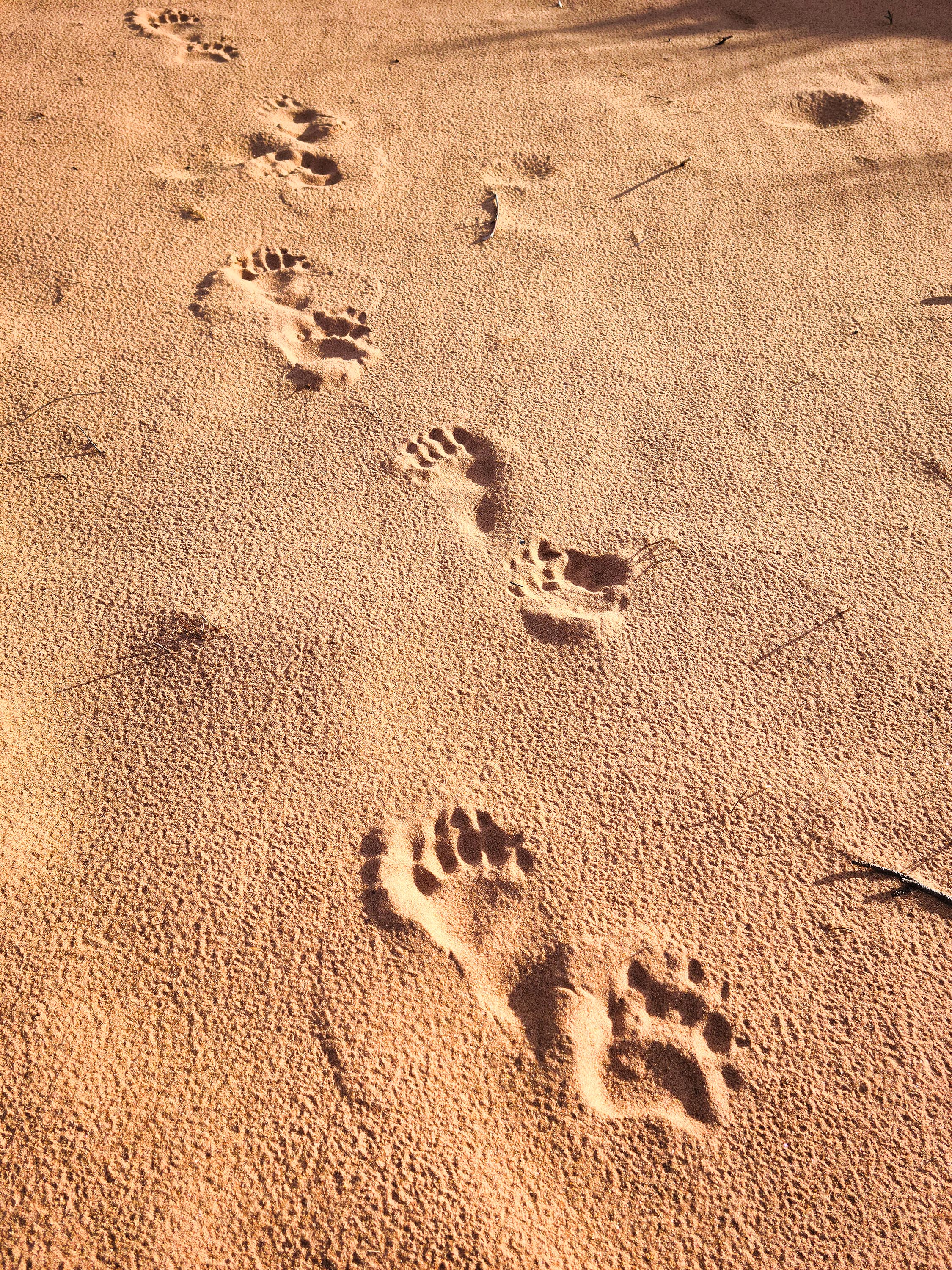
Bear tracks on Julian Bay, Stockton Island.


I had the chance to meander to Stockton Island, one of several islands in the Apostle Islands National Lakeshore in Lake Superior a couple of weeks ago. I was there to cover what the National Park Service is doing to make their facilities on the island more accessible to disabled people. I’ll be writing a story about that for work, but I also got a tour of the island by former park ranger, Neil Howk, who gave us (there were about 8 of us) the skinny on the history of black bears on the island.

Neil Howk imparts his knowledge about bears.

Neil worked for many years in the Lakeshore and is now on the board of the Friends of the Apostle Islands, which organized the tour on a sunny, breezy Friday. Neil took us on a short hike on the trail that leads through the campground on Stockton Island to the signpost for campsite number 4. We took a sharp right and began bushwhacking into the woods. Neil knew there was a bear den nearby.


After not too much whacking or getting whacked by tree branches, we came to a deadfall – a tree that had been blown over by wind. Neil said the bear had made its den among the tree roots, which provided a fairly snug place to spend the winter.

He felt okay taking us to this location because: 1) It’s not winter, so no bear will be actively hibernating there, and 2) Bears usually only use a hibernation site once, so disclosing its location should not endanger the privacy of any bears (except if another one ends up using it!)

Besides overwintering in dens in rocks or tree roots, black bears have also been known to hibernate inside hollow trees and even in eagle’s nests. I did not know the eagle’s nest thing. I also learned many other new bear trivia, such as: bears don’t poop all winter. Neil said they eat grass in spring to get their bowels going again.

The deadfall bear den that Neil Howk showed us on Stockton Island.

Also, cannibalism is normal for bears. Males will sometimes eat cubs – presumably ones that aren’t related to them, in order to bring females into estrus sooner so that they can procreate with them. And bears will also eat meat (besides the berries, ants, and other things that bears are known to consume). Neil said that deer fawns and chipmunks are among their favored meaty fare.

Another fact that Neil conveyed is that when bears were first counted on Stockton Island – sorry, I’m not sure when that began – there were only a couple. But now there are 20 known to live there. I can attest to their presence. On my several trips there, I’ve seen many bear tracks on the island’s beaches. (I’ll try to dig up some of my photos of those for this post.)

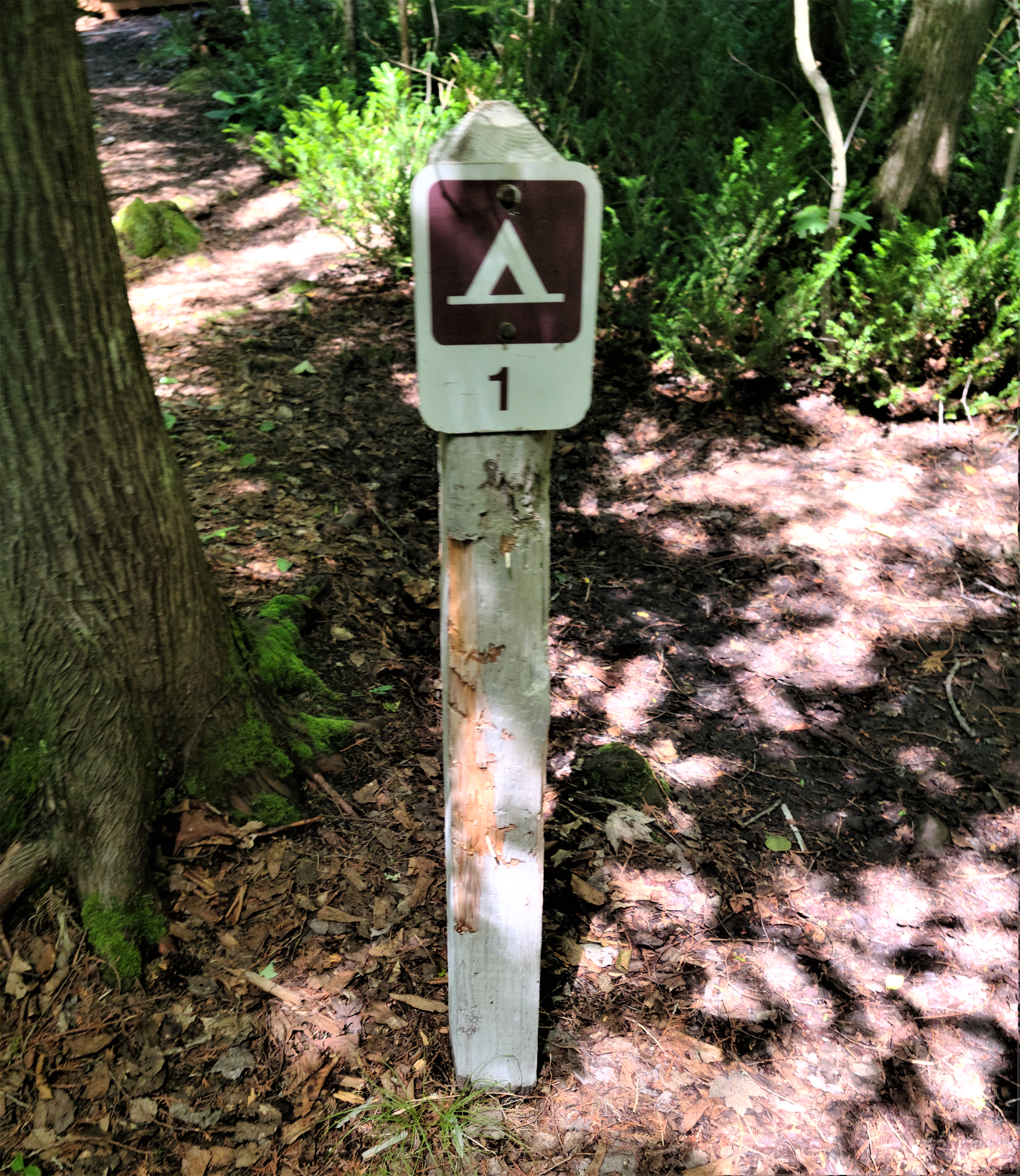
Black bears like to gnaw upon and otherwise dismember the wooden campsite markers on Stockton Island.

One memory that emerged during the tour came from a trip I made to Russia many years ago. One of my former husband’s relatives bragged about a bear he had shot. Granted, this relative liked his vodka and ended up chasing one of my young sons around the picnic table where we were eating – he was a rather scary, imposing figure, somewhat bearish. At some point, he showed us photos of his triumphant hunt. From the snow in the photo and the location, it became obvious that he had shot a hibernating bear. So much for sportsmanship, but I guess maybe they do things differently in Russia!

Anyway, I learned some things I didn’t know about bears from this tour, and I hope you did, too.

Natural History Gone Wild

An Ice Age exhibit at the Bell Museum of Natural History, including a mammoth, giant beaver and musk ox.

I recently had the chance to meander through two very different natural history museums. One was public and the other not so much. Both impacted my psyche.

The public one was the Bell Museum of Natural History. This was one of my favorite hangouts during my college days when I was minoring in biology. (I won’t divulge how many decades ago that was!) Besides the obvious appeal to the science-minded, my poetry professor once took us to the museum for inspiration purposes.


The new Bell Museum.

The Bell Museum used to be on the Minneapolis Campus of the University of Minnesota in Minneapolis. Now, it has a “new” facility on the St. Paul Campus.

Russ indulged me (smart man) and tagged along as we visited the Bell’s planetarium where we learned about astrobiology, or the search for life on other planets. The planetarium has a domed Imax theater roof. We saw a movie that was narrated by an actual museum staffer (in real life). This was unexpected, but cool, because we could ask questions. Many children in the audience did, and I was impressed by their interest in the planets.

One thing I learned was that we’ve had unmanned spacecrafts land on Venus. Somehow, I missed that news. It was so interesting to learn about the inhospitable conditions there – the landing crafts only lasted a few hours before they were incinerated by Venus’s hot temperatures.

Antlers on the wall, Bell Museum of Natural History.

In the natural history part of the Bell Museum, I was heartened to see that the painted dioramas I so loved in the old museum had been moved into the new museum. There was the wolf pack on the North Shore of Lake Superior. There were the sandhill cranes of the Platte River. I can’t imagine what it must have taken to move those overland to the St. Paul Campus intact!

Plus, the museum has many new exhibits that deal with the evolution of life on this planet. I don’t think they knew that stuff when I was a college student.

The not-so-public museum was the Zoology Museum on the University of Wisconsin-Madison Campus. I meandered into it for work. Every year, my boss at Sea Grant organizes a field trip for us science communicators and this year, our focus was Madison. This is where most Wisconsin Sea Grant staff are located, but there are many staffers from other areas in the state (including me), so all this was new to me.

The UW Zoology Museum is mainly for researchers and it was formed by researchers. Many of the specimens were collected during science expeditions or they came from nearby zoos. To give you an idea of its layout, there’s a bone room, where bones of animals are stored in boxes. There’s a skin room where animal skins are stored in drawers (think about an entire polar bear fitting into a small drawer). There’s also a taxidermy room that features various birds and mammals.

A soulful lion greeted us in the taxidermy room of the Univ. of Wisconsin-Madison Zoology Museum.

As we entered the facility, we had to carefully close doors behind us so that bugs and other contamination couldn’t follow us and destroy the samples.


In the lower level of the building is a fish room where various species of fish are stored in ethanol in jars and pails. This is in case the jars ever break – that way they won’t flood the other floors. The various jars are on shelves that are moveable. These are called compacter shelves. As opposed to stationary shelves, these can be easily moved so that more can fit in a room than otherwise possible.  Zooplankton are also preserved here. Various historic scientific instruments are scattered on nearby tables.

Another part of this basement room features preserved mammals, reptiles, and invertebrates in ethanol.

It was all kind of creepy and gave me some good ideas for a horror story. There were so many many samples! Something about all those dead animals in jars seemed wrong, even though it’s for the sake of science.

A polar bear in a drawer.

The piece de resistance, however, was a room we didn’t even get to see. It’s the room with the flesh-eating beetles. The museum staffer described the beetles as the best method to remove the “meat” from the bone samples that the museum staff wants. The beetles live up to their name, eating off the flesh from the bones. The dark room the beetles live in is down a concrete corridor that would give even Edgar Allan Poe pause. We did not get to see it, but our tour host’s description was good enough.

The beetles do a much better job of cleaning than any other method, so the university still uses them, even in the 21 Century.

Mice and bats in jars in the Zoology Museum.

I realize that science needs access to real animals for research purposes, but I must admit that this research museum creeped me out much more than the public museum. I guess that’s to be expected. I’m glad I was able to see both of them.

Look for the fruits of this field trip in my fiction some day! I just discovered that there’s a horror sub-genre called “dark academic.” The Harry Potter series fits into this – think gothic architecture, pleated skirts, melancholia, and leather satchels. This is opposed to “light academic.” “Pride and Prejudice” fits into this – think of the opening of the movie where Elizabeth Bennet Walks through a sunny field reading a book. It’s all about light and happiness. My story will be more along the dark academic vein.

My takeaway with this post? Visit a natural history museum near you sometime. It might spark something!

Sky Lily

I was paddle boarding at our cabin recently and had my phone along. I don’t always take it because it could fall into the lake. It’s the height of summer here in the northland and the water lilies were blooming. I decided to try and get a good photo of one.

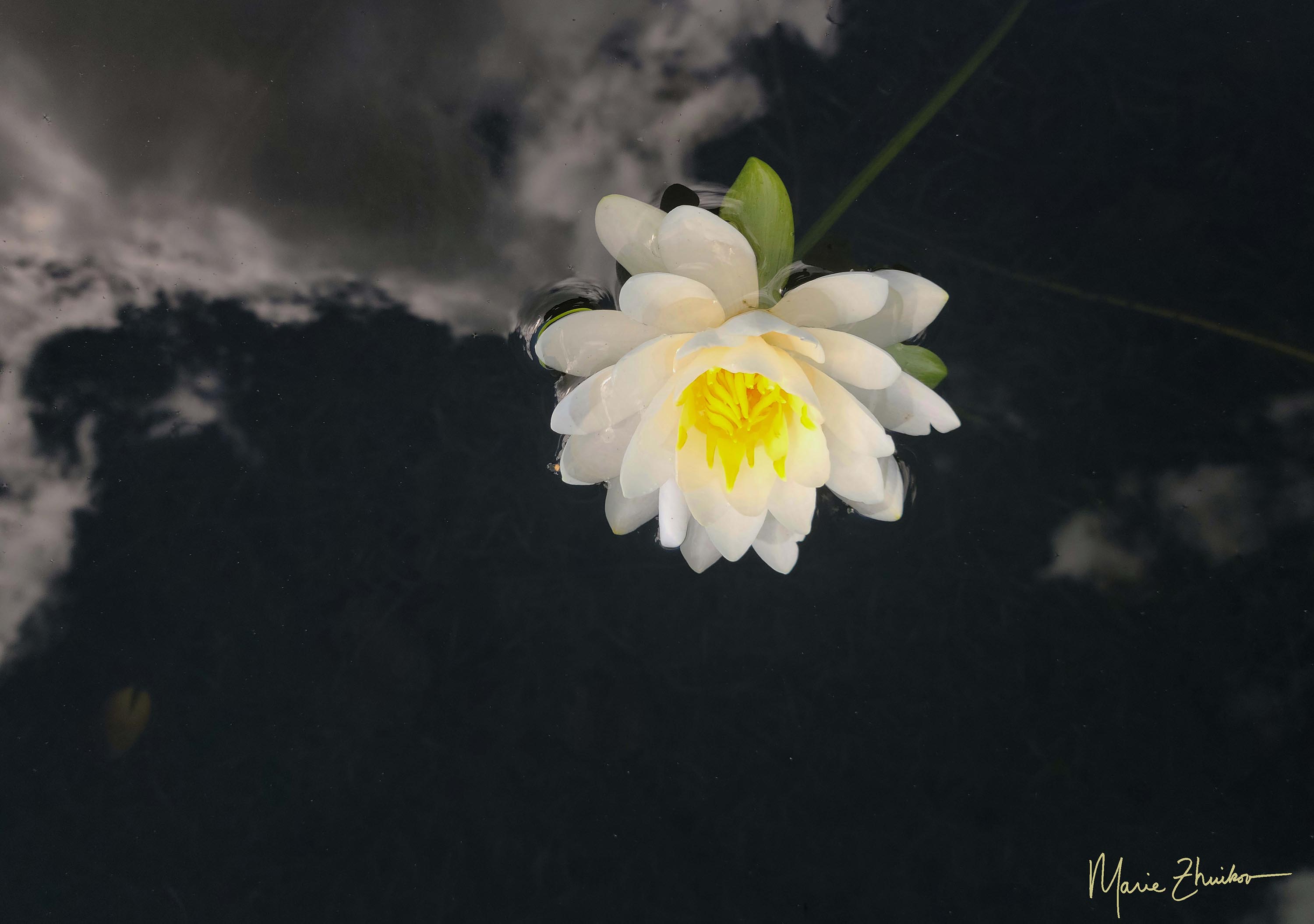
I maneuvered my board next to a lily and ended up sinking it. Argh! But it popped back up. As the water drained from its petals, I began taking photos. After about the third one, I noticed that the clouds were reflected in the water. Cool!

My board drifted away from the lily and my friends, who were in a canoe nearby, requested my presence, so I had to leave the lily.

Once back on land, I excitedly viewed my photos. One turned out just as I had hoped. Although the plant stem and a leaf are discernable underwater, it looks like the lily is floating on a dark sky with white clouds. I hereby dub it, “Sky Lily.”

When Your Butt Forgets What it’s Supposed to do

This does not look like a dead butt to me. Photo by Oleg Melevych on Pexels.com

I recently learned there’s such a thing as “gluteal amnesia.” Have you ever heard of that? I hadn’t.

It’s a condition caused by our society’s sedentary lifestyle – literally by sitting on your butt too much. Also known as “dead butt syndrome,” gluteal amnesia happens when your gluteus maximus muscles (the major muscles that make up your butt) lose their ability to contract naturally. There are different theories about why being sedentary causes this to happen, but it does seem to happen to some unfortunate individuals.

Having a dead butt can cause lower back problems and sometimes pain that resembles sciatica. Also, it can give you a saggy butt. Oh no!

To compensate, a person can do exercises, among them squats, hip thrusts, and bridges. Experts say that with proper treatment and exercise, there is hope for resurrecting dead butts.

According to Self Magazine and Healthline, the condition can even impact people who exercise regularly if they sit a lot when they don’t exercise. Suggestions for preventing it include breaking up time sitting with walks and stair climbing.

Rest assured, my butt is just fine, thank you, especially since I began kick boxing workouts. But now you can say you learned something today.

My Hidden Wasted Talents

A news reporter wearing colors that Marie approves of. Although they do clash a bit with the news van. Photo by cottonbro studio on Pexels.com.

As I walked down a long hallway in my local medical clinic, I analyzed the gaits of my fellow patients walking before me. “That person is walking on their instep. They need arch supports,” I thought. “That person is knock-kneed. I don’t know what they need, but they need something, or they will be facing problems later.”

Sometimes, I suspect I should have been a podiatrist or a psychiatrist in another life. I seem to have this talent for gait analysis and knowing what might help. But I am a science writer/podcaster/photographer by day and a novelist blogger by night. What do I know?

My other secret talent is as a fashion consultant to local television reporters. As I watch the local TV news almost every night, I think, “Why is that person wearing such dull colors, they’re obviously a “winter” in the color scheme! They need jewel tones. Look at that man’s suit sleeves! His arms have grown about four inches and he needs a new suit!”

These talents are a both a blessing and a curse. They’re not the kind of things one can just go and approach people about, unbidden. I would be laughed at, or worse, for offering such medical and fashion advice.

I guess I’ll just need to keep my thoughts to myself or risk another person’s ire. If I had my life to do over, perhaps I’d go to medical school or become a media fashion consultant.

Do you have any hidden wasted talents?

Biking Across Minnesota’s Tallest Bridge


The Rouchleau Mine Pit as seen from Minnesota’s tallest bridge.

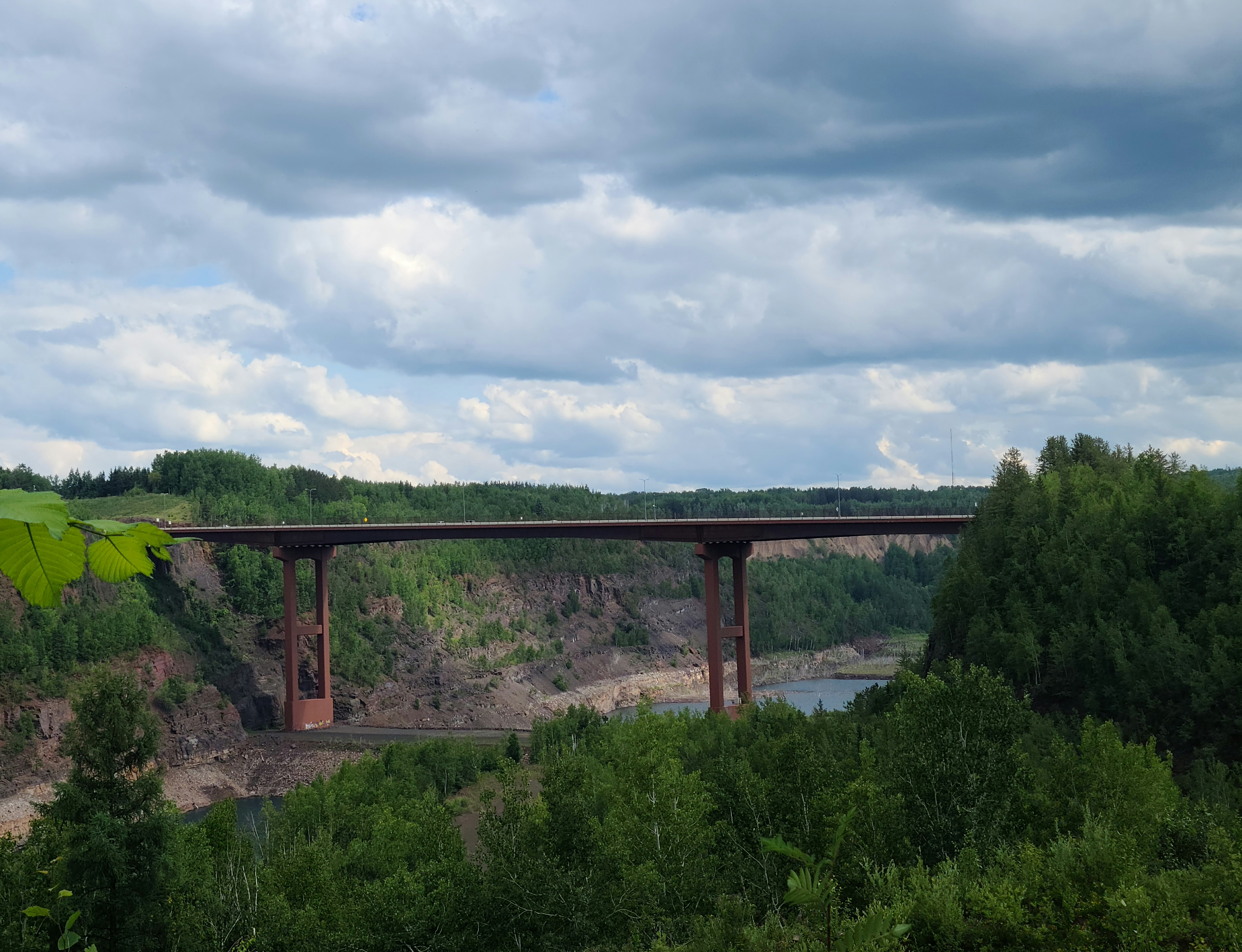
Russ and I explored a new (to us) section of the Mesabi Bike Trail in Minnesota’s Iron Range this weekend. The section we targeted took us across the state’s tallest bridge, the Thomas Rukavina Memorial Bridge, near Virginia, Minnesota. We driven over the 204-foot-tall structure plenty of times but always looked longingly at the walking/biking/ATV trails right next to the freeway, and today was the day to make our dream come true!

The Thomas Rukavina Memorial Bridge outside of Virginia, Minnesota.

We meandered to bike trailhead in the town of Gilbert at the Sherwood Forest Campground. Biking toward Virginia, we promptly lost the paved trail as it merged into the city roads for several blocks. I think in the past, trail directions had been painted on the road, but those have been lost to the weathering of snow and traffic.

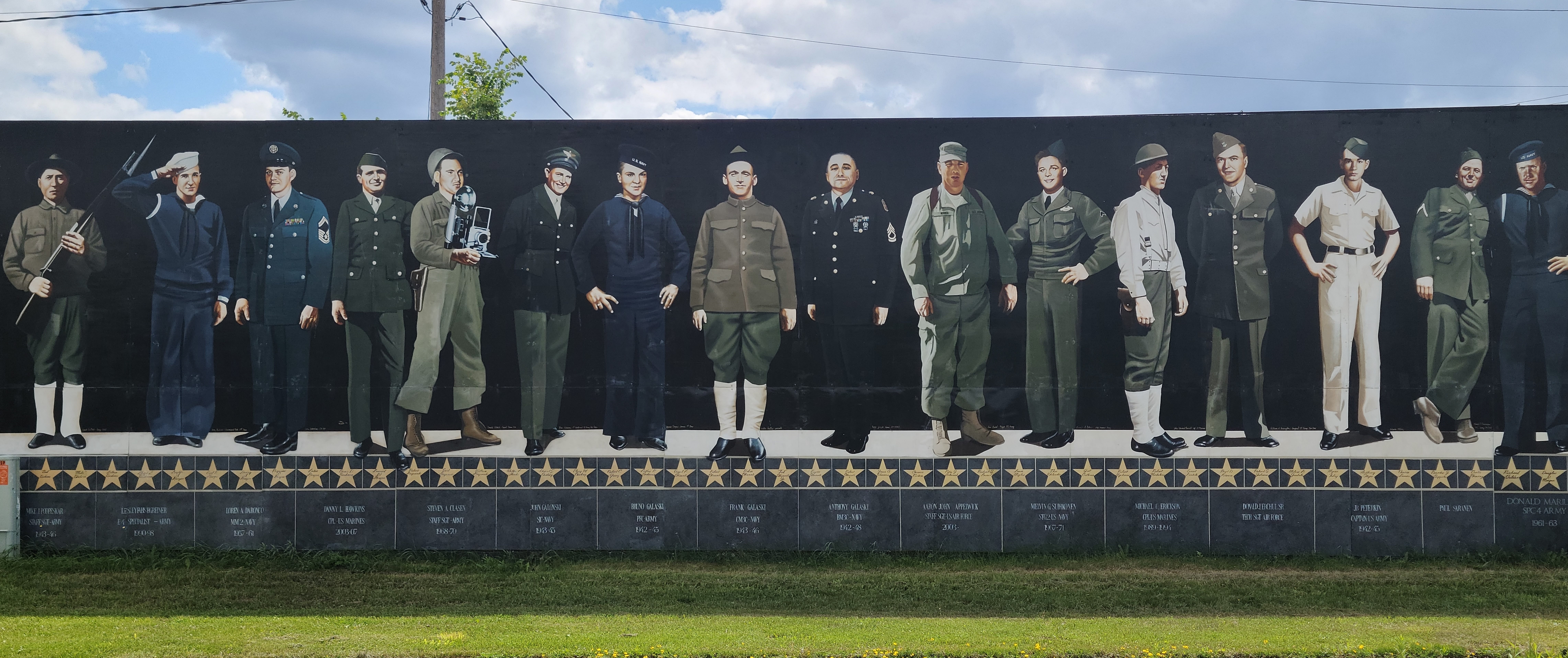
A veterans’ memorial mural we biked past in Virginia.

We had a general idea of where to go, however. We just followed our noses for a few blocks and the trail reappeared, taking us past a restaurant and across Highway 37. Then we headed into the woods. I love these forested sections of trail with their lines of aspen and birch. Pink fireweed is beginning to bloom, which added pops of color to the route. One impressive stretch took us on a skinny peninsula high above a gravel pit and a wetlands area.


What the bike trail looks like across the bridge.

The topography is gradual and unchallenging. The only part my legs complained about was the gradual incline once we returned from the bridge, but I get ahead of myself.

Eventually, we reached the bridge. One side of the trail is for walkers and bikers. The other side of the painted line is for ATVs. A low concrete barrier separates the trails from the freeway. A high railing on the outside provides protection from dropping 200 feet but still provides a view of the Rouchleau Mine Pit below. This mini Grand Canyon was created by iron ore mining activities and now provides drinking water for the city of Virginia.

Wind likes to whip around the bridge, but the weather was fair for us. The bridge was built because mining companies wanted to dig where Highway 53 used to be. They gave the transportation dept. plenty of notice, but, as you can imagine, moving a highway is no small feat. This was the most economical route. Even so, the project cost $220 million! And the bridge was constructed as part of it.

The Oldtown-Finntown Overlook.

Thomas Rukavina, its namesake, was an Iron Range lawmaker born in Virginia. He was a staunch advocate for the Iron Range and its people. He’s also memorialized in a park about a half-mile farther down the trail from the bridge. Bridge View Park offers a good vista of the structure and some interpretive signs and benches.


Once we biked to the outskirts of Virginia, we stopped to investigate a rather overgrown overlook of the mine pit that features a 50-foot caged safety bridge out to the pit’s edge. It’s named the Oldtown-Finntown Overlook.



From there, we passed the historic downtown district with its quaint old streetlights and American flags flying. The trail took us to Lake Virginia. We decided this would be a good turnaround spot. We biked around the small lake, disturbing a gaggle of Canada geese, which hissed at us, and then headed back to Gilbert.

The total trip was 13.5 miles. Although the bridge was our main goal, it was fun seeing the other, unexpected attractions along the way and becoming familiar with a new route.

Downtown Virginia, MN
The bike trail around Lake Virginia.

A “Meander North” Love Fest: The Midwest Book Awards Gala

When I was in the process proofreading my blog memoir, “Meander North,” before publication, I found myself laughing. “Hey, this book is pretty good,” I thought. “Who wrote it?”

Reading my book was like having an out-of-body experience. Finding pleasure in what I wrote was a good thing but it’s not a very Minnesota thing. We’re not supposed to think we’re that special! Well, it’s too late. I really did like what I wrote. That doesn’t happen often.

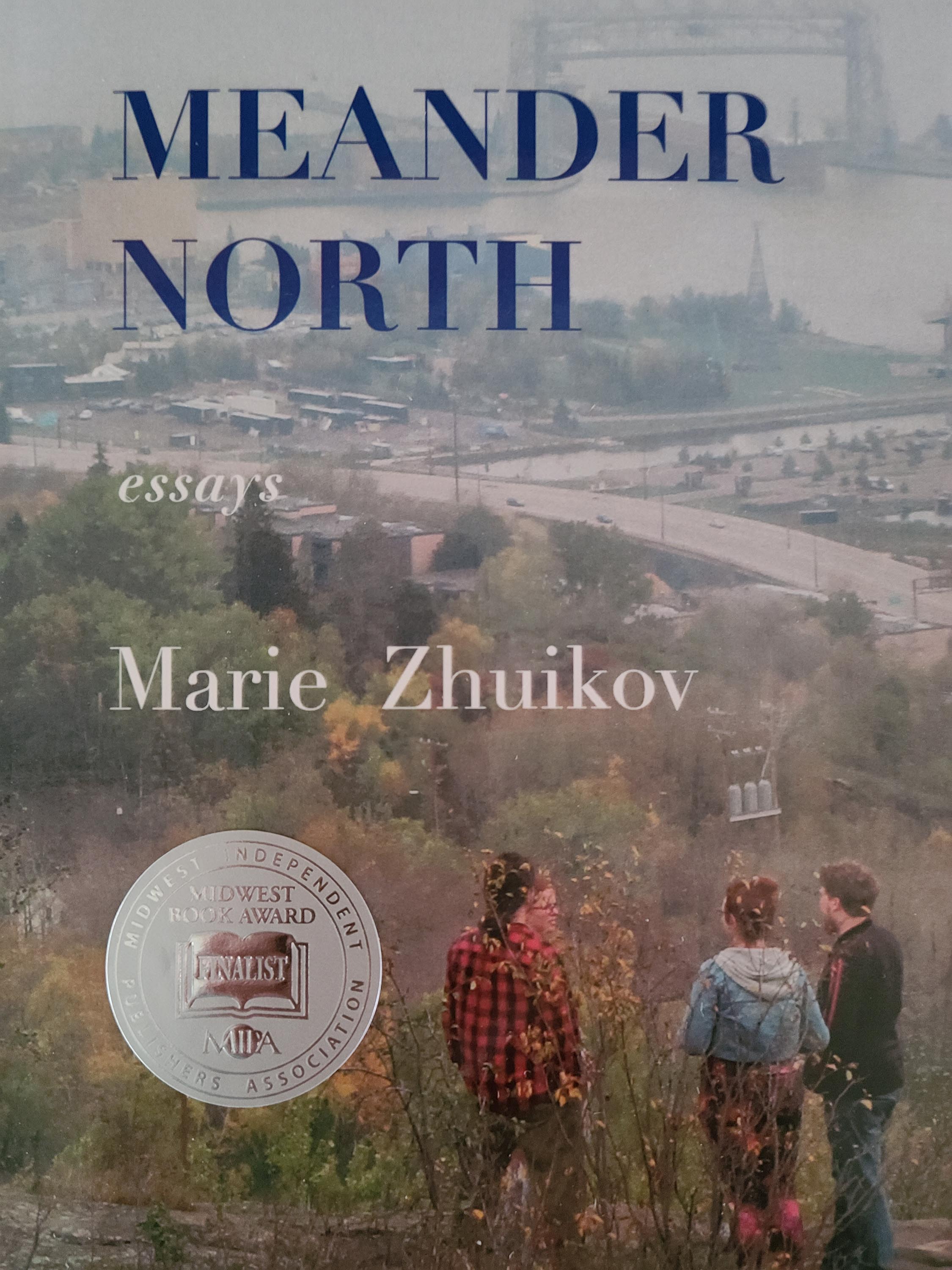
My book with its silver award seal.

I suspect most writers will agree there are several distinct and disparate phases they go through in completing a work. When you complete that first draft, you’re so relieved! You think it’s God’s gift to humankind. Then your writing group or beta readers get ahold of it and you begin to see its flaws. You fix those but by that time, you’re able to distance yourself from it enough that you see even more flaws. You hate the work. It’s awful. It should never see the light of day! There’s so much that needs fixing.

Some writers never get past this point. But if you take it slow, chunk by chunk, and are kind to yourself, and you remember what you were trying to say with your work, you can come out on the other side. You might even like it in the end – enough to think that maybe somebody else wrote it.

I recently attended the Midwest Book Awards Gala, held in Minneapolis for finalists in their awards program. It’s put on by the Midwest Independent Publishers Association, which serves indie publishers in 12 states. This year, the contest attracted 227 books from 122 publishers. “Meander North” was one of them. It ended up earning a silver award in the nature category.

Mary Ann Grossmann, keynote speaker.

The gala’s keynote speaker was Mary Ann Grossmann, retired book editor for the St. Paul Pioneer Press. She told tales from her long career, including when Pulitzer Prize-winning author Studs Terkel “kidnapped” her in his car because he wanted to keep talking, and when Grossmann convinced activist author Susan Sontag to go see the 5,000-pound boar at the Minnesota State Fair.

Grossmann’s main advice to authors was to “hire an editor!” In my case, I hired two of them, just to be sure. I was so close to the material that I felt like I was missing all the little nits that needed picking in the text.

At the end of the gala, authors were given the judges’ comments. I was heartened to see that they all thought the writing was very strong. The book was also judged on things like production quality and mechanics/organization. One judge said their favorite story was the one about the sensory deprivation tank. They said, “These essays are definitely something I would read again, and I intend on following this blog now, as well.” Thank you, whoever you are!

Another judge said they thought I had a “really appealing and charming voice, and I found the writing excellent.”

Do you see me over here, preening myself in a most non-Minnesotan way? Ha ha.

Cheri Johnson, who goes by the pen name Sigurd Brown, accepts her Midwest Book Award at the gala.

While at the gala, I got to meet some people from my past who turned into authors, one of them for the same publisher who produced my book (Nodin Press). I also met some people I have had interactions with online but had never seen in person. One of them was Sigurd Brown, the pen name for the author of the thriller, “The Girl in Duluth.” Her book won gold in its category. I have not read her book yet, but I have it on order.

She was nice enough to read “Meander North,” and she posted this review on Goodreads:

I enjoyed this book very much. Zhuikov’s personal stories of everyday life in northern Minnesota—which include subjects as varied as solving the mystery of headless rabbits on a trail near her house to her discovery, twenty-five years after the fact, that the UPS delivery driver at her new job is the boy she kissed in the coat room of her first-grade classroom—are both frank and charming, and in total they tell not only the story of a life but describe the fabric of a town (the port city of Duluth on Lake Superior, where Zhuikov lives). This is a friendly and calming book, with a narrator who is pleasant to spend time with. Reading one or two of the short essays that make up the book every night before bed, I often had the feeling that I was out on my porch in the evening, exchanging a few words with the neighbor I’m always glad to run into. The writing is also very nice; her sentences are as neat and luminous as pearls. The book is a silver winner of a 2023 Midwest Book Award and I can see why.

The gala audience.

I reread, “Her sentences are as neat and luminous as pearls,” several times. That’s what having two editors will do. Lord knows I don’t have that many editors for my blog! (From which the stories are derived.) Needless to say, I’m feeling a bit of pressure to write a similar glowing review of her book. But I’m sure that won’t be hard since it’s a gold winner already.

“Meander North” was also recently featured on the National Science Writers Association website. They offer a column that describes new books written by association members, and they were good enough to list mine, even though it’s been out for a while. Although my book is mostly personal reflections, there is some overlap with my day job as a science writer, so those things are highlighted in the column.

There, enough bragging. In ending, I’d like to point out that I probably never would have had enough content for a book based on this blog without the feedback and continued readership over the years from all my blogger buddies. So, you can consider this your accomplishment, as well. Thank you!!

Saying Goodbye to my 102-Year-Old Aunt

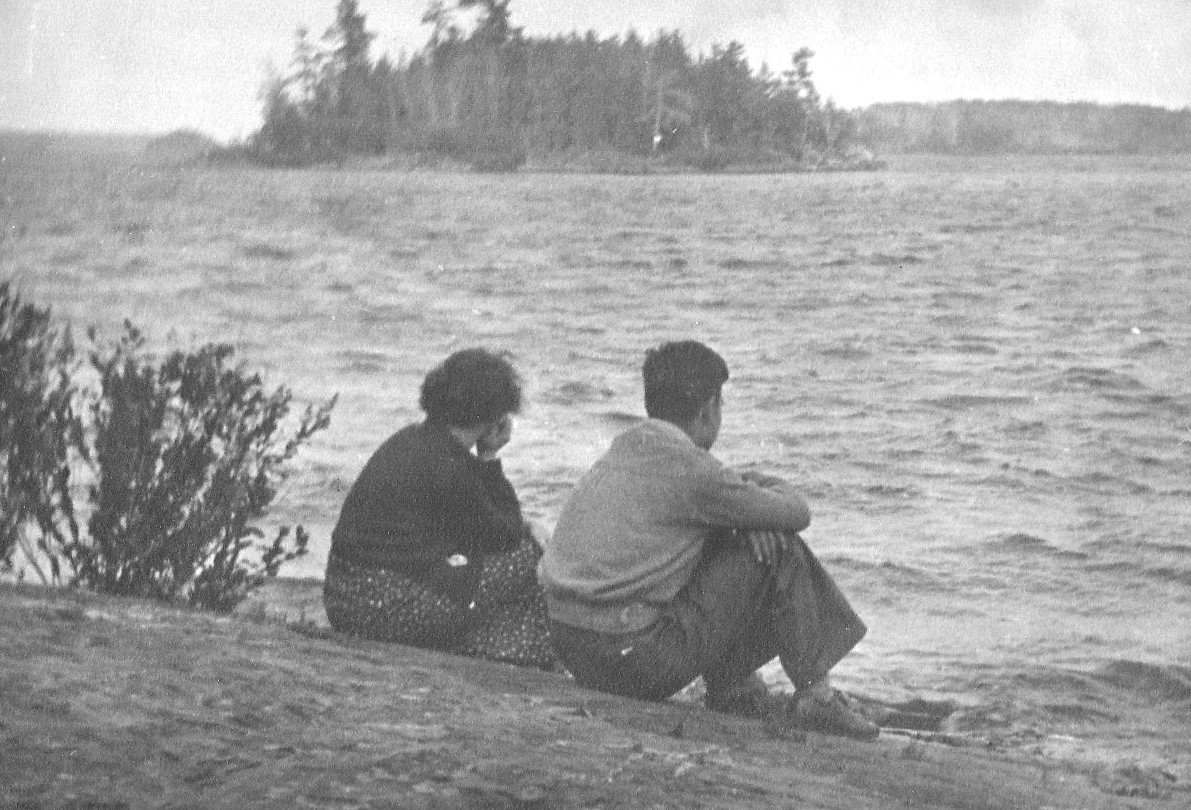
Marguerite and her brother (my father) on the Minnesota-Canada border, 1936.

A few weeks ago, I had the chance to speak with my Aunt Marguerite over the phone. She was in a hospital in Minneapolis and it was pretty clear she was dying. She’d gone in for a urinary tract infection, which should be easy enough to treat, but she wasn’t doing well. After a few days, she was on hospice care.

My cousin Priscilla was with her and said that Marguerite got a big smile on her face when she heard it was me on the phone. My aunt and I exchanged hellos. I said I hoped she felt better soon. I think we both understood that could be taken several ways. Then we said goodbye. Those were the last words she spoke. She died peacefully two days later with Priscilla at her side.

Although I live 150 miles away, the morning Marguerite died, I felt it as did one of my other relatives. We had a connection to this woman, my father’s sister and the last of her generation. I’m not sure how to explain the feeling except that it’s one of absence. A grand and stubborn spirit is gone from this world, into the next.

Russ and I felt lucky to have seen Marguerite in person a couple of weeks before when we made a trip to St. Paul. We felt like we said our goodbyes to her then.

Like me, my aunt loved meandering around. She attended at least 28 Elderhostels (when they still used to be called that) all over the world. If she had a blog, I bet she would have named it “Marguerite’s Meanderings!” We also both played the French horn in school. When I chose it, I did not know that she had played it, too. I just liked the mellow sound of it.

Marguerite never married and had no children of her own, but one special thing she did was take each of her nieces and nephews on a trip. My outing with her was in the 1970s in her Volkswagon camper van she nicknamed Pokey. We camped along Lake Superior’s North Shore. One destination I particularly recall was Finland. I was confused about how we could go there because I thought Finland was a country overseas, but I soon discovered that Minnesota had its own small town by that same name.

She was also very generous with her home. In 2005, when I was commuting to Minneapolis for graduate school, she let me stay overnight at her place on a regular basis. Money was tight for my family at this time, so I was thankful for this free lodging, plus I got to know her better.

I seem to be the family obituary writer, so that has been my contribution so far to all the tasks that need completing when someone dies. You can find Marguerite’s here.

As people like to say, she lived a good long life, but that doesn’t make her passing any easier.