Reading for “Writers Read” and the Lake Superior Zoo

82125457_10157171657572476_4269917595030781952_oI recently had the privilege of reading a poem for Northland College’s “Writer’s Read” 10th anniversary event in Ashland, Wisconsin. This is the second time my work has been chosen for this contest. The first time was an essay I read in 2018.

The theme this year was “Awakenings.” My poem, “Solastalgia,” dealt with my awakening as an environmentalist. As with the previous contest, readings by local authors were broadcast on Wisconsin Public Radio. You can find the program on the web here. My poem airs between the 1 hr 19 min and 1 hr 22 min marks.

20200124_175156We were not offered cash for our winnings, rather the comradery of other writers, instant fame the reading provides (ha ha), and some great food! They fed us Mediterranean-style dishes prepared by a student chef, including homemade marshmallows cooked over a fireplace. Okay, the marshmallows probably weren’t Mediterranean, but they were still impressive on ‘smores.

My next event will be an animal-related reading (poetry, fiction, children’s story) and book sale for World Wildlife Day at the Lake Superior Zoo in Duluth on February 29. The event is called “Leap Into Action for Australia.” One dollar from every zoo ticket sold will be donated to an emergency wildlife fund for the Australian brush fires. Find more info here.

Three other poets will be reading during the event. We each get a half-hour, which is HUGE! Hope to see you there.

20200124_190049

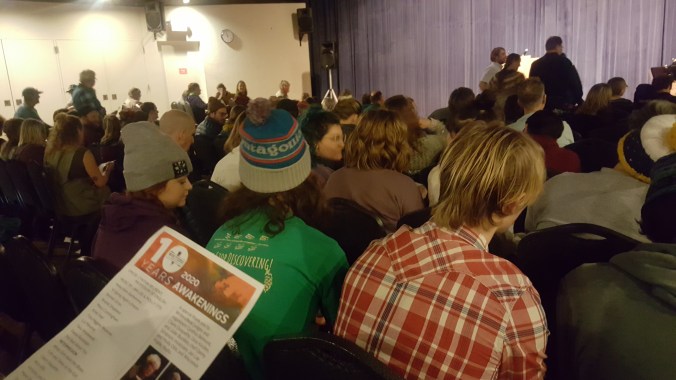
The audience for Writers Read — a full house!

A Sad Valentine’s Day

20180715_185657

My lady, Bea.

I (Buddy the Wonderdog) have bad news to share, especially on Valentine’s Day. You know how I was talking (gushing, actually) about my live-in girlfriend, Bea in my last post? Shortly after I wrote it, Bea started getting sick. She wasn’t acting like herself, she was throwing up, and she was panting like she had a fever.

Russ and Marie took her to an emergency vet because it was the weekend and the regular vet wasn’t open. That doggie doctor thought Bea had a disease caused by ticks, called anaplasmosis. The trouble was, this doctor didn’t know that her tick exposure happened a few years ago, and she never got sick from it. It happened so long ago that Russ forgot about it, and Marie never knew about it because she didn’t know Bea then.

So, the doctor sent them home with medicine to treat the tick disease. We all expected Bea to perk right up like dogs usually do after receiving this treatment. She didn’t. She wouldn’t eat, she couldn’t go very far on our walks, and, I hate to say this about my girlfriend, but she was peeing in the house, which she never did before. I wanted to play with her, but she just didn’t have the energy.

By this time, it was Tuesday and Bea’s regular vet’s office was open. The last time I saw Bea was before Russ took her on this trip. The vet told him she had something called pancreatitis. The symptoms are the same as the tick disease, so I don’t blame the emergency vet for being confused. Bea’s fever was even higher than before. The doctor wanted to keep her in the office and get her rehydrated with an IV.

Later that afternoon, she still wasn’t doing well. The vet wanted Russ to take her back the emergency vet’s office for overnight. So, he did that.

On Wednesday morning, Russ went back right when the office opened up. Bea was still very sick, although they managed to get her more comfortable. After a long talk with the vet, Russ made the hard decision to say goodbye forever to Bea because her pancreas was just too damaged. There was no coming back from it.

We all really miss Bea. I sat for a long time in Bea’s spot on the couch after they told me she was gone. I really don’t know what to do. I am just sticking real close to my people to make sure they don’t leave me, too.

Marie says we are going to get Bea’s ashes soon and release them on a lake up north where we always had a good time together. Life just isn’t going to be the same without her.

20180218_164945

Songs for Dogs

Marie is too busy trying to survive a gray and dreary February in Minnesota so I, Buddy the Wonderdog, am stepping in to write a post.

I want to tell you about a super great thing Marie and Russ did for me and my girlfriend Bea. Yes, I have a live-in girlfriend! Bea is a collie mix rescue dog. She was found in a ditch with her littermates next to a local highway by a mail carrier. Even though she was a stray, I think she’s priceless. She keeps me company when our masters are gone and sometimes even plays with me. Not often, but the rare times she does make me feel all goofy inside.

20200125_152921

Bea (left) and me listening to our play lists.

Anyway, I digress. The wonderful thing our masters did for us is to make a playlist of songs on Spotify. We listened to the music during a recent road trip, and I loved it! I think Bea did, too. You can see how happy we were from the photo I’ll include with this post.

The songs are customized to our personalities. For instance, for me, they inputted that I am super-friendly, curious, and have an average energy level. For Bea, they said she is less friendly and more mellow. My music was a mix of fast songs (including Led Zeppelin, my fave!) and slower songs. Bea’s mix were slower songs, but they were classics and very tasteful.

Now, besides being able to leap tall walls with a gesture from Marie, I am a well-read dog. The New York Times recently published an article, “Does Your Pet Really Need Cat TV or a Dog Playlist?” The story argues that all pets really want is their masters, not music to make them feel better when their masters are gone. But I would argue that if the masters have to be gone, why not play some music that I like? Also, because I’ve already listened to the songs when I was with my masters, it makes me feel like they’re here even when they’re not.

Those videos for cats that the article describes sound pretty funny. I laughed (in my own doggie way) at the quote by one person, who said, “When you are watching birds and chipmunks fight over a corncob, it makes you stop thinking about impeachment.” Anything that can do that has got to be good!

Our masters used to leave the Animal Planet station on TV sometimes when they were gone, but some of those programs are violent to animals. They show people hunting animals and killing them! I didn’t like those very much. I’d much rather have music.

So, to answer the question in the NY Times story, no, I don’t really NEED my own playlist, but I’m sure glad I have one.

Snowshoeing Up North

20200120_134001Russ and I visited a northern Minnesota lake last weekend. Spent part of an afternoon snowshoeing on a frozen lake. The morning’s hoarfrost floated down from the trees, looking like snow magically falling from a clear blue sky.

Oh yeah, that’s the way to do winter!

Wowed by a Pow Wow

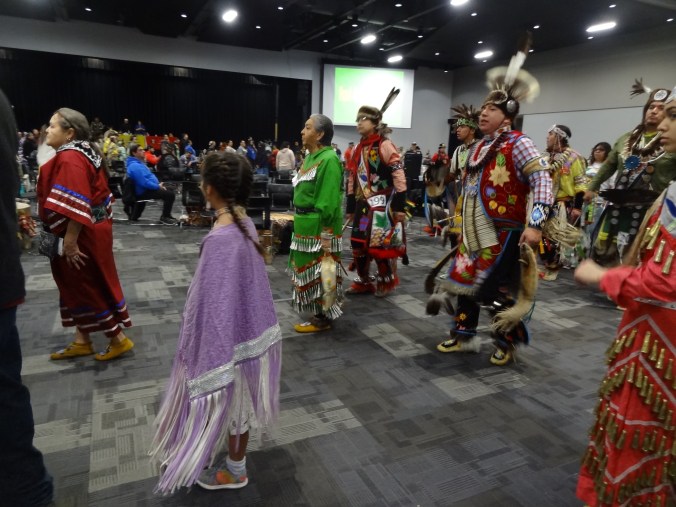
DSC05701I meandered just a bit south to Carlton, Minn., to attend an Ojibwe pow wow for work. More like I white-knuckled it on the drive due to a snowstorm.

I made it to the venue and ended up glad I endured the stressful drive. Why? Because pow wows are fascinating and fun! If you ever have the chance to attend one, you should.

I’ve been to a handful in various locations across the U.S. Every time, I come away impressed by their friendly vibe and the dose of a different culture.

It’s also refreshing to be in the minority for once. Being outnumbered by Native Americans for a few hours administers a dose of empathy for what they must feel most of the time in larger society. And the regalia the dancers wear is so impressive. I could tell they spent a lot of time and effort to make and choose their dress.

I attended the pow wow as part of a teacher workshop I’m doing a story about for work. The workshop offered educators from Wisconsin and Minnesota the opportunity to learn more about Ojibwe culture and their relationship to water to bring into their classroom lessons. Attending the pow wow was part of the experience for the educators.

Before the pow wow, we were given an etiquette sheet so we could avoid making clueless-white-person faux pas.

20200118_134851 (2)I thought I’d share a few of the more interesting points with you. The first is that a pow wow dancer’s clothing is called “regalia,” not a costume. The info sheet says, “Costumes are worn to present yourself as something you are not.”

The sheet does not say what regalia is, but one could assume from the definition of costume that regalia is clothing that reflects a dancer’s true identity. Think of a queen. Her ceremonial clothing wouldn’t be called a costume (unless someone who was not a queen wore it.) It reflects her regal status.

The dictionary offers three definitions of regalia. One is, “the emblems, symbols, or paraphernalia indicative of royalty.” The other is, “decorations or insignia indicative of an office or membership.” The last is, “special dress (especially finery).”

I suspect the last two definitions are the most appropriate when thinking of pow wow clothing – the dancer’s clothes reflect their membership in the tribe(s), and they are clothes not worn every day.  But I also like the idea that their clothing shows their true identity, and that identity is royal.

Another interesting guideline is not to touch a dancer’s regalia. It’s considered rude. I can see how having someone else’s hands all over something so personal could be an invasion of personal space and privacy.

The last is not to pick up an eagle feather that has fallen off someone’s regalia, or take photos of it being retrieved. The etiquette sheet states: “If you see a feather or regalia on the ground, do not touch it but do inform one of the dancers. They will take care of it properly.”

Eagle feathers are sacred to Native Americans, as is their regalia, so it makes sense they don’t want just anyone’s grubby hands on them. I also assume some ceremonies must be associated with retrieving a fallen feather.

End of lesson. Now you know few rules. Go out and find yourself a pow wow! It will be good for you.

Crackerjack Bands and Hometown Boosters: A Personal Story and Book Review

Back in 2010, I Googled my parents’ names, just to see if any information about them was out on the internet. They were aging, and I wanted to ensure their safety, both online and off.

I was also curious. Neither of them had ever owned or operated a computer. Heck, even operating a cell phone was a stretch, and I’m not sure either of them ever used the one they bought for emergencies, despite my repeated and patient instructions. Would anything be on the internet about people who had never been on the internet themselves?

I was surprised to find my father’s name (Howard Pramann) associated with a blog called, “My Musical Family” by Joy Riggs, a writer based in Northfield, Minn. The post was titled, “Music: The Anti-Drug.” It featured an interview with my father about his experience playing the cornet under the instruction of Joy’s great-grandfather, G. Oliver Riggs (the G stands for George, a name Mr. Riggs did not like so did not use). Mr. Riggs was adamantly against smoking, especially since his musicians needed good lungs to play. His anti-smoking lectures no doubt kept many a young man from taking up the habit.

After reading the post, I vaguely recalled my parents recently mentioning something about my dad being interviewed, but I didn’t understand that it was for a blog.

BugleBoy1937

My father, Howard Pramann, in his spiffy band outfit in St. Cloud in 1937.

I shared the post with my family members and parents, and wrote a thank-you e-mail to the author. She responded quickly, and we corresponded a few more times. She explained she was writing a book about G. Oliver Riggs, who was an influential and prolific “Minnesota Music Man.” He developed and directed bands in communities like St. Cloud and Crookston, Minn., and even in Montana. My father, Howard, played in the St. Cloud band for eight years, from age 10 until he graduated high school.

Late this summer, I received a message from Joy through my author website. She noticed I was a presenter at the North Shore Readers and Writers Festival in Grand Marais, which she planned to attend. She was looking forward to meeting there, plus she had published the book about her great-grandfather.

After receiving her message, I looked at Joy’s author page to see how I could lay hands on a copy of her book. I noticed she was doing a signing at a local bookstore a few weeks before the festival. I told her I would see her at her signing and later at the festival.

IMG_7234We met at the bookstore and had a nice chat. Not long after, I read her book, entitled “Crackerjack Bands and Hometown Boosters: The story of a Minnesota Music Man.” (Noodin Press, 2019.)

What immediately impressed me is how Joy interweaves her personal story with information about her great-grandfather’s life. This made the book much more interesting, as readers are able to experience the thrill of discovery that Joy found during her research process. Readers also learn that this book was her return to journalism after many years of subsuming her career to her growing family’s needs.

Her vivid prose won me over to the importance of her topic – bringing to life a bygone era, when public bands were the best form of entertainment in town and brought communities together. Although G. Oliver was a stern taskmaster, Joy’s book shows how his methods and discipline influenced his young pupils in a positive way throughout their lives.

Since my father was one of those pupils, it was thrilling for me to see photos of the venues where he might have played, and learn about the people he performed alongside. I was particularly interested in seeing pictures of my father’s piano teacher, who was G. Oliver’s wife, Islea.

Reading Joy’s book made me wish my father (who died in 2016) had spoken more about his community band experiences. When I complained about having to practice the required half-hour per day on my French horn in junior high and high school, he could have retorted with things like, “When I was your age, we had to practice four hours per day. What are you complaining about?”

I would have liked to hear him describe the contests his band won, and the parades they marched in. But through Joy’s book, I was able to follow the band’s triumphs and challenges across the years.

Joy describes her interview with my father in Chapter 13. He’s mentioned again on page 228 as playing a cornet duet before an audience of 5,000 people in a theater in St. Cloud.

To my surprise, Joy even refers to me on page 200, although not by name, when she discusses our initial correspondence.

Of course, I’m going to like any book that has me in it (ha, ha). But even if I wasn’t included, I’d still recommend Joy’s book for anyone who is interested in Minnesota’s musical history and the important role the arts can play in people’s lives. I gave it five out of five stars on Goodreads.

The Year 2020 in a Cartoon

I was listening to a recent episode of National Public Radio’s “Wait, Wait, Don’t Tell Me” podcast when my heart leapt with joy. The guests were talking about the year 2020 and the grandiose ideas people had in the past about how we would be living today.

What got my heart going was when the host mentioned the “Sealab 2020” cartoon.

I had been thinking about that cartoon lately, with it being the year 2020 now.  Until listening to the podcast, I was beginning to wonder if anyone else but me remembered the short-lived series.

“Sealab 2020” only ran from September until December 1972, but it made a big impression on me – with my proclivities toward all things watery. The setting was an underwater lab. The dramas and intrigue of the 250 “oceanauts” featured heavily, as they faced challenges ranging from environmental disasters to attacks from giant squid.

As a nine-year-old, I envisioned myself as one of the oceanauts by the time 2020 came around. Alas, I am still landlocked, and I don’t think there are any large underwater labs in operation at this time.

My dream did not come to pass. But at least I work for Sea Grant, and that’s almost as good!

The Top 4 Marie’s Meanderings Posts of 2019

NRRI image

Me, staffing the Water Bar. Have a drink! Image courtesy of the Natural Resources Research Institutue.

We made it through another year of blogging, dear readers! It felt like I didn’t blog quite as frequently as during the past six other years of this blog, but I have enough content that search engine-directed visits keep the stats steady.

In fact, during 2019, the number of people visiting my blog almost doubled, going from 7,100 to 13,300, with over 15,400 views.

Here are the four most popular stories from this year. Why four? Because it’s a nice even number.

#1 Bellying up to the Water Bar – This post was connected to my job for a water research organization. We hosted a water bar, where people could taste water from different parts of the state. The event was designed to celebrate the importance of clean water. People mentioned in it shared the post, which accounts for its popularity. But I’d also like to think it’s also because people care about water.

#2 The Jayme Closs Case and the Importance of News Headlines – This was my rant about a local kidnapping case and the headlines it generated when the young lady was “found.” I thought the headlines should have read that she escaped her captor, instead. I Tweeted this opinion, which blew up the Twitterverse and freaked me out good, because I had only just started a personal account on that platform. Jayme seems to be recovering well from her ordeal, thanks to the support of her family and community. And Jayme, if you are ever ready to tell your side of the story, remember, I am here to help! (And a gazillion other enterprising writers, I bet.)

#3 Five Things to do in Freeport, Bahamas – Russ and I traded in the white snows of Minnesota for the white sands of the Bahamas last February. I must have been in an odd-numbered frame of mind, sharing five popular locations and activities to do there — from creating your own perfume, to wave riding for miles on the ocean.

#4 In Which my Writing Inspires Theft – This post offered a peek into the glamorous life of a local author. A lady I met in my church bathroom told me she liked my story on American martens that was in Lake Superior Magazine so much, she stole it out of her doctor’s office so she could send it to her grandchildren in Japan. High praise, indeed!

Thank you again for meandering with me, and Happy New Year wherever you may be . . .

Mountie Art Memories

Russ and I meandered over to the Tweed Museum of Art on the University of Minnesota Duluth Campus last week. Russ had never been there, so we figured it was time for him to get some “cultcha,” even if it is only a Duluthy version of culture.

The museum currently features an exhibit of Russian art (Art in Conflict), which was interesting. You don’t often see Lenin in artwork displayed in America.

D81.x333

Image courtesy of the Tweed Museum of Art.

My favorite collection in the Tweed, however, is the Canadian Mountie illustrations. My father used to get calendars from a local paper company that showed red-suited Mounties in all sorts of exciting and helpful situations, fueling my childhood imagination. There were Mounties petting sled dogs, Mounties building a snowman with native children, Mounties tracking bad guys – you get the drift.

Something I didn’t realize back then was that more than one artist drew the illustrations. The most prolific was Arnold Friberg, noted for his religious and patriotic art. But fifteen others tried their hand at it, as well.

The Mountie art came about during the Depression when the Minnesota Paper Company chose it as their advertising theme because it evoked a strong and dependable product. It was an instant success and continues until this day, although the company’s name has changed several times over the years.

D81.x348

Image courtesy of the Tweed Museum of Art.

While I suspect that real Mounties have committed their fair share of atrocities like any arm of law enforcement, I don’t want to know about it. As a child, I was totally sold on their Dudley Do-Right goodness, and, as I looked at the paintings in the Tweed, I realized I want to keep my childlike innocence where Mountie art is concerned.

If you’re ever in Duluth and want some culture, try the Tweed! Admission is free, although donations are appreciated, and there’s a box for that by the door.

The Cat Who Liked to Swim

Canoe Cat_Page_1

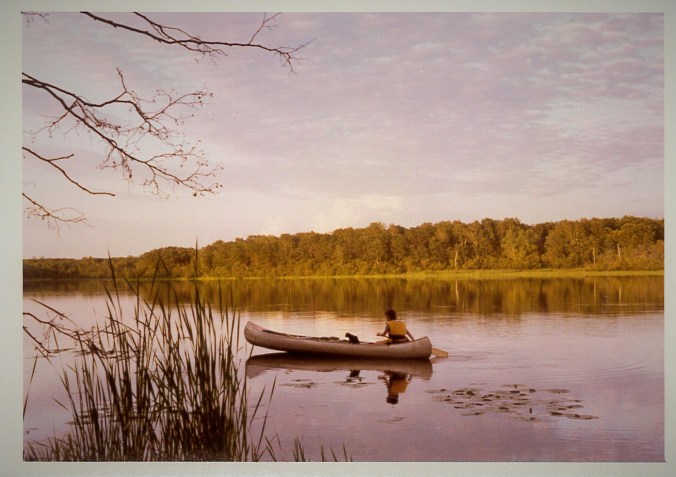
Inky and me, Star Lake, Minn., July 1977. Image by Dorothy Pramann.

I grew up with a black cat named Inky. She was a stray a neighbor boy brought to us because he knew we recently lost a cat. That previous cat was a calico we named Muffin. Alas, Muffin ran away when we were on a camping trip while she was under the care of a neighbor. Perhaps because of that, we took Inky along on all our camping trips.

She did not enjoy car rides – she would disappear under the driver’s seat and not emerge until we’d reached our destination – but she liked being outdoors in the campgrounds where we stayed. We’d leash her to a picnic table so we wouldn’t lose her.

One place we liked to stay for extended periods was Star Lake, a Methodist Church Campground in northern Minnesota. Because we’d stayed there several times and we didn’t need to travel the next day, we’d let Inky off her leash to come and go as she pleased, like she did at home.

We owned an old Grumman aluminum canoe that I used to paddle around the lake. One day, I got the idea of bringing Inky along.

Canoe Cat_Page_2

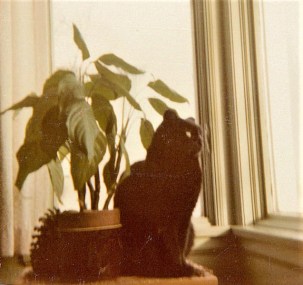
Inky at home, 1975.

She seemed to like the canoe ride better than a car ride. She perched on the gunwale a few feet in front of me, leaning out over the water.

With each canoe outing, she’d lean farther and farther over the side. It seemed like she wanted to go into the water. One day, I tipped the canoe slightly, giving her some “help.”

Plop! Into the water she went.

We weren’t far from the shore of our campsite – only about 30 feet — and she swam in that direction. I can’t recall if she meowed as she swam, or if she swam silently. (My memory has fuzzed during the four decades since this occurred.) She made it to shore just fine and seemed no worse for wear.

The next time I took Inky out for a canoe, as we neared our site again, she jumped out of the canoe by herself!

Could it be, she liked to swim? I’d never heard of a cat who liked to swim, but apparently, I had one. By the end of our stay, her swims from the canoe to our campsite were a regular thing.

Inky the swimming black cat lived to a ripe old age, despite getting hit by a car once, breaking her leg. I’ve had other cats since then, but none who liked to swim like she did.

I just researched swimming cats. Although most cats would rather avoid water, some do like it. (Read stories here.)

My youngest son is allergic to cats, so I have since switched to dogs. But in my home, I keep this photo my mother took of Inky and me canoeing. I think of my swimming cat whenever I pass it.

Star Lake was the only place I ever took her canoeing. I wonder what she would have thought of the Boundary Waters Canoe Area Wilderness? I bet Inky would have liked it.