Author Reading: North Shore Readers and Writers Festival

NS Writers Fest logoI’m going to meander up the North Shore of Lake Superior to Grand Marias, Minnesota, this November. I’ve been asked to give a reading as part of a panel of local writers during a lunch session of the North Shore Readers and Writers Festival on November 9.

I’ll be reading an excerpt of my Lake Superior-inspired story from the “Going Coastal” anthology along with two of my favorite local writers: Felicia Schneiderhan (“Newlyweds Afloat”), and Eric Chandler (“Hugging This Rock: Poems of Earth & Sky, Love & War”).

Best of all, this is a free event! You can bring your own lunch and attend at no cost, but you do need to register through the festival website. There are also options to buy lunch.

The festival looks like an awesome way to meet published authors and learn from them. Check out the course schedule and see if anything strikes your fancy. All the classes are available ala carte, so that keeps costs down.

Scamping in Canada’s Quetico Provincial Park

DSC05536Russ bought a 13-foot Scamp trailer about a year ago and we hadn’t had time to use it until now. Scamps are cute little lightweight campers made in Minnesota. Ours has all the comforts of home in a compact space. The only things missing are a bathroom and an oven.

I needed to travel overnight for a freelance magazine story assignment in Canada, so we decided it was the perfect opportunity for the Scamp’s maiden voyage.

On our way to the Dawson Trail Campground in Quetico Provincial Park, we left Duluth and drove across the border on the North Shore of Lake Superior with our two doggies. Note that to bring your dogs into Canada, you need to have a rabies vaccination certificate. The border agent didn’t ask us for our dogs’ certificates, but we had them along, just in case.

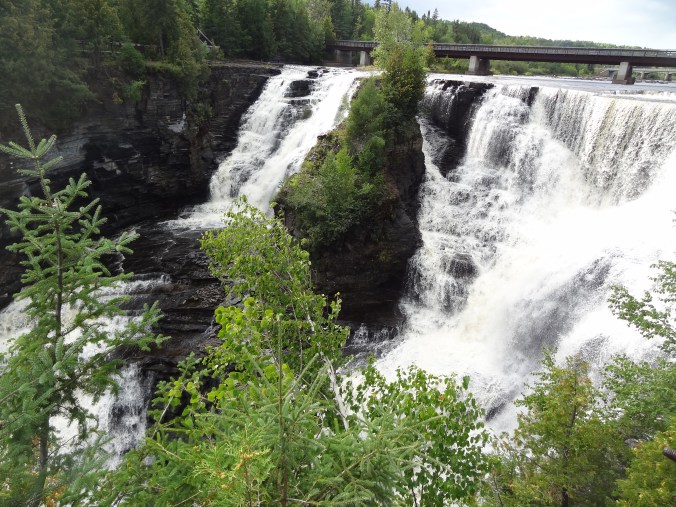
Just outside of Thunder Bay we turned north to Kakabeka Falls. Since the falls are close to the road and we’d never seen them, we decided to stop. At 131 feet, these falls are even higher than the ones on the Pigeon River on the border of Minnesota and Canada. They are truly spectacular and well worth pulling off the highway to see.

DSC05466

Kakabeka Falls

Then we were off to find the Trans-Canada Highway. This impressively maintained road looks totally out-of-place as it takes drivers past pine-lined undeveloped lakes, bogs, and beaver homes. Imagine the Boundary Waters Canoe Area Wilderness with a freeway through it, and that’s what driving this stretch of Highway 11 is like.

There are not many services along the road in this part of the world. In fact, warning signs advise drivers to check their gas at certain points because if you run out, you’ll be stuck in the middle of nowhere.

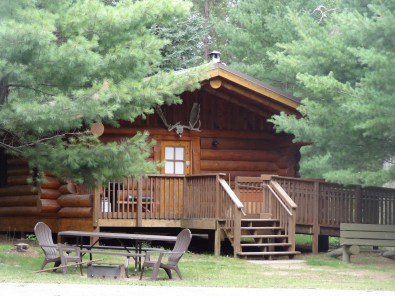
Counting a lunch stop and the waterfall stop, it took us about eight hours to arrive the campground. The campground is actually two campgrounds, a canoe launch, several log cabins, a visitor center, picnic grounds and a bunch of hiking trails.

We parked our Scamp in Ojibwa Campground, which features a small beach, electric hookups, and a bathroom building that offers free hot showers and a coin laundry (if you bring some loonies along). As we checked in, the ranger warned us of bear activity in the campground. The park had a cage trap out to catch it.

DSC05515

A log cabin for rent at the campground. Pretty sweet!

We stayed for three nights, discovering along the way that yes, you can fit two adults and two large dogs into a 13-foot Scamp.

After my writing work was done on our last day, we took a hike to The Pines, which is a picturesque beach lined with a stand of red pines. After being spoiled by hiking among giant hemlocks in the Apostle Islands last fall, we were a bit disappointed by this hike. From the descriptions, we expected giant pines to line the trail, not only the endpoint. And the pines weren’t all that old. But don’t let our expectations stop you from exploring the area – we are just nature snobs, I guess.

Our doggies loved the beach, however. Buddy the Wonderdog ran in crazy circles, he was so excited to have reached this sandy destination. Russ’s dog Bea waded into the water and drank her fill from Pickerel Lake.

DSC05521

The Pines at the end of The Pines trail.

During our hike back to the campground, a drizzle started to fall. We slogged along for several hours and were super happy to have a dry and cozy Scamp to climb into at the end of it. With my only pair of jeans sopping wet, I took advantage of the dryer at the bathroom and was soon able to climb under a blanket in dryer-warmed pants. This truly felt like a magnificent luxury in the wilderness.

While I was gone on this task, Russ said he saw the campground bear being driven away, trapped in the cage.

Our route back home took us farther west along the highway to Fort Frances and International Falls, where we crossed the border back into America again. Once we crossed the border, the dogs, still worn out by the hike the previous day, perked up. Russ and I joked that it was like they could smell America.

If you’re thinking of upgrading from tent camping to a Scamp, I would say, do it! We are looking forward to our next Scamping adventure. I wonder where it will take us?

DSC05541

The beach at Ojibwa Campground and canoe landing.

Free Stuff and Boring Place Names: A Road Trip Through America’s Heartland

We recently returned from an epic road trip straight south. Our mission? To take my youngest son to college in Arizona. He wanted to have his car with him at school, so thus the necessity of driving it 1,700+ miles.

It’s been a while since I’ve taken a long road trip and I was looking forward to it. I’d also never driven across Kansas or Oklahoma before, so was itching to cross those states off my driving list.

20190820_170403

Photo taken by Hunter Zhuikov, somewhere along the Kansas Turnpike.

Two themes soon emerged: free stuff and boring geographic names.

The free stuff started with our first lunch while we were still in Minnesota. We stopped at a Perkins Restaurant. Unbeknownst to us, Mondays are free pie days at the chain. Our waitress thought that everybody knew this and that’s why we stopped there. When she announced our free pie choices, we just stared at her in dumbstruck wonder. Afterward, we continued our drive, fortified by a few hundred extra free calories.

Our luck continued that night in Kansas City where we ate at a Red Lobster for supper. Due to a computer glitch, our food order did not make it to the cooks in a timely manner, so, even though we weren’t upset by the wait, the manager offered us a free dinner and two desserts. More free food, yippee!

The next day our luck changed from food to transportation. We were at a tollbooth on the end of the Kansas Turnpike when the machine malfunctioned. The toll operator let us pass through without paying because it was going to take too long to reboot the machine. Yeehaw!

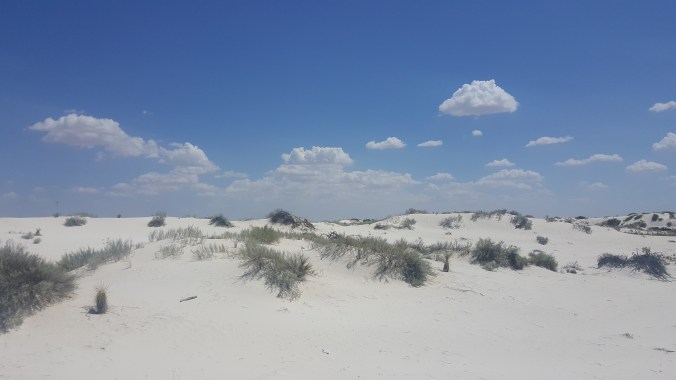
We thought our luck was over when no free stuff appeared for the next 24 hours, but we were wrong. On our third and final day of the trip, we decided to stop at White Sands National Monument in New Mexico because it was right next to the highway and it looked picturesque. We could only spend about a half-hour there, however, because relatives were waiting for us in Arizona. As we drove up to the entrance fee booth, we noticed it was empty. Yay! Free scenery!

20190821_143021

White Sands National Monument

If you ever get the chance to visit White Sands, be sure to do so. The piles of white gypsum flow in spectacular dunes, which you can access right off the park road. We had enough time to drive to a boardwalk trail and hike to the end of it, taking photos along the way.

Now for boring geographic names. C’mon Kansas, you can do better. Examples: there’s a town named Rock, another named Urbandale. How generic can you get? A river called Whitewater. Another town named Grove.

Ugh. As if driving through farmland isn’t already mind-numbing, the place names in Kansas, at least those before Witchita, were totally uninspiring.

After Witchita, things changed. We ran into town called Smoots. Another called Pretty Prairie. That’s better, Kansas. Keep it up! We crossed the Ninnescah River about three times. I probably liked this name because it sounded Minnesotan. Thank goodness the place names got better or I might have fallen asleep behind the wheel.

Other things of note: We passed the world’s largest hand-dug well in Greensburg, Kansas. We did not stop, but maybe we should have. I mean, the thing has its own visitor center, it’s so huge! We also passed the world’s largest pistachio. This was in New Mexico. It’s not a real pistachio, but a “mammoth outdoor sculpture” to advertise a pistachio tree ranch. We didn’t stop there, either, having already used all our spare time at the White Sands.

We were also impressed by all the wind turbines in Kansas and Oklahoma. It seems as if wind power is alive and well in those states.

I am happy to report that my son’s car survived the journey, and so did we! My son is ensconced in his dorm room and starting his classes now. Once we flew back home, the house was eerily silent without his presence. We are still adjusting.

20190822_103411

Moving into the dorm.

A Plethora of Pronouns

20190815_201016My recent Florida trip mixed work with pleasure. The work part was a conference about podcasting. I produce a podcast for work (called Wisconsin Water News) and I was looking for ideas and information to make it better.

Three thousand people attended the conference. I never dreamed that podcasting was such a huge thing! One of the tidbits I learned during the event is that there are over 700,000 active podcasts and that 72 million people listen at least once per month.

20190815_201001Something else I learned is that pronouns are a “thing.” Conference organizers offered buttons so that people could affix the pronoun to themselves by which they want to be referred. (He/him, they/them, she/her.) Also, some of the speaker panels featured introductions where the speakers told the audiences which pronoun the prefer.

As a hick from Duluth, this was new to me. I guess it’s about time I got with the program. Are pronouns a thing in your workplace or community?

A Hidden Seafood Restaurant Gem in Orlando

20190814_183626

Arroz marinero at Casa del Marisco.

We meandered down to Orlando, Florida, last week for a work conference. We stayed at a huge hotel with almost 3,000 people just for our conference, plus thousands of others who were attending other conferences held there.

The hotel housed half a dozen restaurants, but they were incredibly noisy. After a couple of days of hoarse voices from talking over other people, we decided to venture off-site for dinner. After a quick Google search for nearby places, we decided on Casa del Marisco, a seafood restaurant that features Peruvian and Ecuadorian seafood.

The worry began when we arrived. The restaurant seemed to be in the basement of a repurposed hotel. By repurposed, I mean there were tattoo parlors, fast biz cash loan offerings, and other questionable business ventures.

Our sense of dread did not abate when we opened the restaurant doors and found ourselves the only customers. The restaurant was white and clean, yes, but with its mirrored walls and tiled floors, the ambiance harkened back to the 1980s.

We were quickly greeted and seated, however. After perusing the menu, I looked up and could see through a window into the kitchen. The cooks looked like they could be Mexican or Edcuadorian. I suspected that this dining experience could be either very good or very bad.

Our waiter was friendly, and it was obvious that English was a second language to him.

I chose the arroz marinero, a paella rice and seafood mixture served with fried plantains. It arrived as pictured above, with healthy doses of mussels, shrimp, squid and scallops. As my dining companions enjoyed their dinners, it didn’t take long for my taste buds to realize that this was going to be a great dining experience!

The rice was zesty, but not too spicy for my Minnesota palette, the seafood was not overcooked, and the plantains were tender and sweet.

Only one other person entered the restaurant during our dinner, and that was to wait for a to-go order. But the kitchen staff was busy, presumably making other to-go orders. An “uber pick-up” sign made us think the place must do a good take-out business.

When the check arrived, the numbers were in Spanish, with a comma where the decimal point should be. It all seemed thrillingly ethnic to us northerners.

So I am here to say, don’t let the appearance of this place put you off. The food is worth the retro ambiance. In fact, some people might even like the ambiance, since the 1980s are hip once again.

Fun with Acupuncture

acupuncture-on-wristAs you may know, I am in my elder years. As you may not know, I have been experiencing hot flashes for several of those elder years. If you don’t want to know that information, you can stop reading now. But if this revelation holds any interest to you, and you want to know what it’s like to have acupuncture, read on!

At first, my hot flashes weren’t so bad – just a minor inconvenience. After a few months, they went away. I thought they were over and that the whole hot flash thing wasn’t so bad. WRONG. They returned and were a bit peskier than before – interrupting my sleep, arriving at inopportune times during the day, eliciting knowing looks from other older women in airports and grocery stores as I fanned myself.

My doctor offered the idea of estrogen therapy or some anti-depressants, but I shied away from those. Reports of problems with those drugs made me skittish, besides, I figure there’s a good reason our bodies are no longer making estrogen. Why prolong this with adding it back in?

As my hot flashes became more severe over the past year, I tried a few different herbal supplements, but they just made things worse. On the advice of several friends, I decided to try a local acupuncturist.

The first step in my appointment was filling out about a 15-page health history. Wow! I dropped it off at the practitioner’s office a week beforehand so she would have time to look at it before my appointment.

When I arrived for my session, we went over the document and she asked for details on a few things. She quickly zeroed in on several habits I have that can worsen hot flashes, those being drinking WINE and eating CHOCOLATE. She suggested I give those up for a month or so to see if that helps.

WINE and CHOCOLATE. These are the only things that make my life bearable. Because I’m intolerant to wheat and corn, I can’t have pastries, pies, cookies, doughnuts, etc., unless I go to great (and rare) lengths to make them myself from alternative ingredients.

I have often said that I am so glad I can still eat chocolate. If I ever become allergic, someone should just shoot me.

This woman might as well have had a gun to my head. Granted, she wasn’t saying I had to give up these two elixirs forever, just for a month. But still. The only good part of that conversation is that hard liquor (spirits) might still be okay to drink instead of wine. I grasped desperately at the idea that scotch could get me through this deprivation.

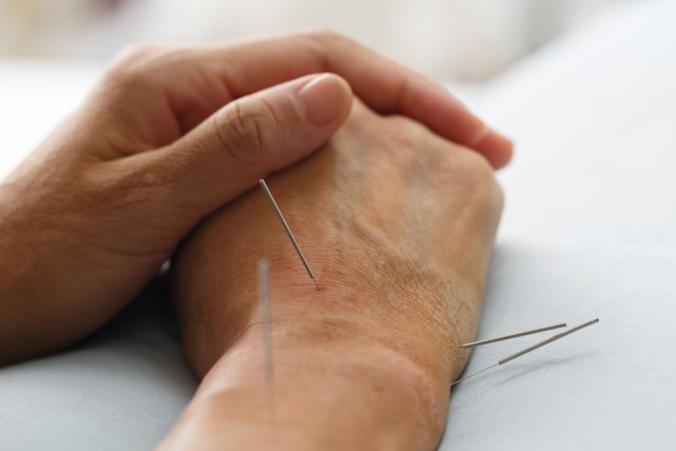
As we spoke, the practitioner took notes for my treatment plan. Then she asked if I was open to the idea of acupuncture. I agreed, so she laid me down on a table. She made me stick out my tongue so she could see the color of it, etc. Then she took my pulse in both wrists. Then came the needles.

I didn’t want to watch. I also don’t watch when I get shots. I’d rather not see sharp things approaching my skin. During television news stories about the importance of flu shots, I cannot watch as other people get shots, either.

As I looked up at the ceiling tiles, she inserted seven thin, stainless steel needles into my wrists, lower legs, and feet. It hurt a little bit, but not as much as I was expecting. On a scale of ten, they were about a three. She flicked the needles as she inserted them.

She said she was going to leave to write up my treatment plan. She asked if I would like some music while I waited. When I asked how long it would take, she said fifteen minutes. “Yes, music, please!”

The practitioner exited, leaving me alone with seven long needles sticking out of my body. Well, not having the courage to look at them, I didn’t know they were so long at first. Eventually, I lifted my head and looked at my wrist. A needle stuck about three inches out of it!

I put my head back down, fighting the urge to rise up, tear out all the needles, and get the heck outta there.

“Breathe,” I told myself. “Relax. This is supposed to help you.”

I tried to concentrate on the music (Carlos Nakai flute music, BTW.) That worked for a while, but then I just had to look at my legs. Mistake! The urge to flee came back.

I laid back down and fought it. I tried to meditate, with limited success. I tried to write this blog post in my head, but that made me concentrate on the feeling of the needles and how to describe it.

My right wrist was developing a deep ache. A nerve in my calf twitched. Was this normal? I began to wish the practitioner was in the room so I could ask her. What if my leg cramped up? If I called for help, would she hear me?

I did not like the being left alone part.

After a long fifteen minutes, she came back and took the needles out. I expected her to ask how I felt, but she didn’t. When I sat up and she noticed me rubbing my wrist, she asked if it hurt. I told her it was a deep ache. She said that meant there was a blockage, and suggested I rub the pain out through my hand, not back toward my body.

I could hardly tell where the needles had been. There was no blood, just some tiny discolorations that disappeared quickly. I felt fairly normal and was able to walk down the hall to her office just fine.

There she gave me a different herbal supplement than the one I’d had before. We talked about a follow-up visit. I paid and was on my way.

Once I was back home, I had a hot flash, but it wasn’t as powerful as before. That night, I had another, but it was at a different time than usual and didn’t last as long. I felt more rested than before when I awoke.

Today is the next day. I just read a research study that says acupuncture has been scientifically proven effective to help menopausal sleep disturbances, which is reassuring.

It’s too soon to say definitively if it is helping me. That will take time. I’ll let you know if it does!

In the meantime, I’m glad I resisted my urges to flee the acupuncture table. That would definitely not have been helpful. Time for some scotch.

* * *

UPDATE: Two months later, what’s the verdict?

During the first week or so, I thought the treatment wasn’t working. It involved an acupuncture session and herbal supplements to take later. Then I realized I wasn’t taking the proper dose of the supplements. When I fixed that, things seemed to improve.

I’ve done well avoiding chocolate, as the acupuncturist suggested. Not so well avoiding wine, but I have cut back quite a bit.

I went back for a follow-up session a few weeks ago. This time, she wanted to stick her needles a few new places to help my allergies and my stuffy sinuses. She asked me if she could stick some needles in my face.

Let me say that again: MY FACE. Stupidly, I said yes. I LET HER STICK NEEDLES IN MY FACE. Specifically, I let her stick two needles in that space between my upper lip and my nose. (Also known as the philtrum.)

I felt nothing with the first needle. I felt the second needle go in, plus she twisted it a bit. She also stuck a needle in the TOP OF MY HEAD. That one started to sting.

I asked her if it was normal for it to sting. She said she thought it would calm down after a while.

Happily, the pain did lessen, but it was rather disconcerting for a few minutes. Lying on the table for 20 minutes was a bit easier this second time. She also gave me an additional herbal supplement for my allergies.

For the first day or two, I had no hot flashes. Then they started returning at night, but only a few times a night. I’ve also had them during the day, but not as often as before I started treatment.

The supplement she gave me for my allergies worked like a charm.

Overall, I’d say that my hot flashes have improved by about 65%. And the flashes I get are not as extreme. They are more like warm flashes than hot flashes. I am sleeping better and plan to continue taking the supplements until I feel like I don’t need them any more (or I get sick of them, whichever comes first.)

If you are thinking of trying acupuncture for help with hot flashes, I say go for it.

Personally, I feel like I’ve had enough sessions with the needle now. I fear a continuing escalation of where she’ll want to stick needles next, and I’d rather not go there.

Two of the Coolest Spots on Madeline Island

IMG_6082

The bridge across Big Bay Town Park lagoon. Look at that beautiful water!

My friend Sharon and I meandered onto this island in Lake Superior a couple of weeks ago. We’d both been there before, but found two cool new places to explore this time. And I mean “cool” as in awesome and interesting.

20190713_141046

The lagoon.

The first was Big Bay Town Park, which friend recommended to us. Unlike with the state park on the island, the town park has a free-will donation fee. A short walk down a stairway from the parking lot leads you to a bridge across a stunning lagoon that enters Lake Superior. On the other side of the lagoon is a public beach studded with white pines. The water is crystal clear and inviting, although as always with Lake Superior, temperatures may be a bit cool.

Canoes are available to rent via self-service onsite, or you can rent watercraft, including paddleboards from a place in town. The kayaks, canoes, and paddleboard are all onsite, and the businesses will give you a key to unlock them.

I brought my own blow-up paddleboard and Sharon rented one for two hours. We cruised the lagoon, watching painted turtles walk across the sandy bottom and startling a fish here and there. The water is so clear, it felt like we were flying through it.

IMG_6099The second place is Tom’s Burned Down Café. I’d seen it from afar before and heard about its, shall we say, counterculture reputation. Maybe it once was a café (before it burned down?) but now it is a bar. No food is available.


The place is a hodgepodge of homegrown-construction seating areas held together with signs with sayings like “It’s not premaritial sex if you don’t plan on getting married,” and “Be the rainbow in a world full of rain.” The top is covered by several tents.

20190714_132120Filter

Tom’s Burned-Down Cafe

Sharon and I sat down, thirsty after our paddleboard, and ordered margaritas. The friendly bartender asked us if we’d like to try beet-infused tequila in our margaritas, pointing to a large glass container of mysterious red liquid behind him.

20190714_133432

My beet-infused margarita with the hand-written menu behind it.

We hesitated for a few beats, and then agreed. We were already brave enough to come into the bar, why not be even braver and try something new? The beet margarita was definitely drinkable, but it didn’t have as much lime in it as we were craving.

Also of note is that the place is cash-only. If you don’t have any, an ATM is available (under its own small tent) in the bar.

Tom’s was named the Number 2 Best Beach Bar in America in 2013 by Maxim Magazine, no doubt, for its unusual ambiance. If you go there with a sense of adventure, you won’t be disappointed!

Book Review: How to Talk Minnesotan, Revised for the 21st Century

9780143122692_p0_v3_s550x406The first version of this book, published in 1987 and later made into a video, helped me understand my own culture. Before reading it, I never understood that the “long good-bye” was something unique to my state of Minnesota. (The long good-bye is where it takes at least three tries to leave a friend’s home before they will actually let you go.)
Also helpful was the “angle rule,” which describes how many Minnesotans talk to each other without actually looking at each other. Instead, they stand at 90-degree angles, looking off at some mysterious distant point while conversing. I had seen that many times and just thought that’s how everyone did it. I was not conscious that these were Minnesota “things.”

I watched the “How to Talk Minnesotan” video so many times, I had the lines memorized. So when I heard the book had been updated (in 2013), I put it on my list to read.

In reading the recent edition, it didn’t seem like a whole lot had changed. Although it now contains sections on Tweets, Facebook, and smart phones, the same lines from the video are there on the page.

However, in reading this new version, I realized something that nagged me with the first version, which is that this is not a book that encompasses the whole of my dear state. The traits described in it are more common in farm country. I’d say that’s about from Hinkley, Minnesota, and south. With token mentions of smelt and lutefisk, this book has a bit of relevance to northern Minnesota, BUT, there’s not one mention of a sauna etiquette, iron ore mining, Lake Superior, Ole and Lena jokes, or wilderness camping. It lacks northern nuances.

A more accurate title for this book would be “How to talk Mid- to Southern-Minnesotan.” If you live north of Hinkley, reading it will be helpful, but it won’t get you the whole way. If a third version is ever done, the author should come on up here and talk to us northerners for some new material, don’t cha know.

Exploring Prophyry Island Lighthouse

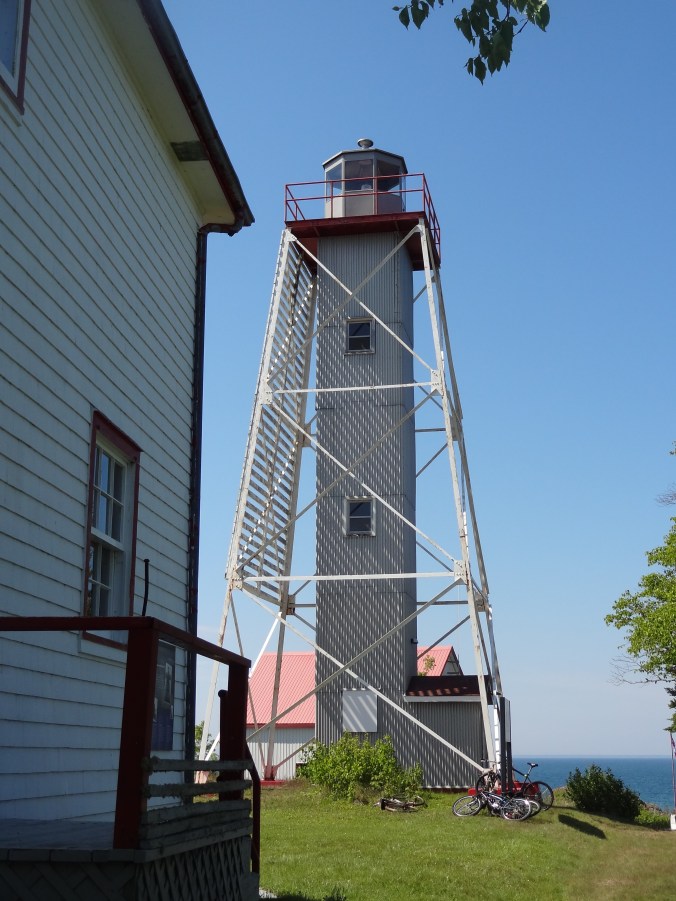
DSC05399

Porphyry Island Lighthouse

Porphyry is a wilderness island in Lake Superior on the east side of the Black Bay Peninsula near Thunder Bay in Ontario, Canada. Most arrive by motorboat, sailboat, kayak or canoe, docking in a secluded cove about a mile away from the lighthouse. Some arrive by helicopter, alighting on the helipad adjacent to the lighthouse.

Us? We arrived by dinghy, rowing from our anchorage farther down the island. When we landed, we were met by a native Canadian lad – a volunteer for the Canadian Lighthouses of Lake Superior organization.

DSC05388

Did you know there’s a universal symbol for taking a sauna? We didn’t until now, either!

When he asked where we traveled from, Captain Dave told him we rowed from Isle Royale — a preposterous 29 miles away. The lad did not take the bait, and instead, graciously offered us a tour of new structures in the cove. A boathouse features a mini-gift shop, and the sauna offers promises of warmth to be dashed by a splash in Lake Superior afterward.

Although bikes were available, we chose to stretch our sailboat- and dinghy-cramped legs by walking the flat trail to the lighthouse. Lined with Canada dogwoods, forget-me-nots, and the mysterious devil’s club plant (readers of my novel “Eye of the Wolf’ will know what this is!), the trail passed two points of interest along the way.

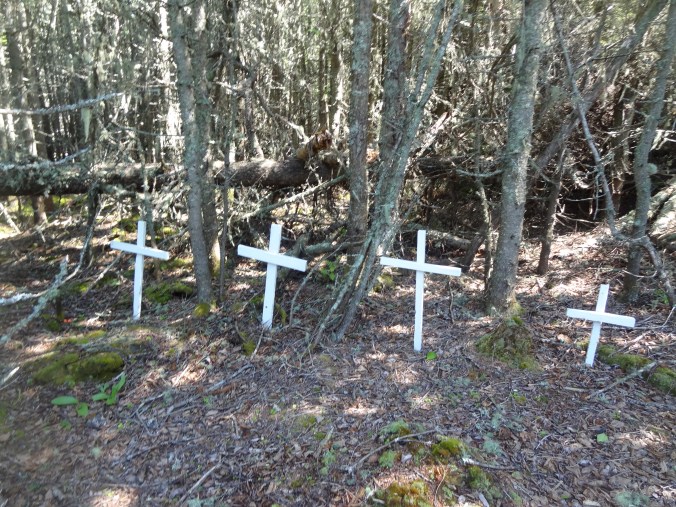
One was a small graveyard. Four white crosses mark where members of a former lighthouse keeper’s family are buried. The second is an area where a couple of junker cars lie moldering, relics from when the trail used to be a road.

DSC05393Upon reaching the lighthouse, we were greeted by several more volunteers, plus Eve, a former assistant lighthouse keeper. Her husband, Graham, was the last to keep the light before it became automated. He died a couple of years ago, and a photo gallery has been set up near the lighthouse to showcase his award-winning photos.

DSC05398Volunteer Kaitlyn showed us the gallery and a small museum. She was walking us toward the lighthouse for a tour when the door of the structure groaned and burst open. A man ran out, cell phone plastered to his ear, talking intently.
After all the wilderness silence we’d experienced, this was shocking. Not only for the noise but for the technology. (We hadn’t had cell phone service in a while.) We all put our hands on our hearts, and stopped on our tracks.

The man continued walking away from us, talking on his phone. After recovering, Kaitlyn and Eve told us the man was Paul, who ran the place. Once he got off his phone, we were able to meet him. He explained his office is in a room in the base of the lighthouse. He did not explain why he had to suddenly run out of it, but one would assume it was because he was in an important conversation and needed better reception. It made me wonder if his heart-attack-inducing bursting forth happened often, and also made us feel a bit sorry that running the place has him so stressed that he can’t meld into the peacefulness of it.

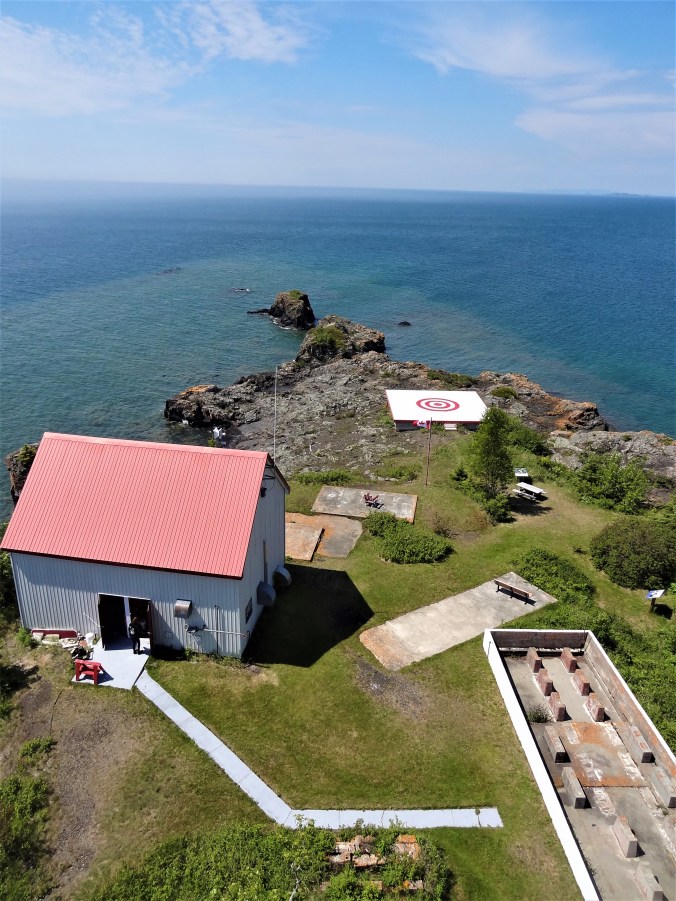
DSC05401

The helipad at the lighthouse.

As we were speaking with Paul, an older woman laden with painting supplies walked by. She was the latest artist-in-residence at the lighthouse, a painter from Jerusalem. The lighthouse organization sponsors several artists each summer. There’s also a guest house that people can rent, which used to be the lighthouse keeper’s quarters.

After we promised to donate to the lighthouse organization, Paul deemed us worthy of a tour of the lighthouse. Eve and Kaitlyn guided us up the six steep sets of stairs, which were more like ladders. Once at the top, we admired the view of Thunder Bay’s Sleeping Giant through the windows.

After a bit, Eve asked us if we’d like to go outside on the railing. Without hesitation, we said yes. We ducked through a small opening, out into the freedom of the summer breeze. The view was stunning. Eve pointed out the other islands we could see where she had worked with her husband, and where her sons were born. She told us that when they worked at Prophyry, her sons used to enjoy dropping water balloons down the inner corridor. I could totally see how that would appeal to them.

DSC05404

The view looking down from the top of the lighthouse.

After drinking in the view, we carefully descended the steps back to the ground. Eve, at 70, navigated them like a much younger woman. Then again, she must have had a lot of practice when she worked here.

We walked back to the cove and socialized with a Canadian sailor who was anchored there. As we rowed back to our boat, a fog started to roll in, relegating the lighthouse and its inhabitants back into the mists of time.

DSC05403

Eve and Kaitlyn

Wilderness Sailing in Canada, Eh?

DSC05356Russ and I had the privilege of crewing on the sailboat Neverland on a Lake Superior cruise during the 4th of July week. We sailed from Grand Marais, Minnesota, to Red Rock, Canada, which is as far north as you can go on the lake.
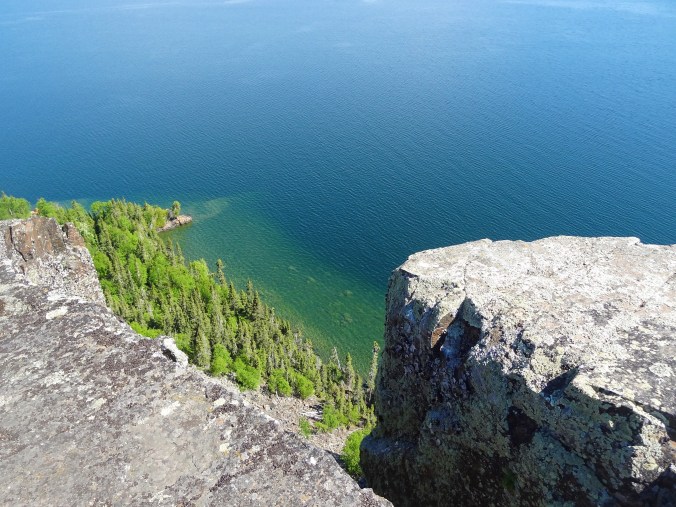
I learned more, not only about sailing, but about my feelings for my country. Before we left Duluth for Grand Marais, we happened to see a beat-up pickup truck driving around town with two American flags stuck behind its cab. Instead of inspiring feelings of patriotism, the sight of the flags struck me as aggressive, pugnacious, and a little redneck.

I have never felt that way before about the flag, and suspect it has something to do with our current president and the political/cultural climate in which we find ourselves. Suddenly, missing Independence Day fireworks because we’d be in Canada didn’t seem so bad. But I brought along several old packages of sparklers I had just so we’d be able to celebrate a little bit on the boat.

The Neverland left Grand Marais on a calm, cool morning. Although the air temperature was in the 60s, the Lake Superior water temperature was around 40 degrees. Brrr! Plunk yourself down in a boat in the middle of it, and it feels like fall in July.

Calm weather means poor sailing, so we motored for most of the day across the Canadian Border. You may be wondering how one can cross the border if there are no customs stations in the lake. Well, you need to fill out a remote border crossing permit beforehand. The permits cost around $30 and you have to provide copies of your passport along with it. Allow a month for processing.

If all goes well, your permit will arrive in the mail a few days before your trip. You need to bring the permit along with you just in case your craft gets stopped once you’re over the border. Thankfully, we never got stopped, but it was good to know we had the proper permissions with us, just in case.

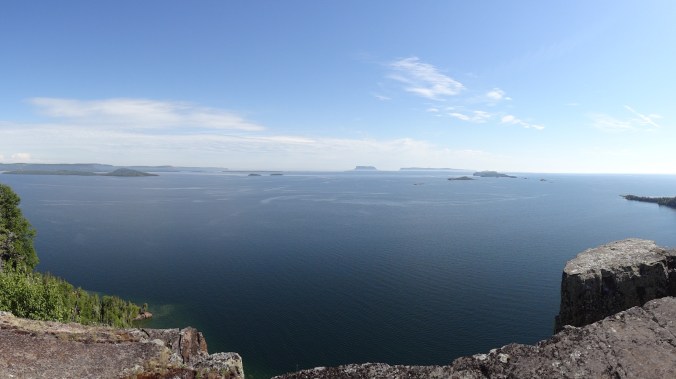
Our first anchorage was at Spar Island, near the entrance to Thunder Bay. This craggy, piney island has a protected cove, which provided for tranquil waters all night. In the morning, we rowed Tinkerbell, the dinghy, to a campsite on shore and found a trail that leads to the “top of the world,” which is a tall bluff that offers stunning views of the lake and nearby islands.

DSC05366

View from the “top of the world” on Spar Island.

Ever observant, Russ found a metal mailbox nestled in a pine tree. It held a logbook and we added our names to it. After enjoying the view, we hiked back down.

DSC05369

Looking down from the top of the world.

After another cold, calm crossing (we could see our breath!), we anchored at Porphyry Island. We began the Fourth of July with a breakfast of luscious banana walnut pancakes courtesy of Captain Dave. Then we rowed Tinkerbell over to Prophyry Island Cove. We were met by a volunteer who gave us a tour of the new sauna and boat house at the cove. The island also features a lighthouse. I’ll describe our tour of that in a separate posting later.

Our afternoon sail took us to Chapleau Island, which is off the Black Bay Peninsula. Cell phone service is nonexistent here, and would be until the end of our trip. We shared our cove with a bunch of kayaker boys who were using the campsite and sauna opposite our anchorage. It was fun to see them whooping and hollering as they ran from the sauna and jumped into the frigid waters.

We celebrated our successful arrival with gin and tonics below decks, enjoying the music of hermit thrushes, winter wrens, white-throated sparrows and loons from the surrounding forest.

DSC05428

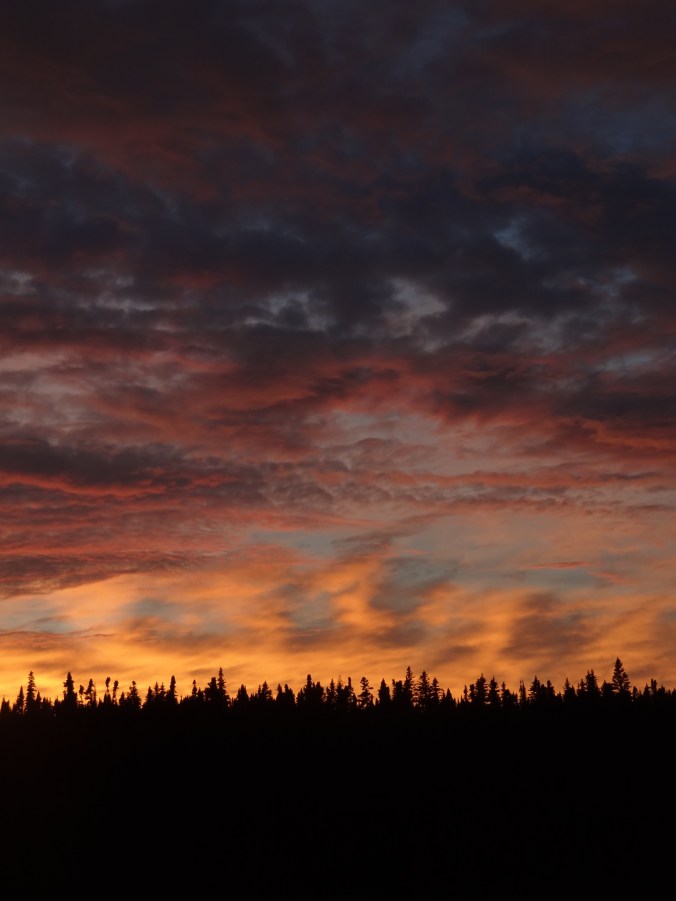
Fourth of July sunset.

Russ cooked us THE BEST maple butter chicken I have had in memory. Maybe it was so good because of the holiday, but maybe it was because we were so hungry from a long day of activity.

DSC05435After dinner, Russ and I went on deck and took out the sparklers. We were heartened to see they still worked. We had our own little private fourth of July celebration as the sparklers quietly hissed and threw their light into the Canadian evening.
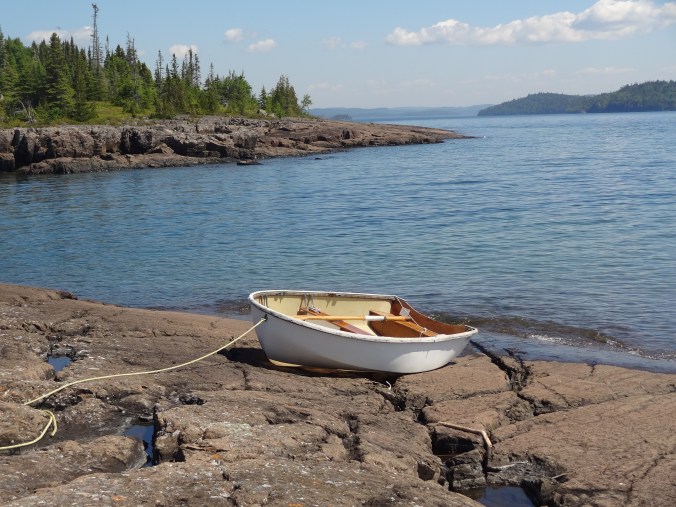
The next morning, I practiced rowing Tinkerbell by myself in the quiet cove. I will admit I did it perfectly backwards, but was soon corrected by my sail mates and got myself turned around in the right direction.

We rowed quite far to explore an unnamed island that Russ and Capn Dave had seen on their last trip here. The island was half rock and half trees, sloping down into the lake gently on one side, with a steep cliff on the other. Pools of fresh water collected in depressions on the shore, featuring tadpoles and mysterious shrimp-like creatures. On the way back to the boat, I even rowed. I can’t say that I am proficient, but at least nobody drowned.

In the afternoon, we finally had good sailing weather. We reached 6 knots on the way to Moss Island, which is at the beginning of the Nipigon Straits. However, good wind means a lot of cold – I had to wear four layers on top and two on the bottom, but at least I didn’t need to use hand and feet warmers like last year. The air was beginning to smell like wildfire smoke and the sky was getting hazy.

A flock of half a dozen white pelicans greeted us and flew by several times during our stay. The weather warmed enough that I could wear shorts, finally – as one should during July!

The next morning, we motored up the straits to Nipigon Bay. In the bay, the wind picked up enough to sail. We made it to Red Rock Marina, our final destination, in time for supper and most-welcome showers.

This is my third trip aboard the Neverland. I am finally getting the hang of what “port” and “starboard” mean. I can steer the boat well while it’s motoring, but not so well with sails. That will take more practice. I am learning the boat’s quirks and how everything works. I would not call myself a sailor, though. I still have a long way to go before that happens.

As we drove home the next day, we saw plenty of Canadian flags, since Canada Day was July 1. I marveled at the different emotions that flag elicited within me: happiness, friendliness, and peace – similar to the feelings the wilderness islands and lake stirred within.

Now, I realize that Canada is not perfect (for instance, their treatment of native peoples is deplorable) but on the whole, their displays of the flag seemed glaringly different compared to the displays in my home town.

I can hear the haters now: If you hate America so much, just move to Canada! I don’t hate America. I’m just pointing out that the 4th of July doesn’t feel the same as it used to, but it took time away on a sailboat for me to realize that.

I hope this time next year our culture will have changed enough that I can be proud of our flag again.

DSC05448

Tinkerbell on the unnamed island near Chapleau Island.