Mary Queen of Scots’ death mask.
Just to forewarn you – this is a long entry. I made the most of my last full day in Scotland. Have a cup of tea and enjoy the read! I’ve highlighted important names to remember for this story to make sense.
My last day in Kelso began with a short drive to the Mary Queen of Scots Visitor Centre in Jedburgh – on the advice of one of my blogging acquaintances. (Thank you James of “Walking with a Smacked Pentax!”)
The approach to the center is through a narrow alleyway, so the building doesn’t look all that impressive (especially for a former queen to have stayed there) until you walk around to the front, where you can see its stately tower. Having watched a public television series on the queen when I was young, I was interested to learn more and to refresh my memory.

The Mary Queen of Scots Visitor Centre
Entrance to the center is free, although the written guide costs a few pence. Mary (whose French name is Marie) stayed there for about a year. She almost died there, too, after a trip to visit her secret lover, and encountering bad weather and falling into a bog on her way back to Jedburgh. It was the last place in Scotland she was to live before becoming Queen Elizabeth’s prisoner in England for eighteen years.
Her sad and devious story is laid out clearly in the various rooms. Walking among the artifacts – a buckle, a shoe with a broken heel, a lock of her strawberry blonde hair – I couldn’t help but feel sympathetic toward this woman whose life started out with so much promise, only to disintegrate after marrying the wrong man and trusting people she shouldn’t have.
By the time I reached the room that features her final letter, addressed to her brother-in-law King Henry III, my heart was heavy and quiet. Mean old Queen Elizabeth wouldn’t even allow Mary the comfort of her own chaplain in her final hours. And then I came upon her death mask on display. It was common practice to take a cast of the face of beheaded prisoners. Mary really was beautiful.
*
The drive back to Kelso allowed me enough time to shake off the sadness. After all, I had a mission to fulfill: I was going to try and find two homes associated with my great-great-great grandmother. Her name was Margaret Gray. She was the mother of Susan Gray, who married William Dick (my great-great grandfather) who worked at Floors Castle.
My mother and/or aunts had requested a report on Margaret from the Scots Ancestry Research Society in the early 1990s. They found that she was listed in the 1841 census as being widowed, 75 years old, and living in a house with her son-in-law and his young daughter. There is no wife listed in the report. One could assume that perhaps the wife died and that Margaret was helping with the child.
The house had a name and location, which, to protect the privacy of the people currently living there, I am not going to divulge. Let’s just call it Pinnacle Cottage. When I was still at home in the U.S. before my trip, I had wondered if a house important enough to have its own name might still be there. I did some Google searches and found a house in the right location.
Graham, the super-helpful host at my B&B, the Bellevue Guest House, also took a look at the name of the house and pointed me in the same direction.
In that same census, another Margaret Gray is listed as being younger (60 years old) and working as a servant in another named house not far from Pinnacle Cottage. Let’s call it Forest Lodge. Could it be that Margaret lived in Pinnacle Cottage and worked in Forest Lodge? (Maybe the lodge owners didn’t know her real age or didn’t want to admit to making a seventy-five-year-old work for them.) Or maybe Margaret lived in Pinnacle Cottage and one of her daughters named Margaret (who she must have had when she was 15 years old!) worked at the lodge. In any event, it seems likely there was some kind of connection.
I was also able to find the lodge with Google, and Graham again pointed me in the same direction. Forest Lodge was within easy walking distance from Pinnacle Cottage.
As I drove back into Kelso, I did so from the Pinnacle Hill direction and parked across a bridge from the hill. I figured I could find the cottage more easily by walking than driving. I crossed the bridge into a neighborhood full of houses, which soon thinned as the area became more wooded. I came to a house with a driveway gate and a sign that had the owner’s last name and “Pinnacle Hill” on it. Not exactly “Pinnacle Cottage,” but close. I walked down the road a bit farther to see if there were any other houses. As I did, I passed another gate where I caught a glimpse of the Pinnacle Hill house through the trees. It was low-slung and covered in white stucco with blue and yellow trim around its many windows.
No other houses stood beyond it – just a natural area with a trail. So I walked back. As I stood near the gate and took a photo of what I could see of the house, I heard the clip of hedge trimmers. I called out a “hullo” and was met by the gardener. (How lucky was that?)
I told him my quest and asked him if he thought this house had been around since 1841. He said he’d ask the owner – an elderly gentleman who was a retired doctor. He went inside to ask and came out with the explanation that the doctor was in his nineties and wasn’t open to having company (actually, he said the doctor liked to hang out naked most of the time, and I laughed and said I wanted to do that when I got old, too) BUT he thought this could be the right house.
Cool. I asked the gardener if it would be all right if I came into the yard to take photos of the house. He said that would be fine, and opened the gate to let me in. The house and yard were well-kept and it looked like another small house was attached behind it. A mother-in-law’s cottage, perhaps??
As I was raising my camera for a shot, I glimpsed a figure that looked like an old man in one of the far windows . When he saw that I saw him, he scuttled from view. (He had clothes on!)
The gardener and I chatted a while longer, then I was off to find Forest Lodge. I continued down the road, past the nature trail and to a sign for the town of “Forest.” I followed the sign and eventually came to a house with an impressive gate and a gatehouse. The name on the gate was “Forest House.” Not exactly Forest Lodge, but it would do.
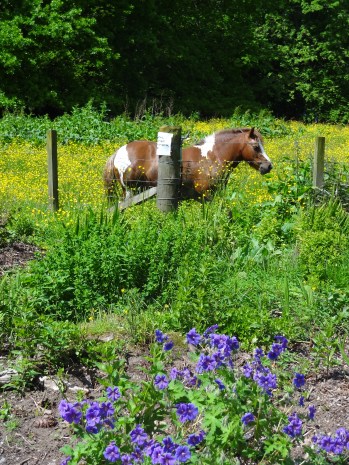
 Another sign on the gate said PRIVATE in big letters. Hmmm. How brave was I? Apparently, I was medium-brave. I knocked on the gatehouse, but nobody answered. I decided to walk down the long driveway to at least see if I could view the house from a distance and take a photo. But as I walked upon the smooth blacktop, past the immaculately groomed flowers and towering trees, I started to lose my nerve. My nerve fled farther upon seeing a beautiful dapple grey horse gazing at me placidly from over a fence. These people were equestrians. Just how much money did they have? I stopped behind a trimmed tree for a moment and the rest of my nerve fled.
I turned and walked back down the driveway toward the road. As I approached the gatehouse, I saw a car parked by it. But nerveless me couldn’t bring myself to knock on the door again. I reached the road and started back toward my car. As I walked, the sky darkened and rain threatened, matching my mood.
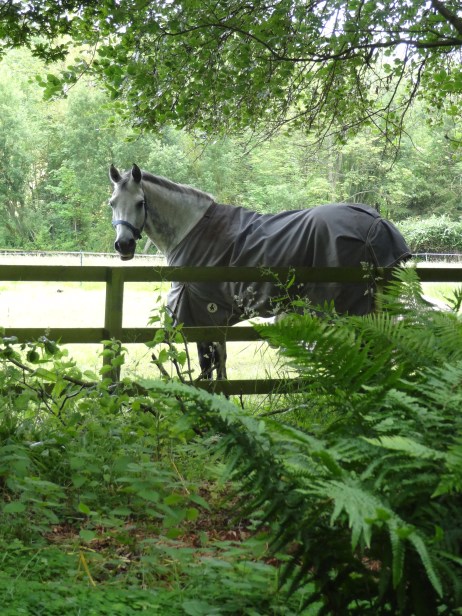 It wasn’t long before I noticed a woman walking a dog in a field. I could see her through the thin hedgerow and it looked like she came from the gatehouse. I gave my bravery a kick in the pants and told myself I HAD to talk to her. So I did. The sun came out and the sky brightened. She said she was the mother of the woman who lived in the gatehouse. She just happened to visit to walk her daughter’s dog. (How lucky was that?)
I told her of my quest and hesitancy to invade privacy, and she encouraged me to ignore the PRIVATE sign and walk to the house. She said the owner was really nice and wouldn’t mind. It did seem silly to come so far and not try harder to see the house, so I followed her advice.
As I walked down the fancy driveway, more horses came into view and yet more spectacular shrubbery. Then I saw a gardener at work across the yard. He didn’t seem to notice me, so I continued on to the house. What a house! It was a big grey castle-like structure with green climbing vines and roses covering the front. I walked past the two marble dogs guarding the door and rang the bell.

Nobody answered. However, a side door opened and a youngish blonde lady stepped out. I thought she looked too young to be the owner, but I gave her my spiel and asked her if she thought this could be the right place. She did. As we talked further and I showed her the census report, I discovered she was indeed the mistress of the house. And yes, she was very nice. I asked her if I could take some photos and she readily agreed. However, she stayed outside with the gardener the whole time. I don’t blame her.
Mission accomplished and copious thanks given, I walked back to the road, ready for my next quest, which was finding the gravestone of William Dick. I happened upon the gatehouse lady’s mother coming up the road, returning from her dog walk. She asked how my visit to the house went and I relayed the happy news.
Then I told her of my next quest and she showed me on my map exactly where the cemetery was. In fact, it was right near where I parked my car. (How lucky was that?)
Purpose clear, I walked down the road and across the bridge. The cemetery gate was open. I had a crude map my mother had drawn of the grave’s location. After a bit of looking, and concluding my mother must have been drunk when she drew the map, I found my great-great grandfather’s gravestone.
I was so happy, I took a selfie at the grave. The stone was in good shape, although moss was growing over the top and beginning to cover the words. I scraped it off and as I did so, the stone vibrated beneath my hands. It sort of freaked me out until I discovered the stone was a bit loose in its setting. That’s just how the gravestones were. I touched some others and the same sensation ensued. Nothing supernatural. Darn.
Feeling fortunate and lucky, I hoofed it back to my car and to Bellevue Guest House.
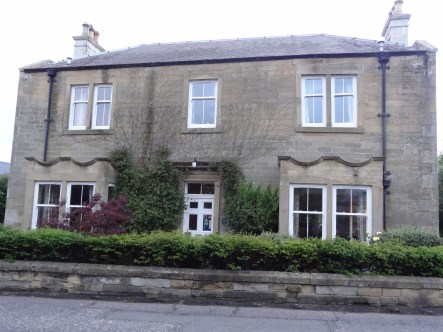
Bellevue Guest House, Kelso.
I would be remiss if I didn’t put in a plug for the guest house – Graham and his wife were super nice and helpful to me, the food was great (you can even order haggis for breakfast!) and the beds are comfortable. If you’re ever in Kelso, give it a try.
My luck was short-lived, however. My next post will detail the adventure I had catching my flight home the next day.