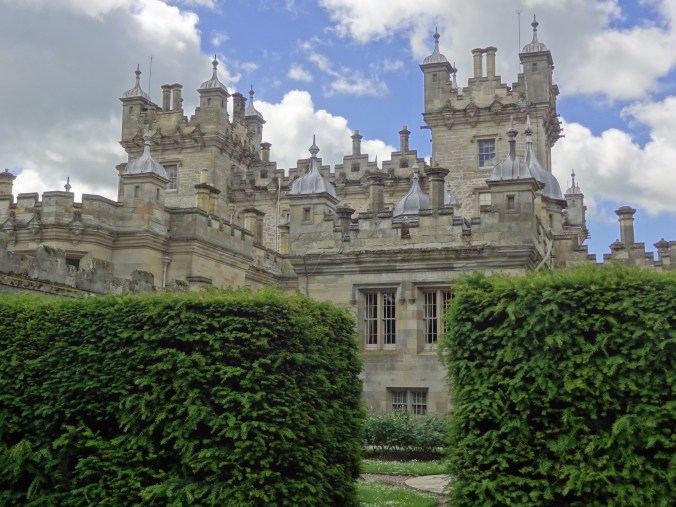
Floors Castle, Kelso, Scotland
My story about Floors Castle starts, not in Kelso, but a few months ago back on my couch in the U.S. (Yes, I’m doing it again – starting a story about Kelso someplace else.) This was before I knew about the newspaper story detailing my ancestor Isabella’s childhood in the castle and before I was convinced of my family’s ties to the castle.
I knew of rumors of the ties, so I was digging through the castle’s website when I noticed a movie had been filmed at Floors Castle, called “Greystoke: The Legend of Tarzan, Lord of the Apes” (1983).
I actually saw this movie when it came out since I am something of a Tarzan fan. (I watched way too many Johnny Weismuller Tarzan shows after school while growing up.) Plus, if you’ve read my novels, you know I have a thing for animal/human communication. But the movie was rather fuzzy in my brain since I saw it so long ago.
I decided to buy the movie for a look at the castle in preparation for my trip. When I eventually watched it (sitting on my couch), I recalled why it got panned orginally. Much of the first part of the movie features Tarzan (Christopher Lambert) grunting at apes. The critics didn’t like the lack of dialog, but hey, what are you going to do? It’s a movie about apes! Nonetheless, the movie did end up receiving three Academy Award nominations. It didn’t win any, though.
The last half of the movie is set in Scotland at Floors. My dear blogging audience, because I have no pride left, I will share my reaction to the movie with you. In short, I bawled like a baby. When the castle first appears in the opening credits and the duke and his doomed son (Tarzan’s father) race toward it on horseback, tears were coursing down my face and I didn’t know why. It’s not usual for me to burst into spontaneous copious tears at movies. I’m more of a leaky-tear-wipe-away person. And the castle scenes weren’t particularly emotional, either.
But once the movie was over, I realized the tears were from an overwhelming feeling that my ancestors loved the place and their time there.
A few months later, I found the newspaper story about how my great-great grandfather worked at the castle for over fifty years, and I decided that maybe I wasn’t so crazy after all. I mean, why would he work somewhere so long if he didn’t at least like the place and the people in it?
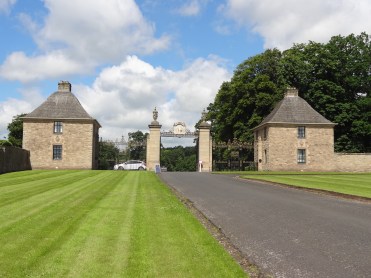
The castle gate.
My Bed and Breakfast was close enough that I could walk to Floors Castle. When I reached the gate, I asked the attendant if walkers got a reduced entrance fee, but she wasn’t buying it. 🙂
I meandered up the castle driveway with some trepidation. After all, if a movie could affect me so strongly, I wasn’t sure how I would react to seeing the real thing. This was after a search for my great-great grandfather’s gravestone at the Kelso Abbey that morning, which proved unfruitful. But I was told of another cemetery in town that I hoped to check on my next, and last day in Kelso.
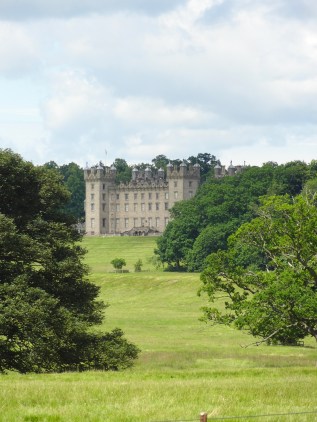 The driveway was long and lined with tall trees and rhododendrons. It wound through fields and afforded views of the castle and the River Tweed in the distance. Set on a hill above the river, the castle appears to grow directly out of the lawn. I knew from my research that, in addition to the castle tour, Floors features a gift shop and two cafes (one with an outdoor terrace), plus a walled garden. It was still early in the day and I wasn’t hungry, so I planned to tour the castle first and eat later.
Built in 1721 for the First Duke of Roxburghe, Floors Castle is still home to the Roxburghe family and the Tenth Duke of Roxburghe. It is the largest inhabited castle in Scotland but parts of it are open to the public.
As I approached, I became confused about where to enter for the castle tour. It seemed as if the signs were pointing to the castle’s front door. Surely that couldn’t be right. Tourists entering through the impressive massive intimidatingly wealthy front door? What if I was mistaken and I walked in the front door and everyone turned to look at me in horror?
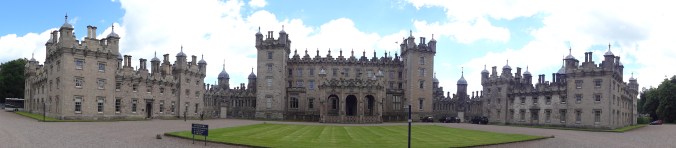
The front door. Intimidating, much?
I decided it was safer to enter the gift shop around the side of the castle first. I browsed the Floors Castle Christmas ornaments, Floors Castle honey, and Floors Castle dish towels, then asked the clerk where the entrance for the castle tours was. “The front door,” she said.
When I explained I couldn’t believe they’d let tourists in the front door she just laughed and said, “Of course, why not?”
Buoyed by newfound certainty, I walked to the front door. I did not get yelled at as I entered. Instead, the docent gave introductory remarks to the small group of us gathered in the entry, then he set us loose upon the castle. The tour is self-guided, although docents are in some of the rooms to answer questions and to ensure that nobody walks off with a priceless vase.
I wandered amid the tapestries, paintings and porcelain. There was even a room full of stuffed birds. Apparently one or two of the dukes were ornithologically inclined. One of the duchesses collected a few Matisse paintings. When I got to the dining room (which was originally a billiards room) I encountered a particularly friendly and knowledgeable docent named David.

The dining room where David and I talked. Image courtesy of Floors Castle.
I told him about my ancestral connections to the castle, and he was intrigued. He had a list of dates when the various dukes reigned, and we figured out my great-great grandfather must have worked for the sixth and seventh dukes of Roxburghe. David said a lot of building was going on during the reign of the sixth duke and that perhaps my grandfather was instrumental in it. The castle isn’t the only business on the estate, there’s also forests, fields, horses, wind farms and the like. It’s a huge operation.
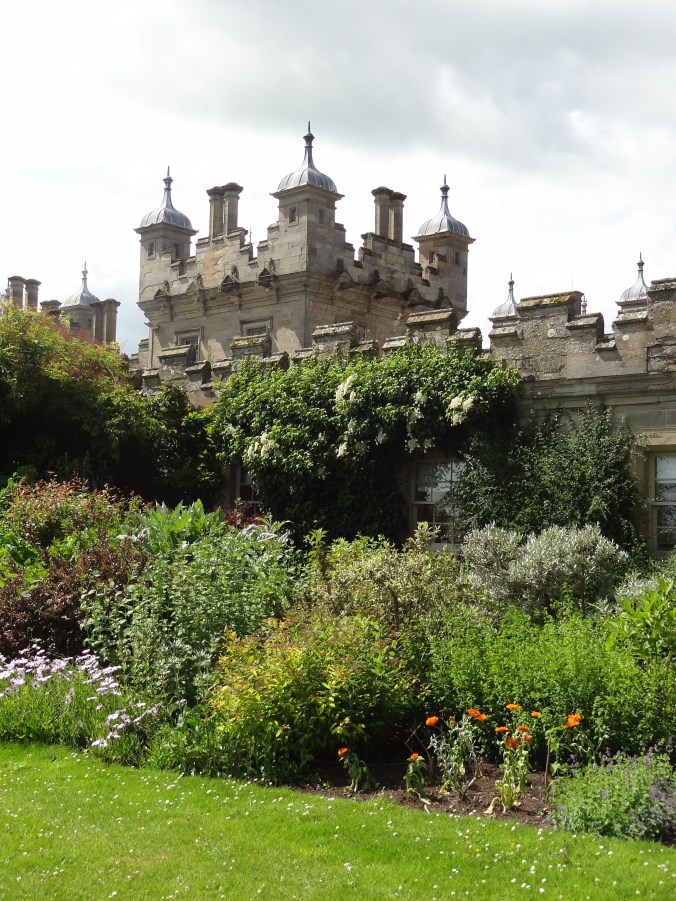 We also got to talking about the Tarzan movie. He told me he was in the movie – he played a cleric. He said the rainy scenes at the castle were shot with the help of the local fire department up on the roof, spraying “rain” with their hoses. He also mentioned that the film directors were sticklers for historical accuracy. All the television antennas on the roof had to be hidden during the day, and were put back out in the evening so the residents could watch TV.
David promised to look into some things for me. I gave him my card. As yet, I haven’t heard anything from him, but who knows? So, although I didn’t get to totally “vindicate” my ancestors’ role with the castle estate office, at least David knows about him, and my family, and all of you!
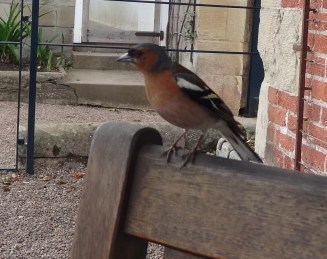
My bird friend.
By now I was hungry. Thankful that I didn’t burst into tears during my castle tour, I made my way to the terrace café. I sat outside and indulged my sweet tooth in chocolate eclairs and meringues. A friendly (and hungry) bird kept me company – reminiscent of the Kelso Welcome Swan.
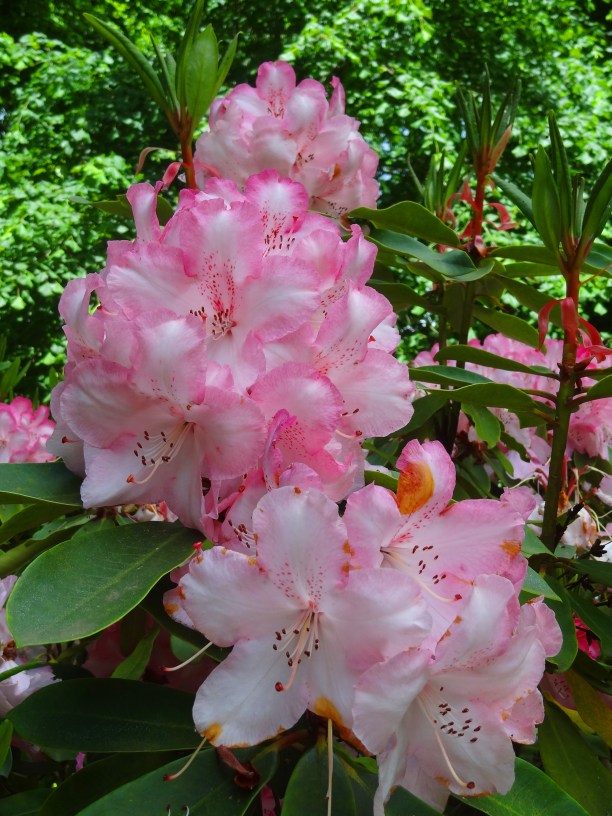
Sated and peaceful, I toured the walled gardens. But I must confess the flowers that truly impressed me were rhododendrons growing in the forest on the trail to the gardens (see photo below). After another visit to the gift shop to buy mementos, it was time to go.
As I left and walked down the drive, I couldn’t help but stop and turn back to look longingly at the castle several times. It was like the ancestors inside me didn’t want to leave just yet. I indulged them for a while, but then it was time for the next adventure.



 We found my friend’s Edinburgh lodgings for the night, then took a bus to the Royal Mile. After being in the tourist-sparse northeastern part of Scotland, seeing the crowds on the Royal Mile was a shock. The “mile” is a corridor of shops, restaurants and historic buildings that span the center of the city between Edinburgh Castle and Holyrood Palace, where the queen hangs out upon occasion.
 Was it a marketing ploy to get others to join their ranks, or a protest? I didn’t have time to find out since I had to leave for my Bed and Breakfast awaiting in Kelso. I bade my friend goodbye and was off.




 Another hike found us on the Great Glen Way above Loch Ness, making our way through primeval forests and gorse hedges with mountains in the background for accompaniment. I never got to see Loch Ness on my


 Our abode was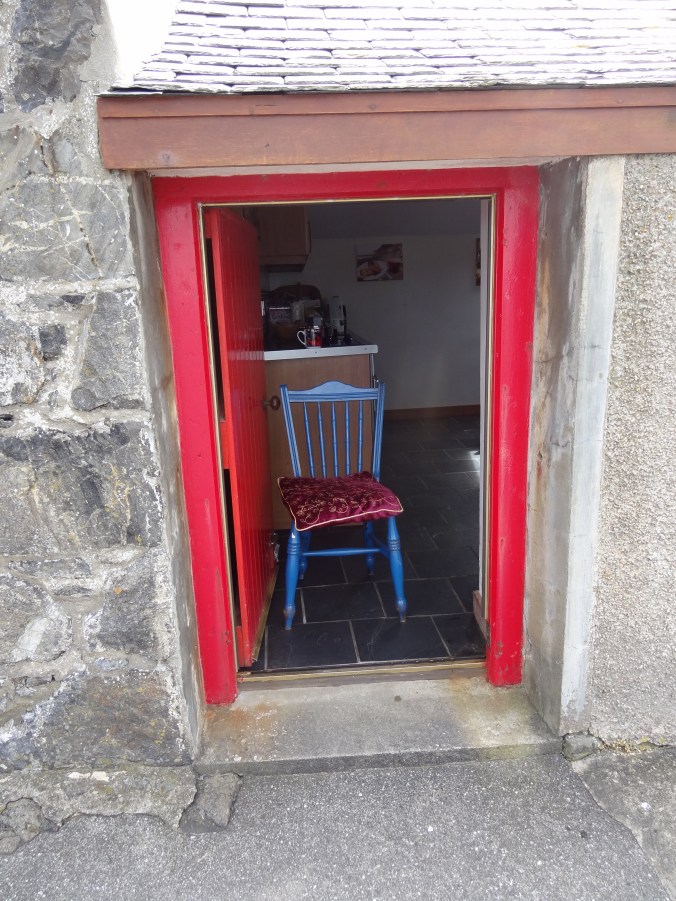

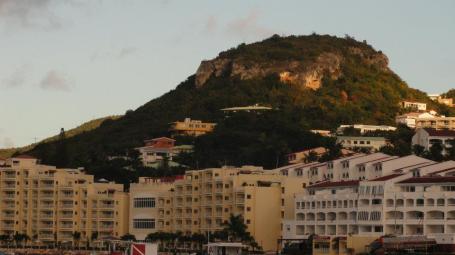
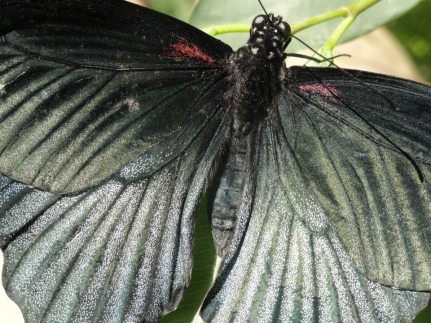 Farther inland, visitors can zipline through the jungle at a nature preserve, visit a butterfly garden and open air markets, and hike to the highest point on the island (Pic Paradise).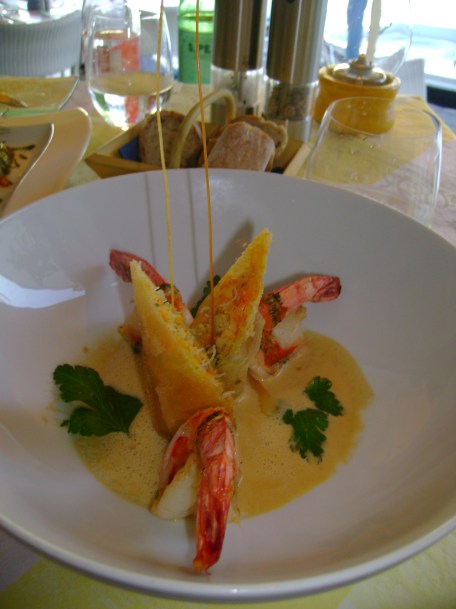
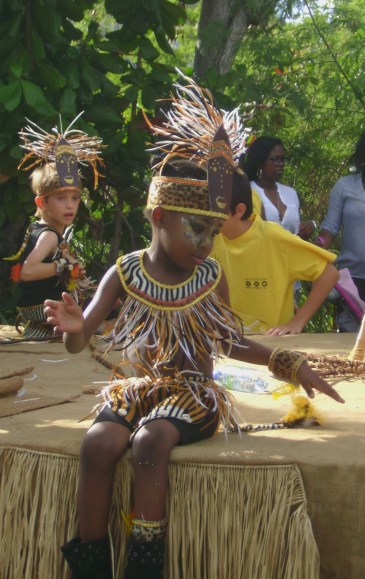 Although we ran away from the nude gay beach, we did find a nude beach suitable for the adventurous introvert. Sorry, I can’t recall the name of it now (Happy Bay?), but it lies within a gated community. A couple who were leaving through the gate were good enough to give us the entry code, and we enjoyed freeing ourselves of our swimsuits on a relatively private beach.