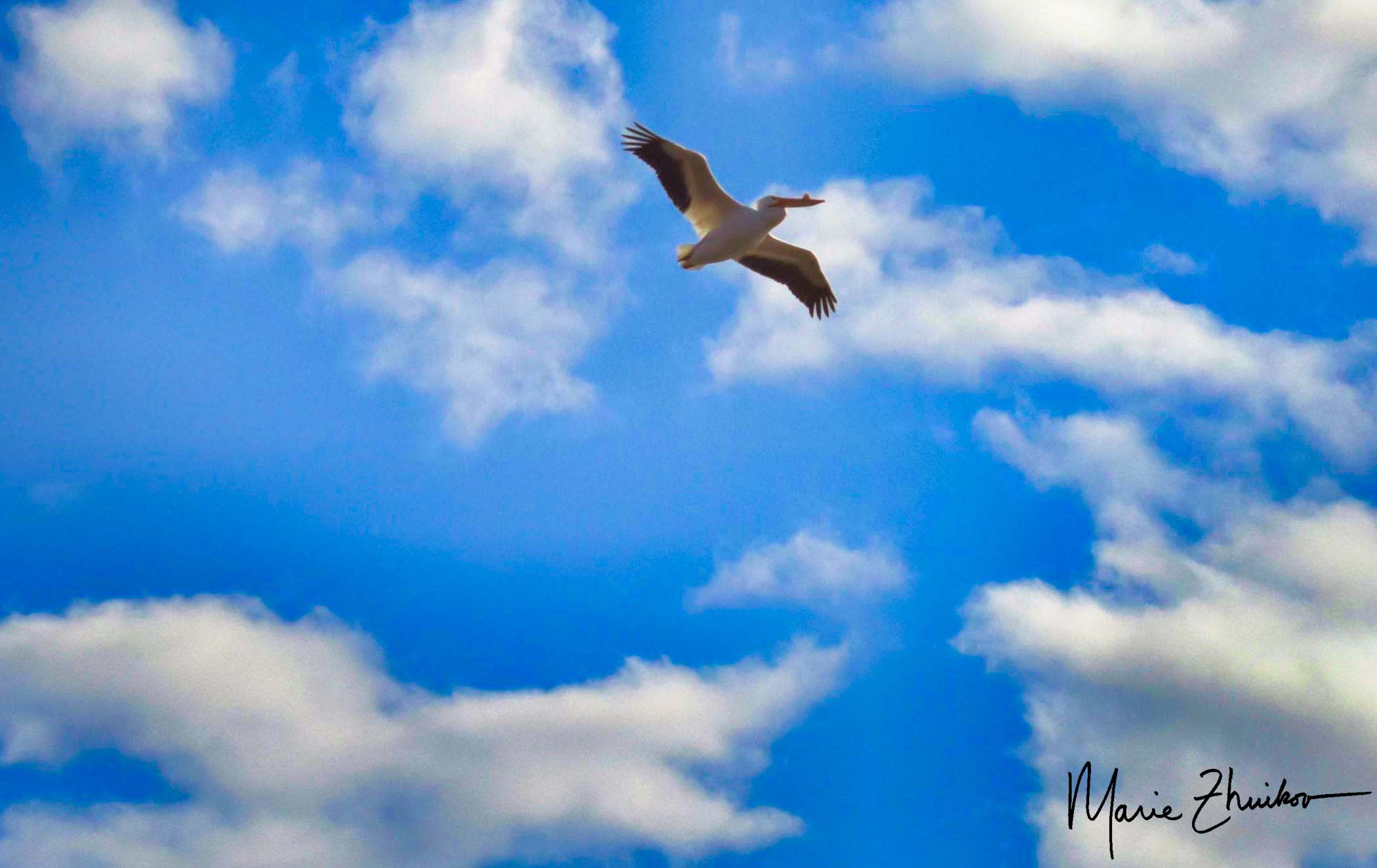
An American white pelican comes in for a landing on the St. Louis River, MN. The bump on its bill denotes that it’s a breeding bird. The bump falls off after the birds have mated and laid eggs.
Last week I took the long way home from work. My route took me past Chambers Grove Park, which is in the far western part of Duluth, along the St. Louis River. I had heard that the pelicans were back, resting there on a stopover during their migration north, and I wanted to see them.
I brought my camera in case the birds were close enough for me to photograph. Alas, the experience reinforced my thought that I really need to buy a more powerful telephoto lens! Also, the light was right in my face, harsh and white, fading out everything on the far side of the river where the pelicans rested.
Luckily, a few were flying around, and I was able to get at least one good shot.
According to the Duluth News Tribune, pelicans were “virtually unseen in Minnesota between the late 1800s and 1960s. Fishermen destroyed them out of the erroneous belief that they competed for game fish, and pesticides took a toll.” They mostly prefer nongame fish and do not compete with anglers.
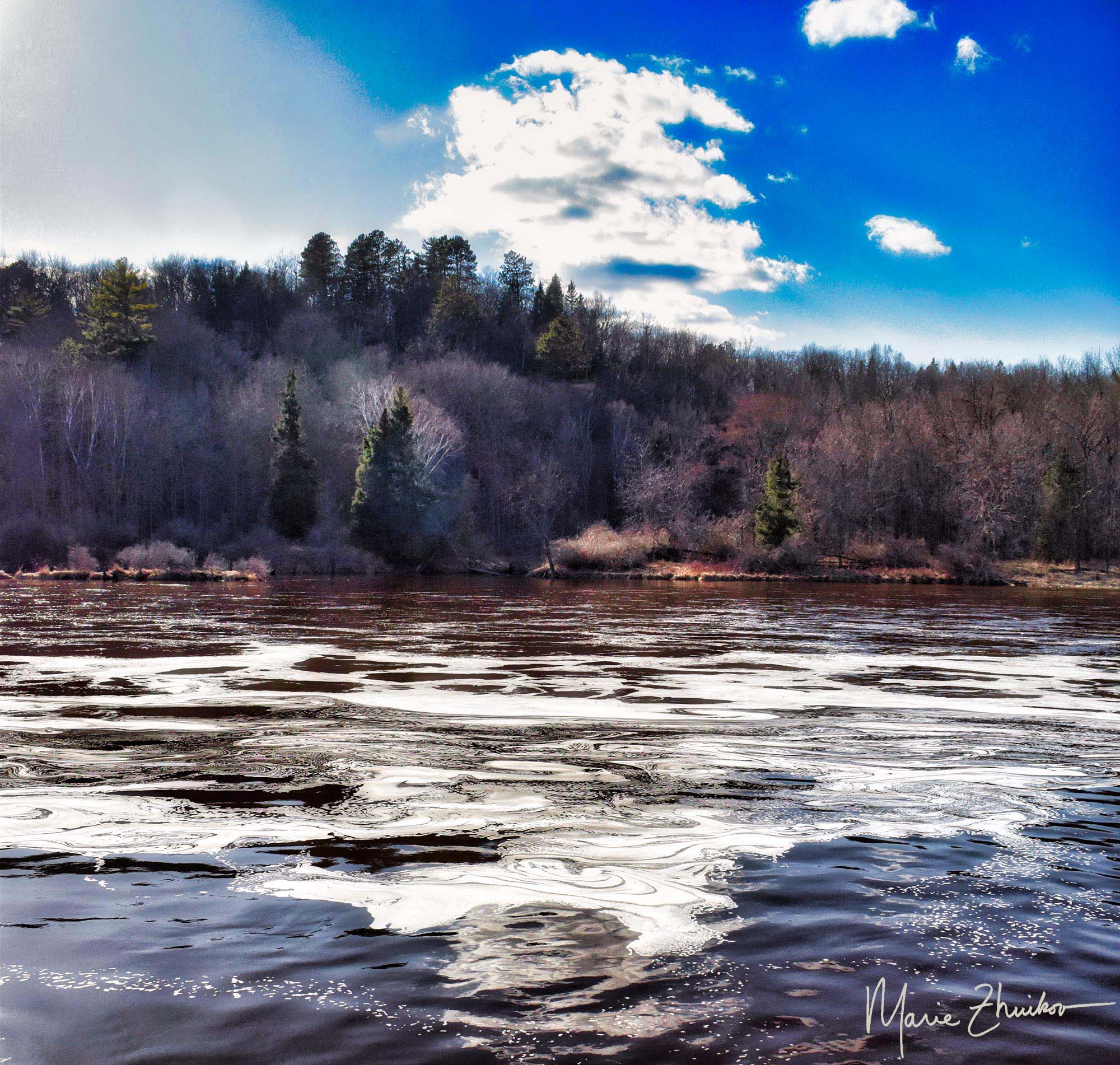
No pelicans in this shot (but they are nearby). I just liked the cloud and water patterns. St. Louis River, MN.
Thanks to environmental reforms and protection, their numbers have recovered. Minnesota boasts one of the largest populations of nesting white pelicans in the world. I thought I’d share my photos from my sojourn with you.
If you’d like to see some better, close-up images of the birds, please visit Richard Hoeg’s blog, “365 Days of Birds” for some great shots.
Despite the snow we’ve been having lately, their presence is a sure sign that spring is coming.
We’re in that awkward and dreary “shoulder season” when the snow conditions are too crappy for skiing but it’s still too cold to bicycle or do anything else outside. The trees are bare, what little grass is showing amid the snow piles is brown. It was time to explore somewhere new indoors. So, Russ and I meandered north to the largest museum complex outside of the Twin Cities.
It’s had several names since it opened in 1977 near Chisholm in northern Minnesota. First it was the Iron Range Interpretive Center, then Iron World USA, and now it’s the Minnesota Discovery Center.
Perched near a defunct open pit mine and atop underground mine shafts, the Minnesota Discovery Center tells the story of the Iron Range through exhibits, interpretation, programming, and research materials. It highlights the story of the immigrants who migrated to the Iron Range (or the Iron Ridge, as President George W. Bush once mistakenly said during a campaign speech in Duluth). The immigrants came at the turn of the 20th century to find work in the iron ore industry. Native Americans are also featured.
Apparently, everyone else was holed up in their homes because we had the place almost to ourselves on a Saturday afternoon. We were able to wander through the exhibits totally unimpeded. So unimpeded that when Russ saw a person standing in front of an exhibit, he mistook it for a mannequin until it moved!
The lower level of the center features exhibits about the immigrants’ journey to the United States, examples of what a schoolroom and a saloon were like, and information about conditions of the land farther back in time – geology and fossils.
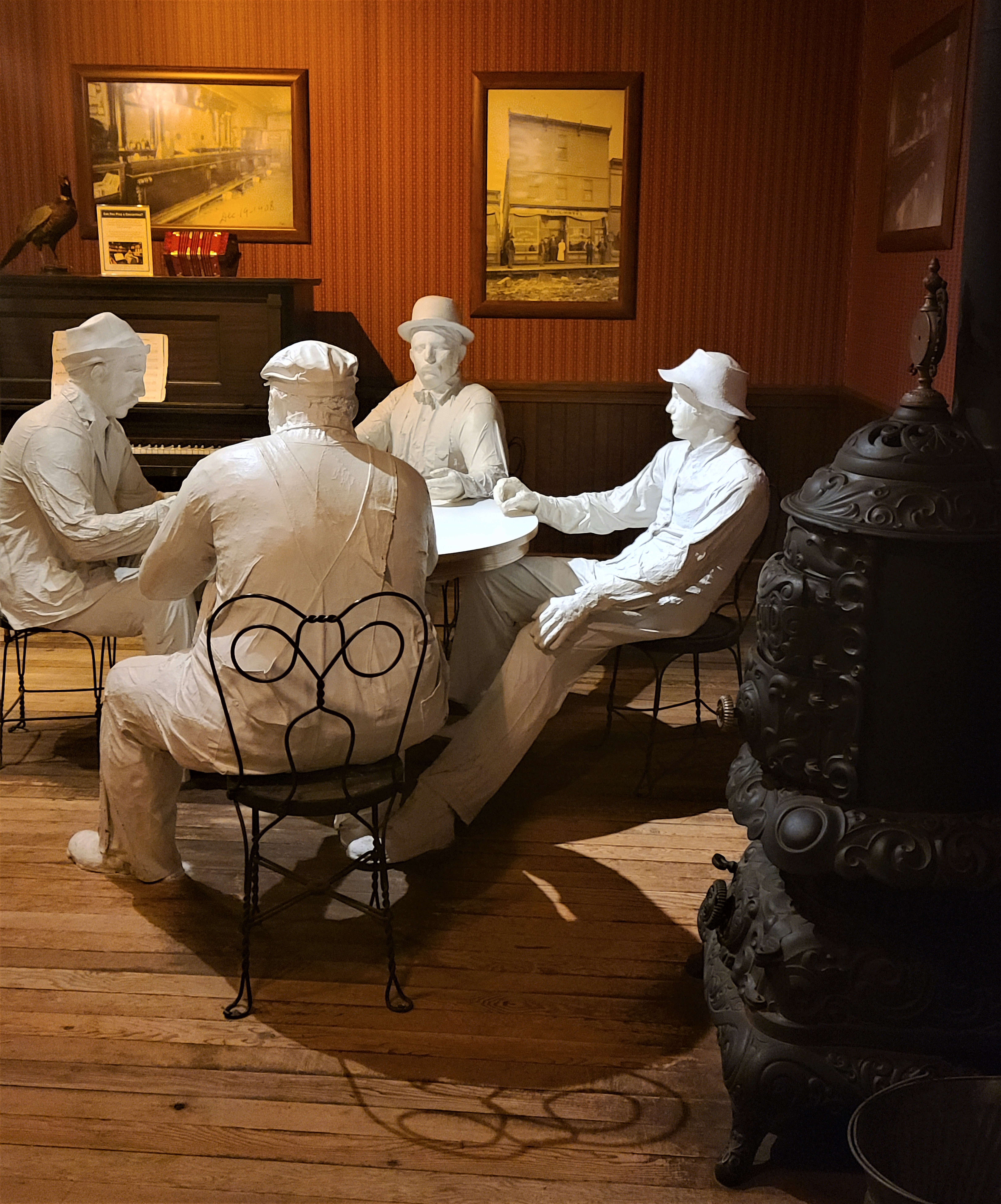
The saloon
I must have been feeling lonely because my favorite exhibit was the replica saloon, complete with mannequins who were playing cards and standing at the bar. Back in the day in the nearby town of Hibbing, there were 6 dry goods stores, 12 general stores, and 45 saloons! People had their priorities and it wasn’t churches back then. Saloons were social centers where miners shared the news of the day, had a drink, and spent time with each other.

Both floors of the center offer views of the Glen Mine Pit, but I chose to look from the second floor. The open pit mine was closed in 1957 and trees have started to reclaim its banks. The second floor also features a movie theater. With the push of a button, Russ and I had our own private showing of the documentary, “Iron Range: Minnesota Building America.” This floor also provides access to a research center.
The Glen Mine Pit
The discovery center’s restaurant is closed for the season, but their gift shop is open. During summer, they offer trolley tours of the grounds, plus there’s a mountain bike park that opens in mid- to late-May and a mini-golf course. I’m sure it must be a busier place in summer.
As we left, the staff at the reception desk were marveling at the “crowds” that were visiting the center. One exclaimed, “There were four people in here already and we just got eight more!”
They were serious.
Russ and I just gave each other a look and chuckled.
If you’re still social distancing due to the pandemic, this is the place for you. But if you get too lonely, you can at least socialize with the saloon mannequins.
The weather is still wintry here in the North – stubborn snow piles linger, and more snow is falling as I type this. A few days have been warm enough to provide a hint of spring, but today is not one of them. Everyone is bundled back up in their puffy jackets and boots. A perfect time for a bowl of thick, creamy goodness.
This is a recipe I saved from our local newspaper. It was originally written by Bea Ojakangas, Duluth’s Scandinavian version of Julia Childs. I have modified it over the years to make it wheat- and corn-free, plus I’ve changed some of the spices more to my liking. If you want to make it with wheat, the original flour measurements are included. If you want corn, simply add a can of corn when you add the beans. Instead of cream, I prefer evaporated milk because cream is just too rich for me these days. This makes 4-6 servings.
Bon appetit!
White Chicken Chili (Wheat- and Corn-Free)
½ lb butter 1 T chopped garlic (or ½ tsp dried minced garlic) 2 lbs chopped chicken or 2-10 oz cans of chicken 2 cups white onion, cut in large chunks (one large onion) ¾ cp gluten free all-purpose flour (or ½ cup regular flour) 2 tsp cumin sprinkle of chili powder salt to taste (I use 1-1/2 tsp sea salt) pepper 4 cups chicken broth (I use Imagine organic vegetarian no-chicken broth) 1 pint cream (or 1 can evaporated milk) 2 cups cooked navy beans (1 can beans)
Melt the butter in a large saucepan. Add garlic and cook until it starts to brown, stirring occasionally. Add the chicken and onion and stir together. Slowly add the flour to absorb the butter. Add the cumin, chili powder, salt, pepper, and broth. Simmer approximately a half-hour. Add evaporated milk (cream) and beans. Simmer another 15 mins.
Serve topped with sour cream, shredded white cheese and chopped parsley, if desired.
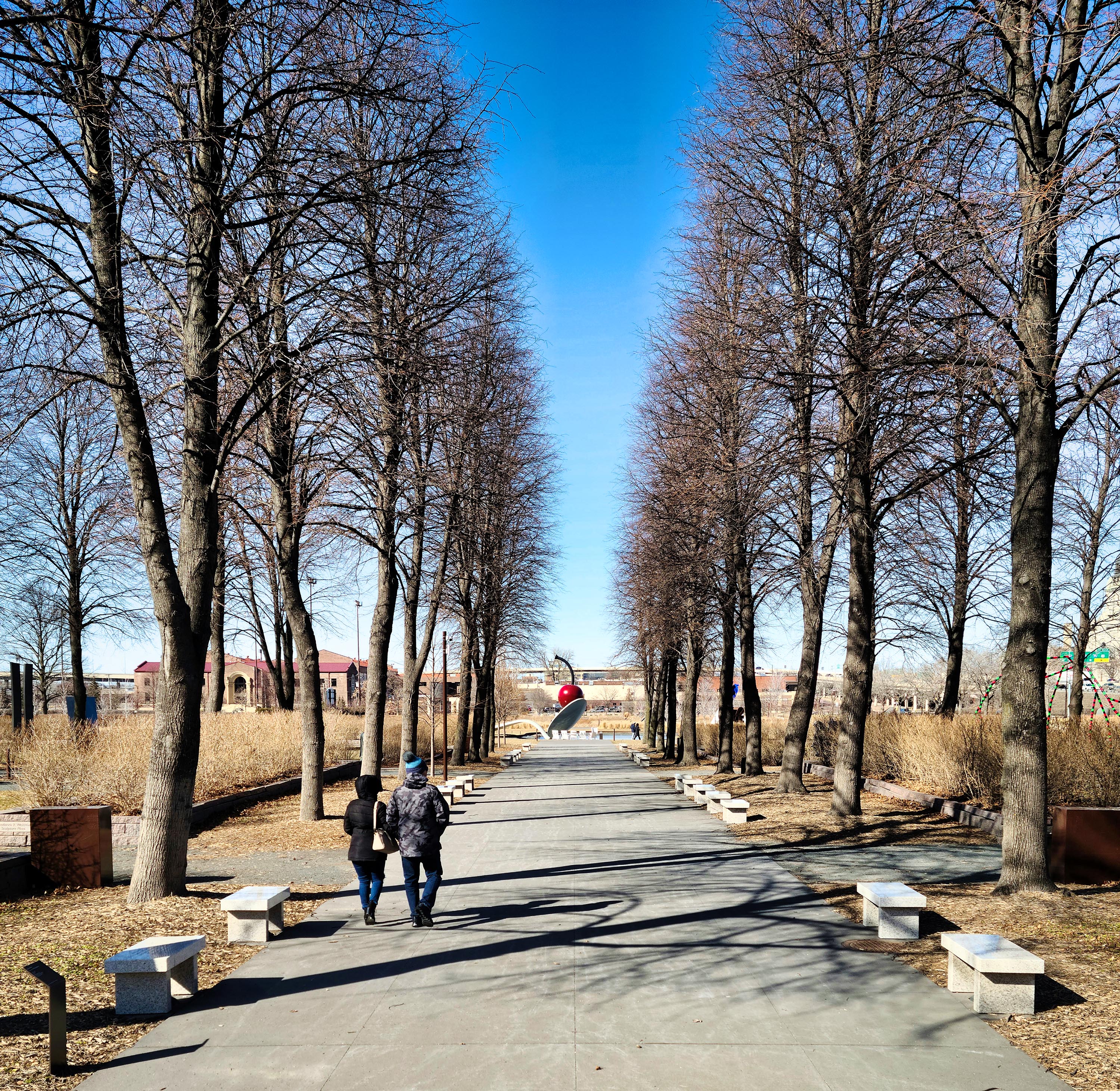
The walkway toward the “Spoonbridge and Cherry” sculpture in the Minneapolis Sculpture Garden.
My aunt is 101 years “old” and lives in St. Paul. I know, one-hundred-and-one, amazing! She’s my inspiration for aging well. She still resides in her own condo and is fairly self-sufficient. She’s cared for by my cousin.
Sometimes my cousin has other things she needs to do, so friends from the condo building or my relatives in the Twin Cities step in and visit my aunt in her stead.
The other weekend was one of those times for us to help. We needed to be at my aunt’s place early in the morning, so Russ and I meandered down from Duluth the night before. To make the trip more fun, we booked a stay in a bed and breakfast in an historic mansion near the Walker Arts Center in Minneapolis. We’d never been to the center or the sculpture garden near it, so this trip was going to fulfill those cultural deficits as well as getting in an Aunt Marguerite visit.
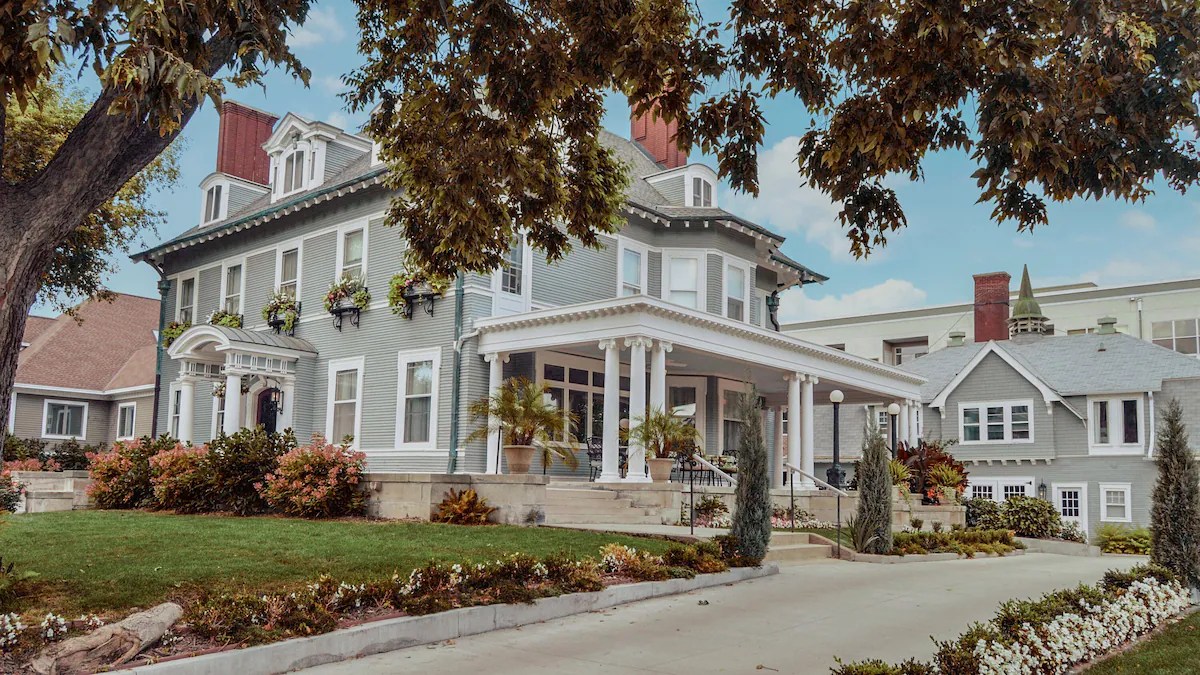
We booked a room in the carriage house of 300 Clifton, also known as the Eugene J. Carpenter Mansion. Carpenter was a lumber baron who totally overhauled the Queen Anne-style home, complete with turrets and gables, into a more rectangular Georgian-style mansion after purchasing it about a hundred years ago.
300 Clifton. The carriage house where we stayed is on the right. Image courtesy of 300 Clifton.
As we checked into the big house, we were greeted by the two resident great danes, Madonna and her grandson Clifton. I thought Madonna was big, but Clifton was even taller – his head came to about the middle of my chest and I’m 5-6. After the requisite petting and ear rubbing (I found the spot on Clifton that made him groan) the two mellow dogs returned to their spots by the hearth in the library.
Sorry, I have no pictures of the dogs. I was too busy petting them.
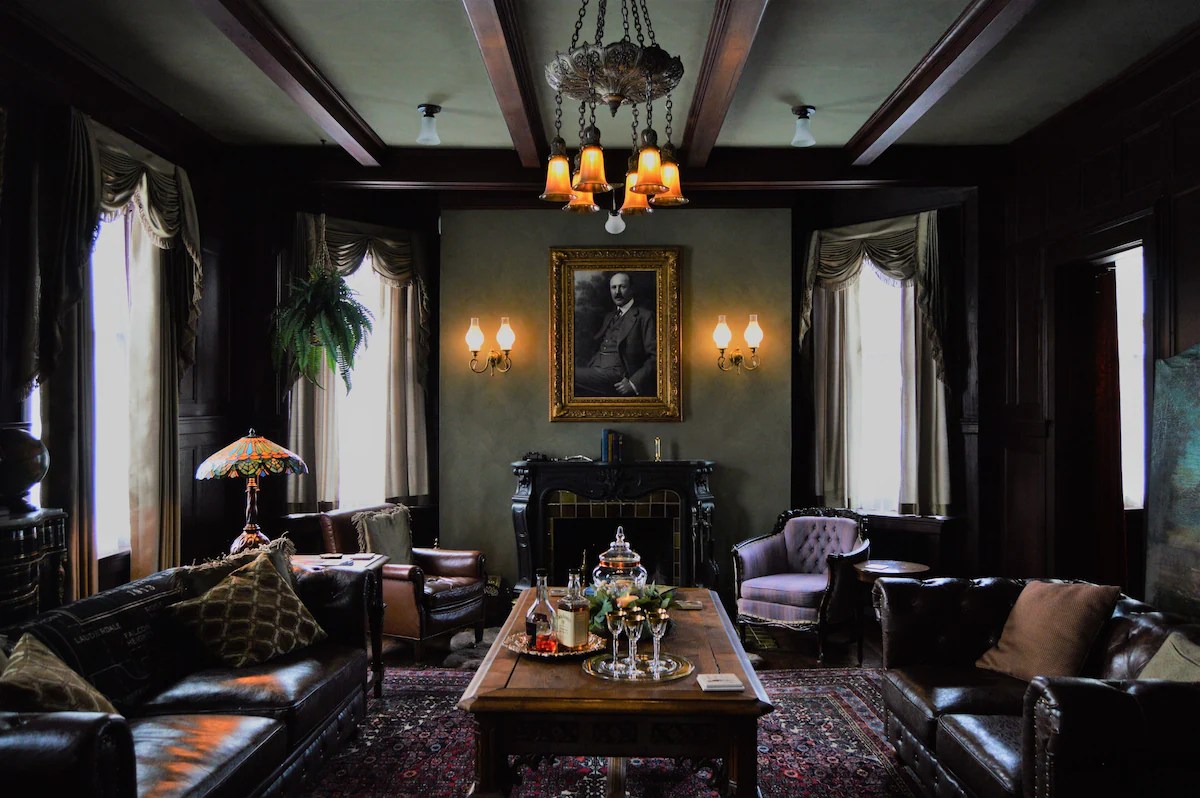
The Library. Imagine one great dane on either side of the fireplace. Image courtesy of 300 Clifton.
We were oriented by a knowledgeable young man who’s been working at the mansion for eight years. He told us the Carpenters were instrumental in creating the Minneapolis Institute of Art (MIA). At that point, we decided not to tell him about our desire to see the Walker Arts Center (we’d already seen the MIA). As it turns out, that might have been a good call. Later, reading an information sheet in our room, we found out that the Walker was established by someone who got disillusioned with the MIA project, a competitor of the Carpenters. I expect a rivalry must still exist between the two institutions to this day.
The nice young man (it’s so typical that we know the dogs’ names but not the human’s name!) took us back outside, past the large courtyard with a fountain and gardens, and showed us our room in the carriage house, explaining this was where all the men on the household staff slept because the Carpenters had a daughter they didn’t want sullied by male influences.
The ground level of the carriage house contains an antique taxi, a pool table, big-screen television, and arcade games. The building originally housed horses but then was renovated for cars. The floor even sports the original turntable used to point cars in the right direction for storage. Sleeping rooms are on the upper floor.

The antique pedestal sink in our room.
Our room was small, but totally adequate – full of nooks and crannies that you just don’t get in a modern hotel room, not to mention the Tiffany-style dragonfly lamp. Our room didn’t have the sound proofing you’d find in a modern building, but that is really the only criticism we have.
Once unpacked, we dropped back into the main house to explore its three floors. The interior is arts and craft style. It contains little of the original furnishings because it was made into a boarding house and offices in the past. However, there is a Georgian Room in the MIA that holds original furniture from the home and pieces collected by Carpenter during his travels.
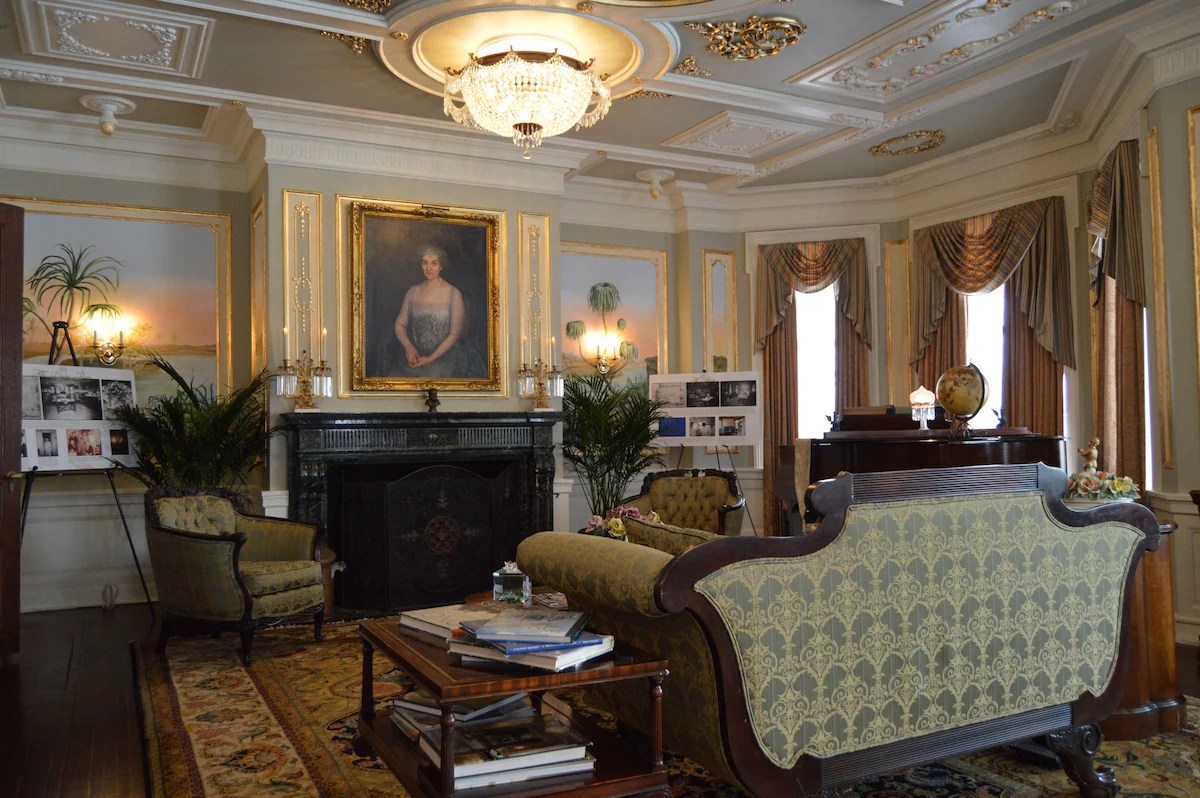
The library (with its hearth and great danes) features original sconces that were moved from elsewhere in the house. The dining room sports an impressive painted ceiling. The music room, done in muted greens, feels like a place too nice for the likes of us to hang out.
The Music Room at 300 Clifton. Image courtesy of 300 Clifton.
The main staircase reminds me of the one in Duluth’s Glensheen Mansion, but it didn’t have the impressive window art found in Glensheen. The top floor features modern skylights and plants everywhere, including historic images and interpretive text.
Explorations over, we returned to our cozy room and slept while the wind whipped through the city, rattling the windowpanes.
The next morning, we ate our continental breakfast in the impressive dining room. If a person wants to spend $99 more, you can get a four-course breakfast, but we didn’t need that since we were going out for lunch with my aunt and cousin later that day.
We made it to my aunt’s and had a great visit. She brought out some of her old scrapbooks and we took trips down memory lane, which included some highly unflattering class photos of me in junior high, which made Russ laugh.
After lunch at the Tavern Grill in Arden Hills (delish!), we drove back in the direction of our bed and breakfast, which was three blocks away from the Walker Art Center. We could have parked at the B&B and walked to the art center, but a cold wind was still blowing, so we wimped out and parked at the center.
I really wanted to “walk to the Walker” because I like the sound of it, but it was not to be. Sorry for misleading everyone with the title of this post. I know, false advertising! (I’m just seeing if you are paying attention.) But, if you ever stay at 300 Clifton, be aware of this option.
Right now, entrance fees for the Walker are half-priced because many of their displays are closed for renovation, but there was plenty still there to keep us occupied for an hour-and-a-half. I especially enjoyed seeing an Edward Hopper painting (Office at Night) and an Andy Warhol (Sixteen Jackies). Some of the other art just made me scratch my head.
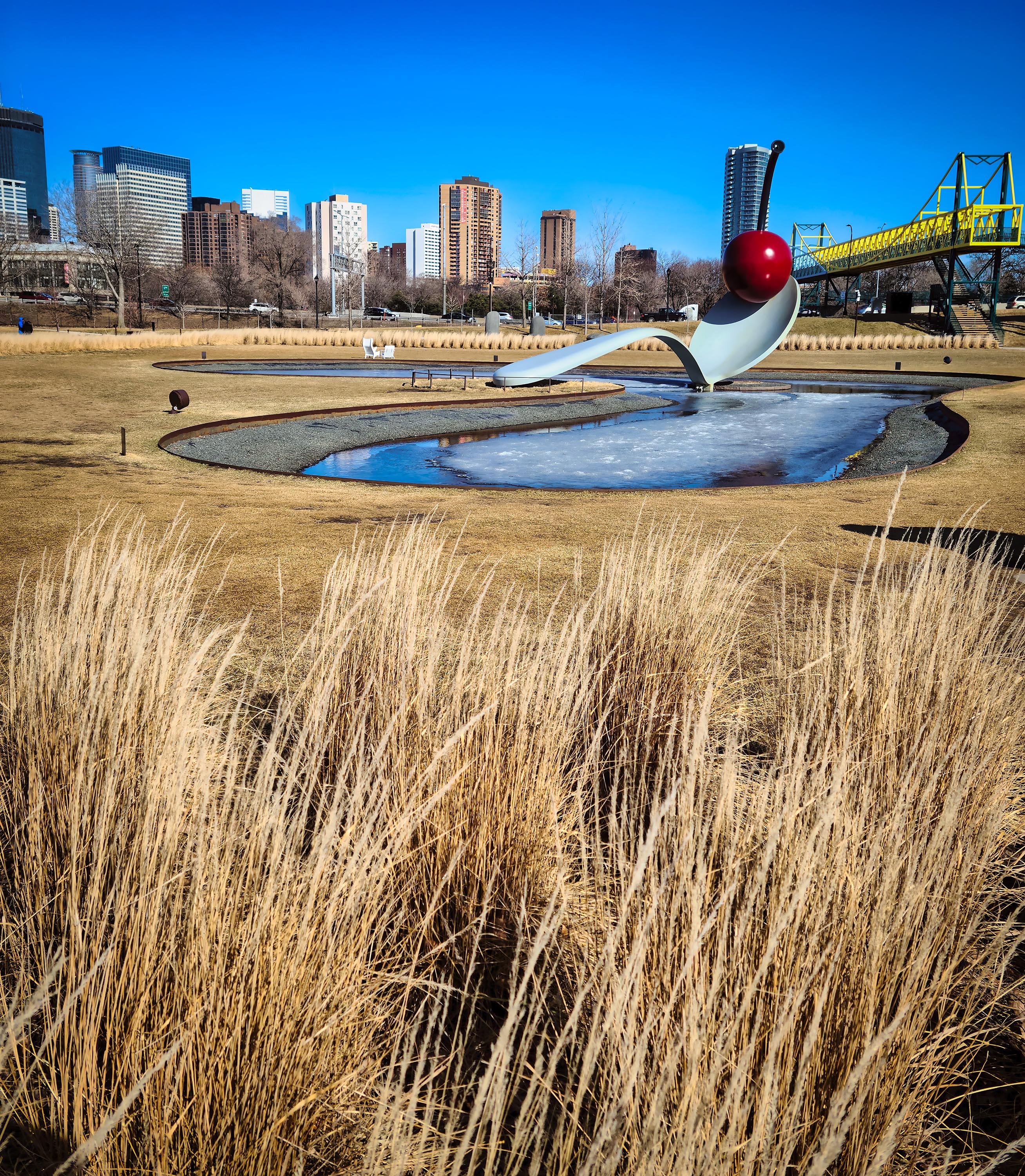
The bright sun made our quick walk in the sculpture garden across the street bearable despite the wind. We had watched television news stories with interest when the cherry from the iconic Spoonbridge and Cherry sculpture had been separated from its spoon and hauled to New York for cleaning earlier this year. The cherry is now back.
Spoonbridge and Cherry sculpture.
The fifty-foot sculpture is synonymous with the identity of Minneapolis. It was created in 1988 by Claes Oldenburg and Coosje van Bruggen a husband and wife team from Sweden and the Netherlands. It was inspired by a novelty item that Oldenburg collected, which featured a spoon resting on an “island” of plastic chocolate. The sign at the site says, “From this, the artists envisioned a gigantic utensil as a fanciful bridge over a pond. In considering Minnesota as a site, they compared the spoon’s raised bowl to a prow of a Viking ship or a duck bobbing in a lake. Van Bruggen added the cherry, a personal symbol recalling happy moments in a childhood clouded by World War II.”
The sculpture from another angle.Prow of a Viking ship or bobbing duck? You decide.
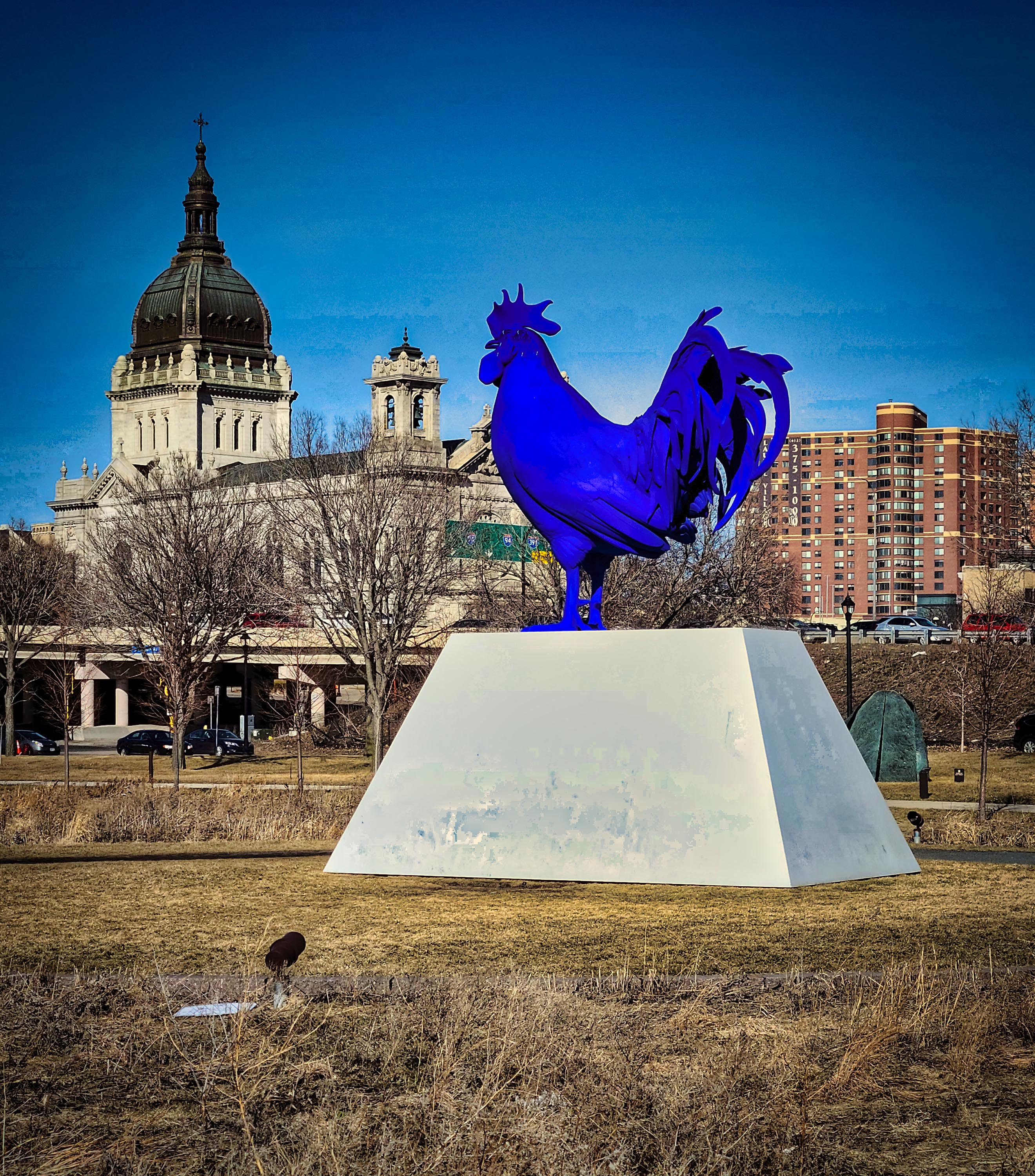
The cherry was the first sculpture added to the garden, but there are many others, including a bright blue rooster, which also caught our attention. The rooster is called Hahn/Cock, created by Katharina Fritsch from Germany and it towers twenty-five feet over the garden.
Its sign says, “The rooster can be a symbol of pride, power and courage, or posturing and macho prowess. Fritsch has admitted that she enjoys ‘games with language,’ and the sculpture’s tongue-in-cheek title knowingly plays on its double meaning. Like Spoonbridge and Cherry, Hahn/Cock presents an unexpected take on the idea of a traditional public monument. Together, these two landmarks show how ordinary objects can become iconic and deeply symbolic.”
The Hahn/Cock sculpture.
If you’re ever in Minneapolis, the sculpture garden is a must-see! Access to it is free and open to the public. You don’t need to walk to the Walker to see it.
This is a post I wrote for work, but I thought you might enjoy it, too. During the latest St. Louis River Summit, I had the chance to meander over to the library in Superior, Wisconsin, for field trip . . . .
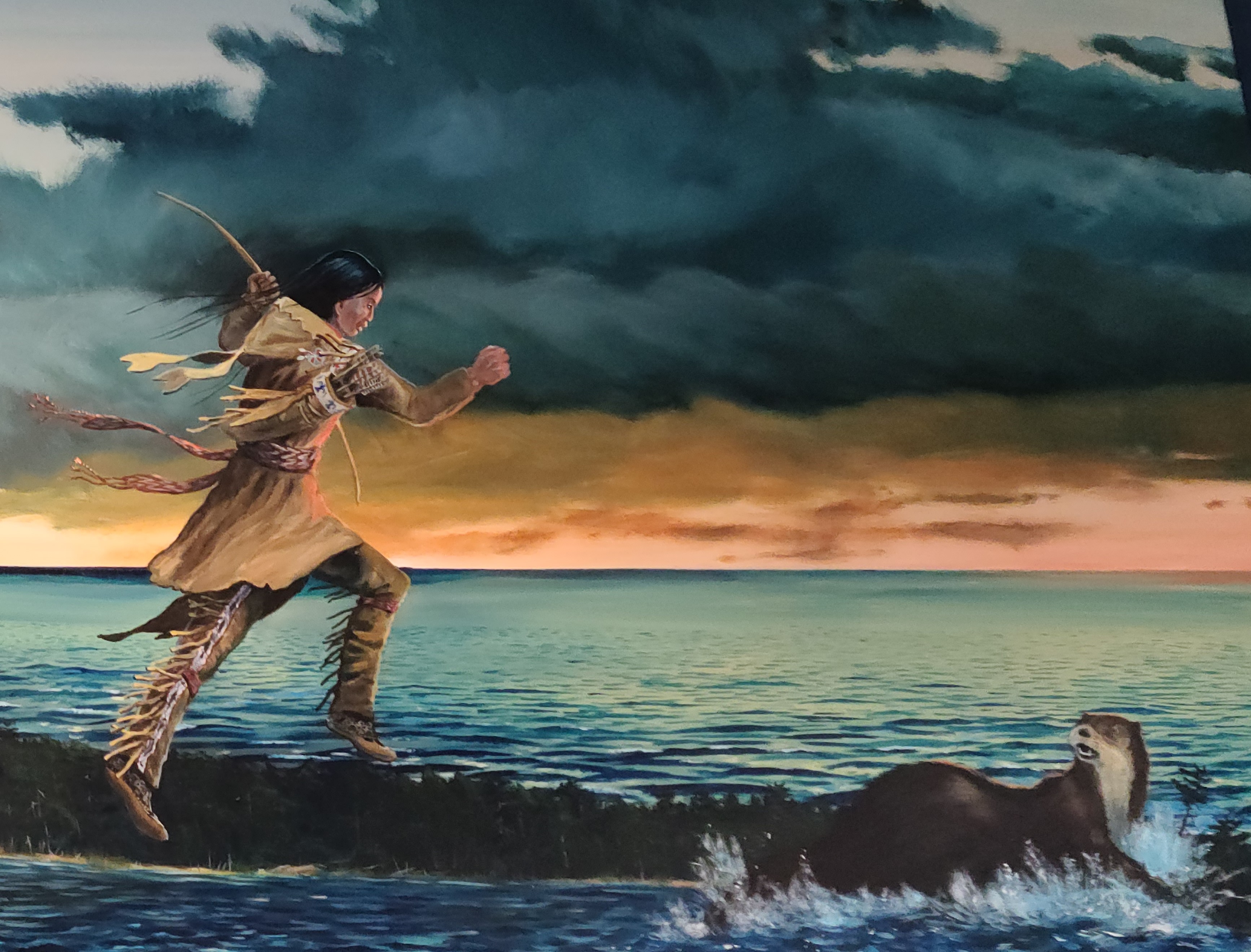
Mural #2 in the Superior Public Library by Carl Gawboy. It shows the area where the Ojibwe people settled on Wisconsin and Minnesota points on Lake Superior and how the points were separated by a giant otter. Image taken with permission by Marie Zhuikov, Wisconsin Sea Grant.
What’s in a library that could relate to a river summit? A series of 35 murals line the Superior Public Library walls, showing the history of the area. Many feature the St. Louis River, Duluth-Superior Harbor and Lake Superior.
The murals were painted over 10 years by artist Carl Gawboy, an Elder enrolled in the Bois Fort Band of Chippewa. The murals begin with the Ojibwe creation story and continue through the 20th century, reflecting how people have interacted with the landscape through time.
Local historian and retired librarian Teddie Meronek led the tour. “I like to say I was here at the birth of the murals, but that started long before any paint went on canvas,” Meronek said. She described how Paul Gaboriault, the library director who commissioned the murals, was a former co-worker of Gawboy’s. Gawboy was born in Cloquet, Minnesota, and grew up on a family farm outside of Ely. He eventually taught at Ely High School, which is where he met Gaboriault. The friends both ended up back in the Twin Ports.
To research the murals, Meronek studied Gaboriault’s and Gawboy’s correspondence. She said the library used to be a Super One grocery store. “If you really look at this building it was just a big warehouse. It wasn’t built for a library. Dr. Gaboriault knew, in his way, that it needed something, and the first thing he thought of were murals.”
The second mural in the series shows the story of how the Superior Harbor opening was created through Wisconsin Point. A giant otter digs as a Native man approaches.
“The great otter represents the Ojibwe religion,” Meronek said. “He is breaking an entryway from Lake Superior into the harbor. The human figure is Nanabozho. He is bringing arts and fire to the land. That was Carl’s interpretation of the legend. The otter is pictured as being so large because it’s representing power.”
According to Gawboy, Lake Superior ties all the murals together, Meronek said. “You can’t always see it in every mural but it’s there. It influences what is going on, which is very true. I’ve lived three blocks from the bay of Lake Superior every day of my life and I can tell you there’s not a day that goes by that the lake doesn’t influence you in some way.”
The location of the horizon line also links the paintings. Meronek said it’s in the same place in each image. As she walked past the murals, she described each one, sharing her impressive knowledge of local history along with personal observations. Other murals include notable buildings and personages, as well as historic events.
Meronek ended the tour on a somber note at a mural of the Edmund Fitzgerald. She often listens to Gordon Lightfoot’s song about the ill-fated ship. “There’s one line in it that always makes me cry: ‘Does anyone know where the love of God goes when the waves turn the minutes to hours.’ Always beware of Lake Superior, right? I can’t even put my foot in it, it’s too cold! What a beautiful thing though, isn’t it? It’s the greatest of the Great Lakes, right? An inland ocean.”
If you’re ever in Superior, stop in the library and take a look. Of course, if you’re not a Superior resident, you can’t check out a book, but you can check out the murals, so to speak. Not planning a visit soon? You can also see the murals online.
Nodin Press in Minneapolis is planning on publishing a book of the “best” posts from this very blog. The process received a boost yesterday when I learned I received a grant from the Arrowhead Regional Arts Commission to pay for the book’s editing. I’ve received plenty of grants through my Sea Grant work before but this is my first personal arts grant, so I’m pretty psyched.
As planned at this point, my “Meander North” book will be arranged by season and will celebrate all things northern Minnesotan. Plus, bonus chapters will relate to bookish adventures and brushes with fame. There will also be some content you haven’t seen before. When asked what genre it is, I answer that it will be a blogmoir (blog memoir).
Thank you, Arrowhead Regional Arts Commission, for the grant and for all the work you do to support artists and writers in this neck of the woods!
In my childhood home, my father would sit in front of his ham radio microphone, sending out his call sign to the world. His call letters were W0RXL, which in amateur-radio-speak equate to Whisky, Zero, Romeo, Xray, Lima. (I use the version of “whisky” without the e to honor my Scottish heritage.)
Those of you who have been following my blog for years may remember that my father’s ham radio hobby meant so much to him, we even buried his cremains inside one piece of his radio equipment.
When his call sign made it into some other ham radio operator’s ears in some far-flung place, they would tell each other a bit about themselves and where they lived. My ears would prick up whenever I heard him mention that he had a daughter named Marie. Sometimes he would tell jokes.
I’m not sure how this worked, but apparently, they would even exchange addresses and send each other postcards with their call signs on them. Since my father was also a stamp collector, this transaction did double duty, serving that hobby as well as documenting his contacts across the world.
I swear, he talked more to these strangers than he did to his friends. By eavesdropping on his radio conversations, I learned more about him than I did from our dinner table conversations, which were mainly led by my mother.
Some ham radio operators he contacted regularly. Some he became friends with. I remember we even met a few of them during our road trips across America and Canada when I was young.
The other day, it struck me how much blogging is like amateur radio. We blog authors post our words for anyone in the world to read much like ham radio operators send out their call signs. I’m always amazed how many people from other countries access “Marie’s Meanderings.”
Several bloggers I consider friends and would love to meet with them if I was ever in their necks of the world.
Word Press offers a way to look at what countries have accessed blogs over different time periods. Just for fun, I looked at the stats for countries since I began my blog. Readers from everywhere but a few places in central Africa and islands north of Norway, plus Tajikistan have clicked on my blog at least once. Maybe those places are without internet access.
Not surprisingly, English-speaking countries have the most hits (the U.S., the U.K., Canada, India, and Australia). The country with a foreign language that has the most hits is Singapore, but even so, I guess about half of its citizens speak English at home.
I suppose the comments people leave on my blog (which I appreciate, by the way!) are similar to the postcards my father used to receive. And I suppose if my sons read my blog, they would learn things about introverted me they didn’t know before. I honestly don’t know if they read it. I’m afraid to ask. If they said no, I’d have a hard time with that. Then again, they each have busy lives. Besides, I’m just their mom! What interesting things could I possibly have to say? 😊
Recently, I learned of a new hobby that’s gaining in popularity. It’s called Postcrossing. One of my coworkers participates in it. It’s a project that allows people to send and receive postcards from random people across the world. It reminds me of my father’s hobby, and I bet he would have loved this service.
Through thinking about the similarities in amateur radio and blogging, I’ve come to realize I might be more like my father than I ever suspected. And maybe that’s not such a bad thing.
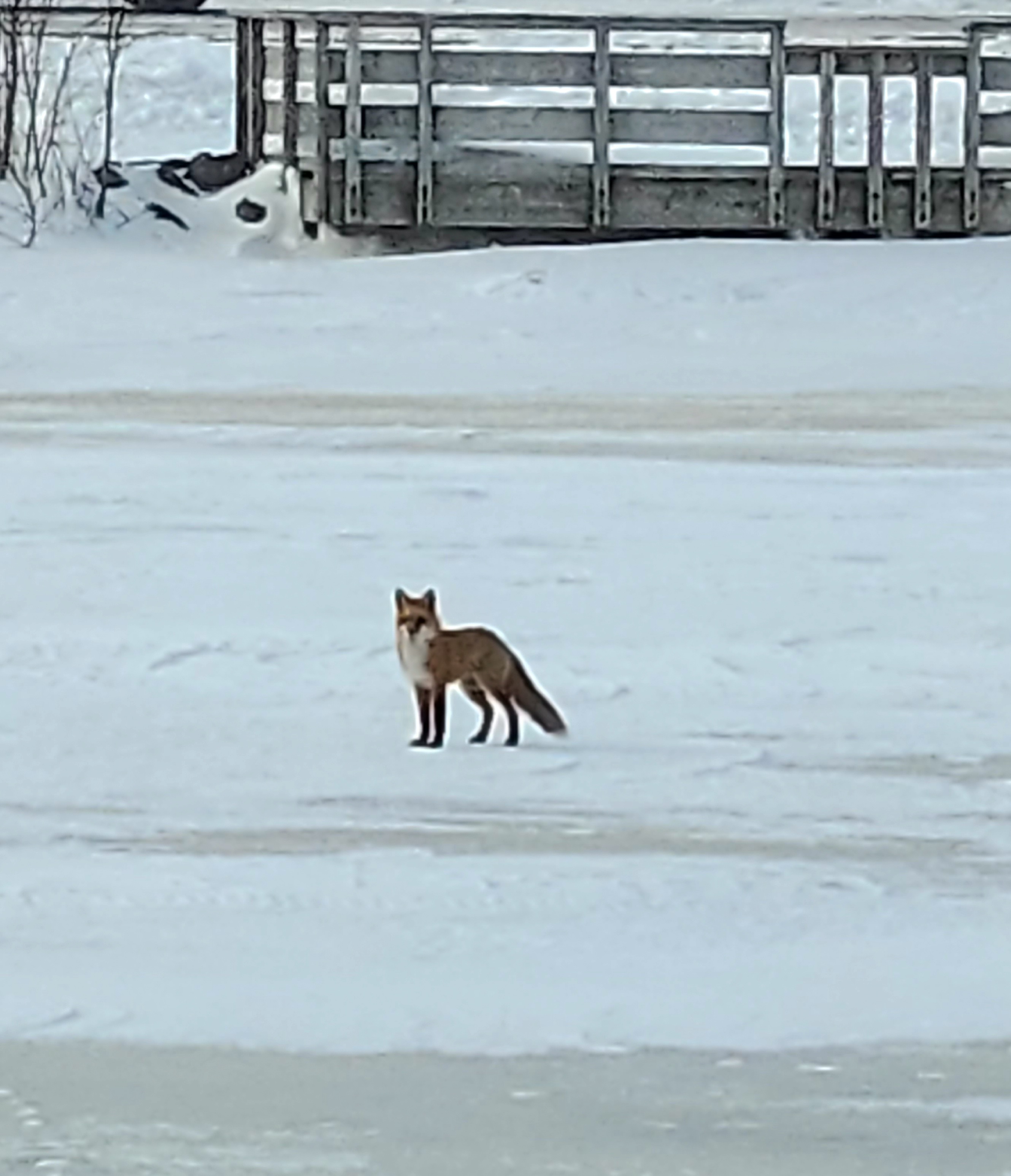
The curious fox after I crouched down. No, it did not obey the “Danger Thin Ice” sign.
My office sits on a manmade island in the Duluth-Superior Harbor. Its windows overlook a stretch of water that leads to the mainland. In addition to water, sky and ice, the view sometimes includes animals like coyotes, bears, groundhogs, birds (lots of waterbirds!), otters, rabbits, and foxes.
This winter, a fox has been frequenting the island. I don’t think it lives here – I don’t see its tracks that often, but maybe the island is one of its winter getaways.
The other day as I was transcribing an interview, I saw the fox pass my office window. It was headed toward the slope along ice and snow-covered water. I leapt out of my chair and grabbed my phone to take pictures. It was cold that day, in the single digits, so I remembered to take my jacket but not my gloves (can’t take pictures with gloves on).
I trotted out the office door and carefully looked around the corner toward the harbor. The fox was far out on the ice by now, but as I stepped away from my office building, it must have noticed my movements and it stopped, looking at me intently.
I took a few photos, but (as you can see) the fox was too distant for anything good. My hands were getting cold, so I put them into my jacket pockets along with my phone. I waited to see what the fox would do. It just stood, watching me.
I wished the fox would come closer. Inspired, I crouched down so that the fox couldn’t see me because of the small hill of snow that lined the slope leading down to the ice. Soon, the fox’s head popped up above the snow hill, his/her eyes still trained on me. Appealing to the fox’s curiosity worked!
I took a few more photos from that vantage. The fox was still too far away. I knew that food was the only thing that might lure it closer. I didn’t have any and don’t really like the idea of feeding wild animals, so I just stayed in my crouch, enjoying the fox’s undivided attention. Its fur was fluffy and full, its color a rich red – quite a handsome animal.
Putting my phone and hands back into my pockets was awkward at this angle so, my icy hands soon told me it was time to go back inside. Besides, I also realized the fox probably thought I was going to give it a handout. I’m sure other people must have. I didn’t want to tease it any longer, so I stood and went into the office.
When I looked out my window again, the fox had moved back onto the ice, but it was still staring intently at the office door. Maybe it thought I was going to come back out with some food. Maybe it missed me, ha ha. It waited a few minutes, walked further, stopped and stared again. This went on several more times before the fox gave up and trotted back to the mainland shore.
Despite the interruption in my work for pay, I felt like I accomplished a lot that day during a few minutes spent communing with a fox.
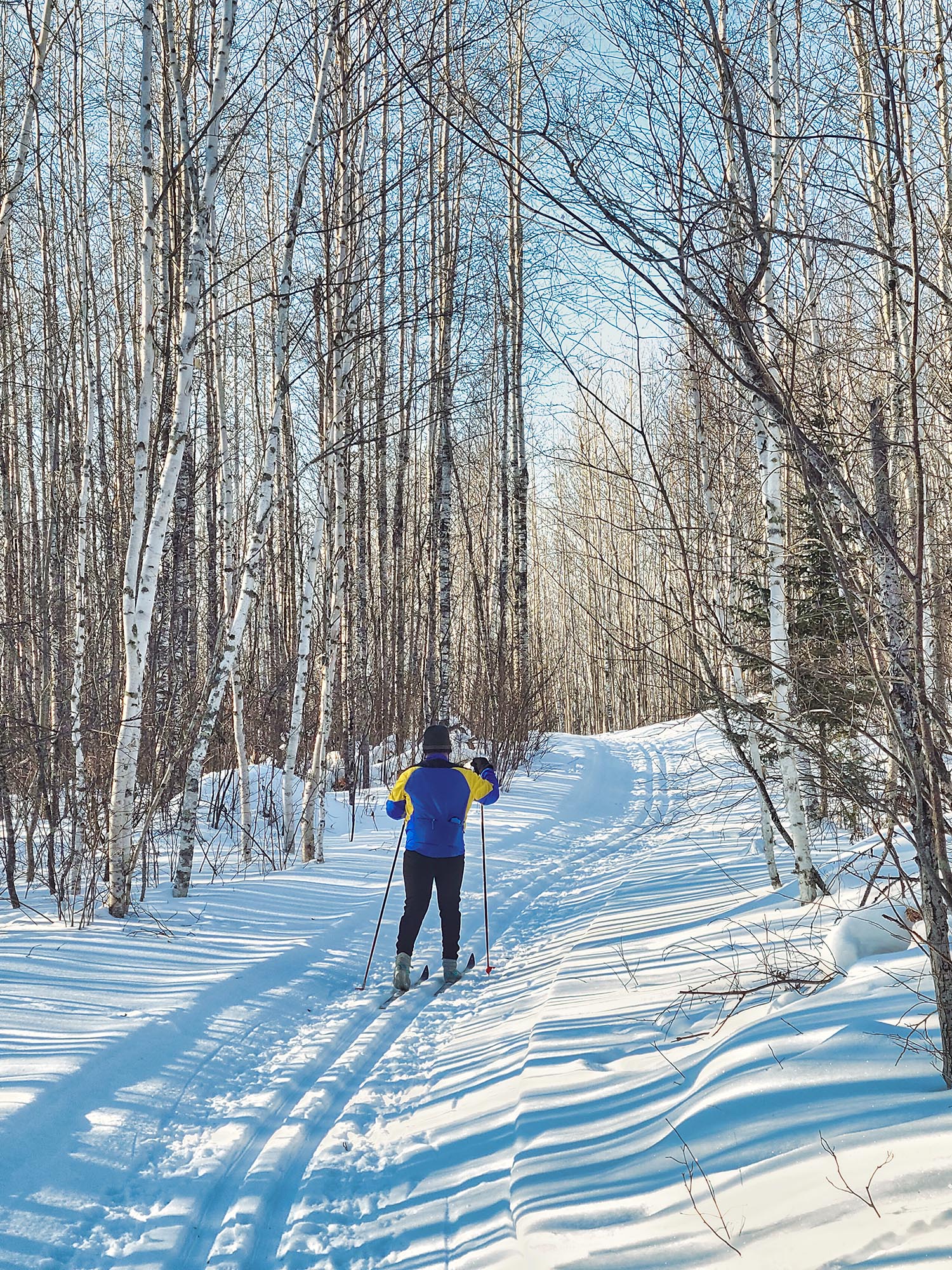
All I can say is that these cross-country ski trails are terrible. They were noisy and crowded. The other skiers scowled at us and muttered oaths most foul. The snow was coated with soot, the scenery filled with skyscrapers. The forest was mangled and misshapen. The grooming was awful – tracks all over the place. And the air held a lingering stench, reminiscent of dried pickles.
If you enjoy the Korkki Nordic Ski Trails near Duluth, you’ll intensely dislike these ski trails because they are like Korkki but with frozen ponds everywhere.
By all means, you should never ever go on these classic-only ski trails. Really, don’t go.
Pergrine falcon. Photo by Frank Cone on Pexels.com
One summer, not long ago, I was walking down my home street in Duluth when a pigeon came streaking above it, like the proverbial bat out of hell. A flock of pigeons lived in an old school building on the end of my street. Seeing pigeons around was not unusual, but I’d never seen one fly so fast. In another few seconds, a peregrine falcon zoomed by in pursuit.
This minidrama was a first for my quiet neighborhood, as far as I know. The birds were too far away for me to see if the pigeon was doomed, but witnessing the chase was definitely exciting.
Not long ago, peregrines were classified as an endangered species in Minnesota and the rest of the country. They were delisted federally in 1999 and in Minnesota in 2013, although they are still considered a species of special concern.
I’ve had the privilege of documenting and even helping a bit with their recovery, so seeing one fly down my street did my heart good. It all began in the spring of 1985 when I was the environmental reporter for the University of Minnesota college newspaper, “The Minnesota Daily.” A photographer and I were invited to the top of the IDS Tower (also known as the Multifoods Tower, the tallest structure in the city at that time) for a peregrine falcon media event. Staff from the university’s raptor center and biology department were going to install chicks that had hatched in a hack box that had been newly established atop the tower.
Hack boxes are large wooden boxes with a nest inside them. Young birds of prey grown from eggs that were either captive bred or taken from wild nests are placed inside the boxes a couple of weeks before they fledge (start trying to fly). In the meantime, the birds are closely looked after and provided food without too much human contact. In a few days, the box is opened, and the birds can start stretching their wings, so to speak. They are still fed until they are self-sufficient.
Why was it a good idea to introduce falcons into the middle of the city? Well, Minneapolis contained plenty of food for the falcons (pigeons), the skyscraper mimicked their preferred habitat (steep cliffs), natural enemies were scarce, and it was an easy place for researchers to access.
I remember the excitement when one of the researchers (Pat Redig) took a squawking, fluffy baby falcon out of a carrier to put into the box. As he did, he described the plight of the birds and the concept behind hacking. Photographers clicked away and reporters scribbled in their notebooks. We were able to wander around atop the building and look over the impressive edge, 51 stories high – a memorable experience in itself.
A pre-event story I wrote about that news conference ended up being 40 newspaper column inches long. This was longer than usual. My editor (Doug Iverson) asked me to justify why he should give me such a large space. I don’t remember what I said (probably something like, “because peregrine falcons are cool!”), but it must have worked because he didn’t cut its length. The post-event story I wrote made page 1 of the newspaper, which was a big deal to this cub reporter.
The next time peregrines came into my life was a couple years later when I was a summer volunteer for the Forest Service on the LaCroix Ranger District in Cook, Minnesota. My boss (Steve Hoecker), was a falconer and he was involved in the recovery effort. A hack box was being constructed on one of the iron ore mine pits nearby in Virginia, MN. Like the IDS Tower, the mine featured steep cliffs that peregrines prefer.
My memory of this experience is hazier than the IDS Tower event, but I think I helped Steve scramble box construction materials down the steep banks of the mine. I took photos and covered the story for the local newspaper.
The next time I saw a falcon, it was in the wild. I was hiking on Isle Royale, a national park island in Lake Superior in the early 1990s with a group from an Audubon Society camp, when a peregrine shot across and above the trail in front of us, like a kamikaze jet. The island features some steep cliffs as does the Canadian shore not far away where the falcons could nest. I remember thinking that maybe all the work being done to restore the falcons was beginning to pay off.
After that, my last experience with a falcon (before seeing the one on my street) was in downtown Rochester, Minnesota. It happened during the winter of 2009 when I was working at Mayo Clinic in public affairs. I lived within walking distance of my office. As I trudged along on cold winter days and evenings, a strange call of a bird echoed loudly against the clinic building walls. The call was familiar to me, but I couldn’t quite place it. And what kind of bird would still be in Minnesota in February, for goodness sakes?
It took me a few months, but I finally figured out that the obnoxious bird call that accompanied my walking commutes was a falcon. They had been hacked atop one of the clinic buildings. I think I was even able to attend some sort of celebration event about the project at Mayo that year.
If you’d like more information about the history of peregrine recovery in Minnesota, a good article can be found here.
So, it seems like peregrines have been following me around ever since my first encounter with them in downtown Minneapolis. Or have I been following them around? Maybe we’ve been following each other. In any event, their recovery is a good news story in a world beset by so many environmental problems.







 Marie's Meanderings