Rain moved in on our last full day at Pictured Rocks. It foiled our morning plans to hike from our campground (Hurricane River, Lower Loop) to the Au Sable Lighthouse, a 3-mile round trip. But after Russ and I read and were generally slothful, the rain stopped in the afternoon and we were able to hike.
The “trail” to the lighthouse is more like a gravel road. In fact, the park employees who staff it drive on it with their car. It’s mostly level and easy walking along the shore of Lake Superior. Several shipwrecks lie on the beach near the lighthouse, but we couldn’t access them because of the rough waves.
The treacherous sandstone makes up Au Sable Point.
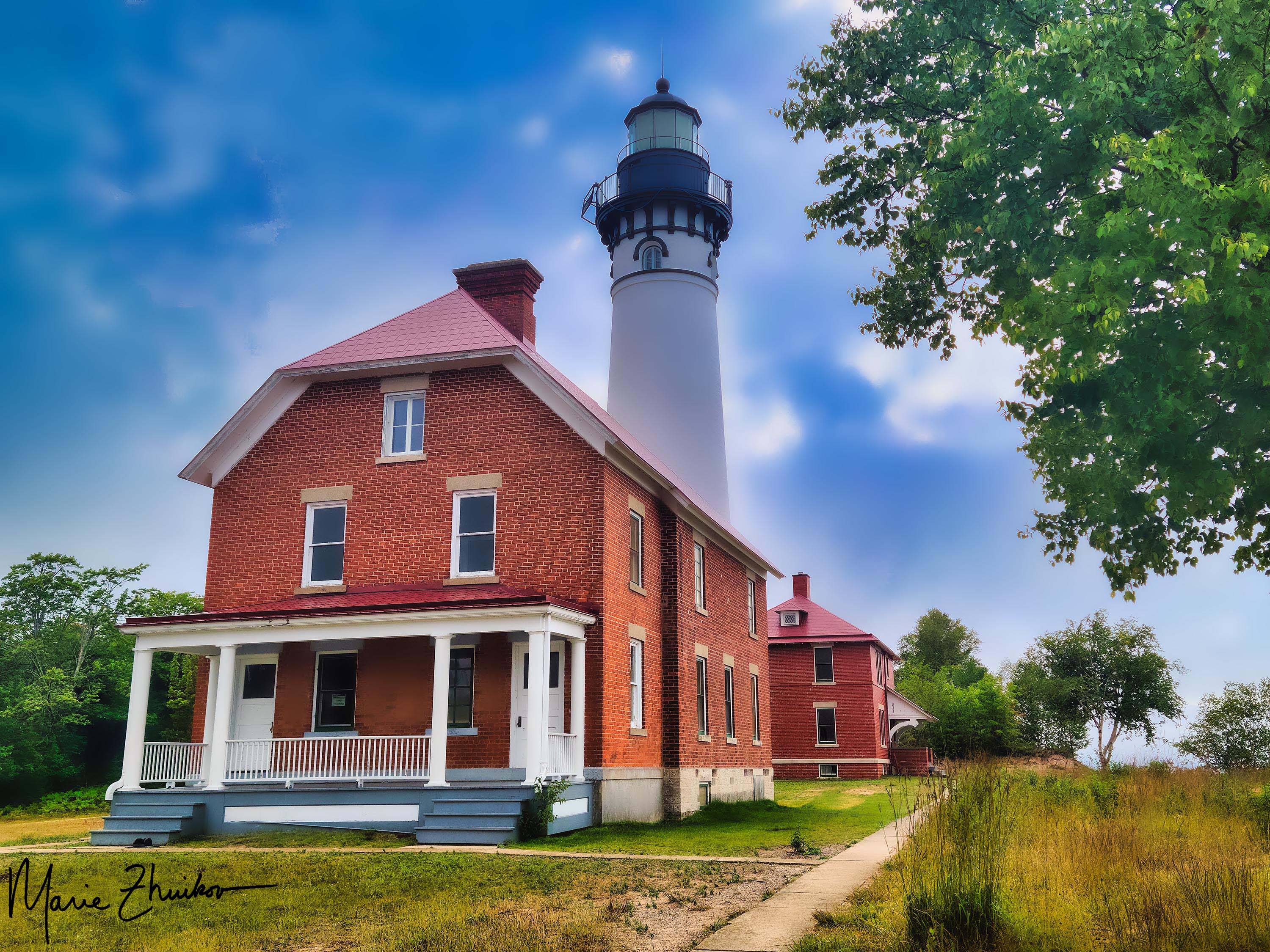
The light station is comprised of a small museum, the lighthouse and keeper’s quarters, a foghorn signal building, two historic outhouses (plus one the public can use), and a small brick oil building.
I’d wanted to visit this particular lighthouse for several years – ever since I discovered it’s the twin of the lighthouse on Outer Island in the Apostle Islands National Lakeshore. I would like to set a novel in the Outer Island lighthouse but was unable to tour inside it, so the Au Sable Light was the next best thing! Tours are offered during the summer for $5.
With its underwater reefs and thick fogs, Au Sable Point is a hazard to Lake Superior mariners. The lighthouse was built in 1874, the same year as the Outer Island Lighthouse. The light tower is 86 feet high. In 1945, the U.S. Coast Guard took over operation, replacing civilian keepers. In 1958, the Coast Guard converted the light station to an automatic, unattended light and discontinued the fog signal. The station became the property of the park service in 1968. The Coast Guard maintains the small LED beacon and solar panel that charges its battery. The park has completed several restoration projects over the years.
The Au Sable Lighthouse as the fog rolled in.
The furnishings inside the lighthouse are not original, but they are of the appropriate time period. The keeper’s quarters consist of a kitchen, dining room, living room, bedroom, work room and several closets. The lighthouse tower can be accessed directly from the living quarters.
The second floor of the keeper’s quarters is much like the first and was built for the assistant keeper’s family. Tours include a trip up the 90 steps to the top of the tower, with its impressive view of Lake Superior and the surrounding forest.
After the tour, Russ and I wandered the grounds (with me taking photos). As we prepared to leave for the hike back to the campground, a fog rolled in, completing the ambiance.
Our evening plans included a drive to Munising to trade in our Spam camping food for more elegant fare. We made reservations at Tracey’s at Roam Inn. It was pricey, but the food was worth it! I had the Lakeshore Pan Roast – a seafood stew made with lobster, whitefish and scallops in reposado cream (made with tequila). Russ had the Grass-Fed Bison Filet Mignon. You can choose three different ways for your meat to be prepared. He chose the “House” method, which involves covering the meat in pepper and serving it with mashed potatoes, birch syrup asparagus, and morel mead cream. If you like pepper, this is the dish for you.
The Lakeshore Pan Roast from Tracey’s Restaurant in Munising, MI.
Both of our meals were luscious and provided the perfect end to a wonderful trip. For dessert, Russ had the chocolate cake (served with raspberry sauce and whipped cream), and I had the crème brulee served with lingonberry sauce and a stroopwafel (a Dutch waffle cookie with caramel filling). This put our meals over the top!
Chocolate cake for dessert.
As we dined, we reflected on our experience. I was tickled by how excited people became from seeing “rocks.” On our sunset cruise, they were taking selfies with the various rock formations as well as cell phone videos to share with friends. Calling the Pictured Rocks National Lakeshore “just a bunch of rocks” (like our church friend did) was like calling the Grand Canyon “just a big hole in the ground.”
The next day, we would drive home with our Scamp. But we would do so filled with a new appreciation for an area we had driven past many times but never had time to visit.
Russ and I meandered down to St. Paul for a family gathering a few weeks ago. We brought a gift card with us that my cousin had given me to the Apostle Supper Club. When she had given it to me, Duluth still had an Apostle Supper Club. It used to be in the rotating top of the Radisson Hotel. However, they closed without notice and before we could use the card. We’d been there a couple times before and were looking forward to dining there again. It looked like St. Paul was our only other option.
The Apostle touts itself as “a 1960s Palm Springs-inspired supper club, piano lounge, and tiki bar” located in the heart of St. Paul. It also has a fireplace lounge in the back, which is where we were seated.
The décor is what struck us first – full of 1960s colors of orange, red, brown and yellow. While the front part of the club where the bar is has windows, the rest of the place has the dark, no-window supper club vibe. Cushioned chairs were scattered about and the tables were bedecked with those small lounge lamps. The fireplace lounge sports a freestanding circular yellow-gold fireplace surrounded by matching comfy chairs.
But the best part of the décor was what I found on my way to the bathroom: a wall of shag carpet! Done in yellow, brown, red and orange, of course. I had to run my fingers through it and make sure that Russ saw it before we left. The Duluth restaurant was well-decorated, but it did not have a shag carpet wall.
Our dinner was excellent. For an appetizer, we shared the broiled crab and artichoke dip, which was served with grilled baguette and veggies. We savored those nice big chunks of crab. My main course was red curry striped bass – a pan-seared bass fillet served on a bed of crispy sesame rice with red coconut curry sauce and a radish salad. The fish was cooked just right, with crispy skin and a flakey center. I’m not a big fan of radishes. I couldn’t really tell that the salad had any radishes in it, which was a good thing for me.
The red curry striped bass.
Russ’s entrée was the rigatoni arrabbiata with a spicy roasted tomato sauce, garlic, white wine and whipped basil ricotta. He said the sauce was excellent. You can add various meats to the dish, but Russ was fine without them.
We topped the meal off with espresso crème brulee. I’d never had that particular type of crème brulee before and it was truly memorable – a coffee and cream confection!
During our meal, some hubbub ensued at a table in a dark corner of the fireplace lounge. Two people arrived bearing a dozen roses, which they presented to a woman at the table who had been dining with a man. Then one of the rose-bearers broke out into song. We couldn’t really hear what is was, so we spent some time speculating whether this was a birthday celebration or something more romantic.
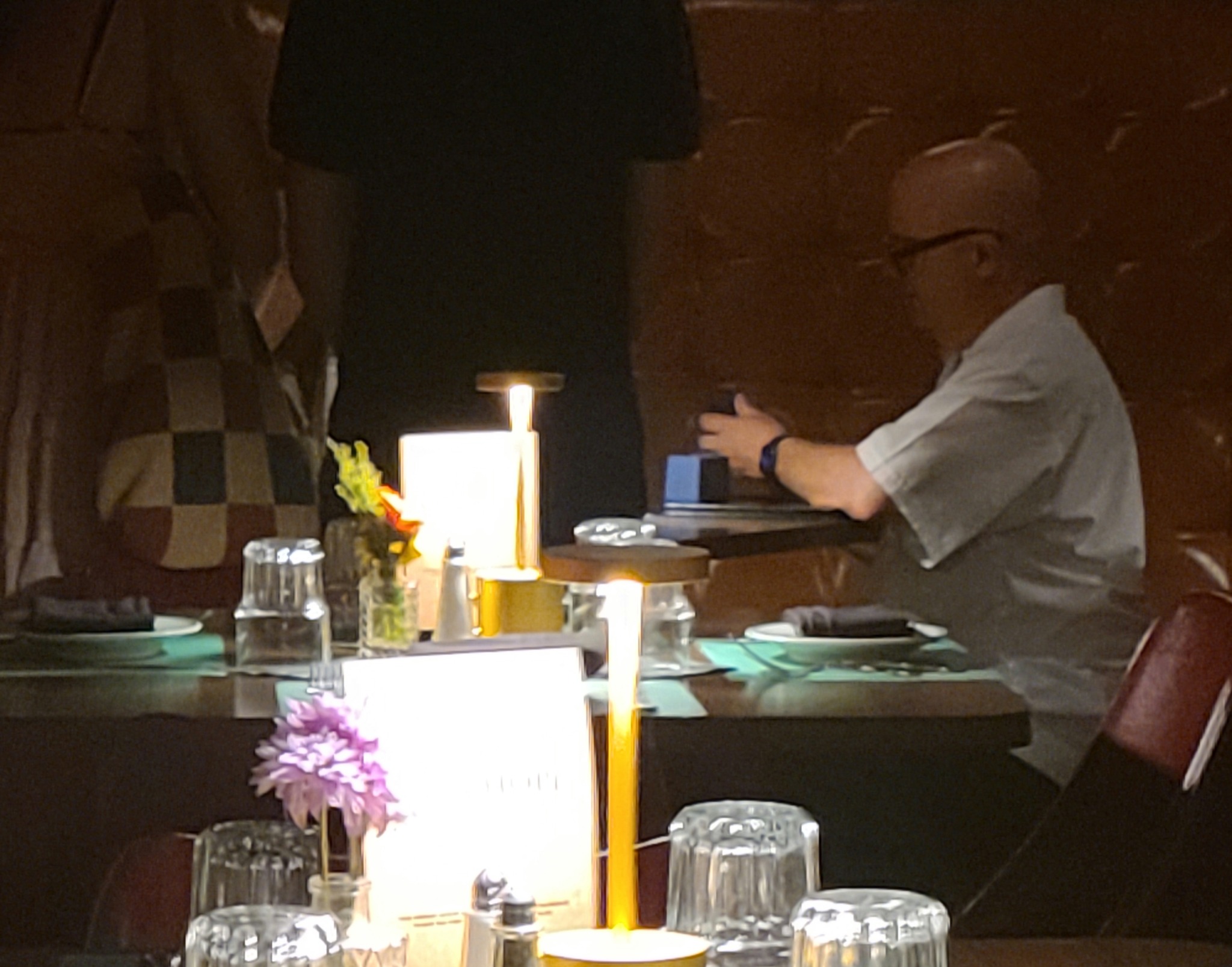
Our speculation was put to rest when the man at the table got down on one knee and presented the woman with a ring box. She said, “Yes!”
The proposal, in progress.
I tried to get a photo of this occasion, but alas, the two performers were standing in my way. This was the best I could do.
Russ and I remarked that we seem to attract marriage proposals whenever we go to the Twin Cities. The last one happened at the Como Conservatory when we visited it for a poinsettia show.
If you live in the twin cities and would like to be engaged, Russ and I are available for hire, ha ha!
While we will miss The Apostle in Duluth, we’re glad to know that it’s still done right only a couple of hours away should we have a yearning for a supper club experience.
UPDATE: The Supper Club is closing the end of May 2025. I guess we’ll need to find someplace else for a supper club vibe. 😦
A giant burbot replica found in the lobby of Duluth’s Great Lakes Aquarium.
My recent post about a trip to a local fish market in Cornucopia, Wisconsin, to buy some burbot piqued readers’ curiosities about its taste and my experience eating this ugly looking fish for the first time. I’m here to say that I survived and that I’m no longer a Burbot Virgin!
The experience is memorialized in “The Fish Dish,” a podcast I co-host for work. We chose a Valentine’s Day theme for the show because Feburary is an important time in the burbot’s life cycle: a time for LOVE.
See photos and hear all about it at this Fish Dish link. And while you’re at it, get your sweetie a card with a big burbot on the front for that special day. Such smooth moves might not work on everyone, but you just never know . . . .
Long-time readers of my blog may recall that I identify with my Scottish heritage. I had a chance to celebrate that recently by attending Robert Burns Night, which was organized by the Duluth Scottish Heritage Association (DSHA).
Robert Burns is a well-know historic Scottish poet. If you’ve ever sung Auld Lang Syne on New Year’s Eve, you have him to thank. His birthday is recognized on January 25 by Scots, rather in the tradition of Christ’s birth on December 25 by parts of the world, if you’ll permit me a bit of sacrilege.
Scottish dancing lassies doing the sword dance.
The celebration was held at a historic club downtown. This was not my first Robert Burns Night. My mother took me to one held at the university many years ago. Then last year, Russ and I ordered a takeout Robert Burns dinner from the club since there was no gathering due to the pandemic. That “dinner” fed us for four days! It featured neeps and tatties (turnips and potatoes), haggis (more about that later), black pudding (blood sausage), Scotch eggs (hard-boiled eggs wrapped in sausage meat, breaded and fried), and trifle for dessert (a decadent concoction of cake cubes layered between berries, pears, and vanilla pudding mixed with whipped cream).
Attendance was larger than usual for Burns Night this year because it was the first time in three years it had been held in person. One-hundred-and-sixty of us gathered in kilts and clan scarves to listen to bagpipes and watch Scottish dancers.
After that came the formal part of the program, which included 4 toasts of scotch: One to “the immortal memory of Robert Burns,” one to the president, one to the king, and one in Gaelic.
Then came the star of the show, the Haggis. This traditional dish takes minced sheep heart, liver, and lungs, and mixes it with oatmeal, suet and spices like nutmeg, cinnamon and coriander, plus salt, pepper and stock. The mixture is boiled in a bag, usually made from a sheep’s stomach. We love it. I’d say it tastes like a chunky beef barley stew.
The Haggis is paraded into the hall by the chef and a whisky bearer, led by a piper in formality that would border on the absurd if it weren’t Robert Burns Night. Once the Haggis was settled up front, one of the DSHA members recited Burns’s “Address to the Haggis,” which involved stabbing it with a large knife and inhaling its pungent vapors.
Make way for the Haggis!
After that, a local reverend offered grace and a piper in the rafters played “Amazing Grace.” Then we dispersed to seven clan rooms. Each featured different foods to sample and memorabilia specific to each clan. One room featured scotch. I was disappointed at the lack of trifle this year, but our enterprising friends found dessert bars on a different floor.
After much eating and conversation, a ceilidh dance was held in a large lounge room. Even though I’ve been to a ceilidh before, it wasn’t until that night that I learned (from overhearing a conversation) that ceilidh means “party” or “social visit.” We danced and listened to Scottish music performed by a live band.
We were sated and pleasantly tired from dancing once the evening ended. We felt like we’d been on a trip to Scotland without leaving the comfort of our own city. If you ever have the chance to attend Robert Burns Night, I’d encourage you to do so. It’s a spectacle, indeed.
The view from Chewbaca Point on Loterie Farm, St. Martin.
Continuing my posts about the isle of St. Martin, I offer this one about Loterie Farm, a private nature reserve on the French side of the island. This was my second time at the farm, but a first for my traveling companions.
The Jungle Room
The other time I was there, I was initiated into ziplining. The farm has a course that takes you through the surrounding trees and hillsides. If you’re lucky, you’ll see the resident monkeys as you glide along. But since I’d already been there, done that, I and two others from our group decided to explore the farm’s hiking trails.
I admit to not doing much research on the trails beforehand. But I should have clued into the strenuousness of the hike from the switchbacks on the map, which we paid $10 for. (I advise just accessing the map on your phone from the farm’s website if you have coverage). The receptionist’s questions about whether we were wearing adequate footwear also should have been a big hint.
We each grabbed a cane stalk hiking stick from a box near the trailhead, which we were thankful for later. We took the short (60-minute) hike to a spring and then up to Chewbaca View Point.
The hike to the spring was easy, although the spring was not flowing when we were there in November. Then the trail headed up a mountain. There were parts where we Elders were scrambling over boulders, clinging to handholds as best we could. This is where we were very thankful for the hiking sticks.
But, the view from Chewbaca Point was worth it. We could see all the way to the ocean and many of the towns in between. We rested there and rehydrated. (Bring water!) The temps were about 85 degrees (F) and my tank top was totally soaked in sweat from the climb.
From the point, the trail descends back to the farm whence we came. Erosion caused gullies and tricky footing, but we went slow, and everyone made it back to the trailhead without mishap. Along the way, numerous green moths fluttered around us, making us feel like we were in a Disney movie or something.

The best mojito ever!

I should also mention that before our hike, we ate lunch at the farm’s Jungle Room Restaurant. It’s up among the treetops and features cozy couches for large groups and an area for sit-down dinners. The food was exquisite the first time I was there, and we certainly had a repeat performance. I had one of their poke bowls and Russ had the cajun Mahi Mahi salad (see image). Both were delectable, plus my mojito with fresh mint was the best I’ve ever had.
After our hike, we contemplated a plunge in the farm’s Jungle Pool, but we would have only had an hour to enjoy it, and the price tag didn’t seem worth it. So, we hung out at the bar while waiting for the rest of our crew to return from their activities. I ended up having one of their nonalcoholic mixed drinks – I think it had mango in it. So refreshing!
I find it ironic that I was able to complete our hike intact because when I returned home, I ended up breaking my ankle doing a simple side-shuffle exercise during a kickboxing workout. So, I sit here in my ankle boot, envious of my past flexibility and prowess on this adventure. Oh well. Go figure!

The weather is still wintry here in the North – stubborn snow piles linger, and more snow is falling as I type this. A few days have been warm enough to provide a hint of spring, but today is not one of them. Everyone is bundled back up in their puffy jackets and boots. A perfect time for a bowl of thick, creamy goodness.
This is a recipe I saved from our local newspaper. It was originally written by Bea Ojakangas, Duluth’s Scandinavian version of Julia Childs. I have modified it over the years to make it wheat- and corn-free, plus I’ve changed some of the spices more to my liking. If you want to make it with wheat, the original flour measurements are included. If you want corn, simply add a can of corn when you add the beans. Instead of cream, I prefer evaporated milk because cream is just too rich for me these days. This makes 4-6 servings.
Bon appetit!
White Chicken Chili (Wheat- and Corn-Free)
½ lb butter 1 T chopped garlic (or ½ tsp dried minced garlic) 2 lbs chopped chicken or 2-10 oz cans of chicken 2 cups white onion, cut in large chunks (one large onion) ¾ cp gluten free all-purpose flour (or ½ cup regular flour) 2 tsp cumin sprinkle of chili powder salt to taste (I use 1-1/2 tsp sea salt) pepper 4 cups chicken broth (I use Imagine organic vegetarian no-chicken broth) 1 pint cream (or 1 can evaporated milk) 2 cups cooked navy beans (1 can beans)
Melt the butter in a large saucepan. Add garlic and cook until it starts to brown, stirring occasionally. Add the chicken and onion and stir together. Slowly add the flour to absorb the butter. Add the cumin, chili powder, salt, pepper, and broth. Simmer approximately a half-hour. Add evaporated milk (cream) and beans. Simmer another 15 mins.
Serve topped with sour cream, shredded white cheese and chopped parsley, if desired.
I saw an article in the Minneapolis Star Tribune yesterday saying that Owamni Restaurant was designated as the newspaper’s top restaurant for 2021. It reminded me I still needed to follow up on my promise to write about Russ’s and my experience at this Native American eatery during our weekend Romancing the Minneapple.
I’ve wanted to eat at one of Chef Sean Sherman’s places (he has a food truck, as well) ever since I saw him speak at a launch for his cookbook in Duluth. Sherman focuses on precolonization food (food that Natives used to eat before all us Europeans immigrated and mucked up their lifeways). This includes ingredients that Natives grew themselves or foraged, like squash, wild rice, venison, chestnuts, fish, berries, and cedar boughs.
He’s trying to reconnect Natives to their pre-European culture, so much of which has been lost. I suppose it’s also a way to show us nonnatives what life used to be like in America historically, plus the food is super healthy – no wheat flour, dairy, or refined sugar.
Several recipes from his cookbook have found their way into my permanent recipe file, notably the squash apple soup with cranberry sauce and cedar-maple tea.
Russ and I were late in planning our trip to Minneapolis and only began making reservations for it a couple of weeks beforehand. Owamni has been featured in the New York Times, Lost Angeles Times and Chicago Tribune, among others, so, as you can guess, reservations are booked months in advance. But, they have first-come, first served bar seating, so we decided to take a chance on that. If it didn’t work out, we had a Plan B restaurant in mind.

Wild game salad
We took a snowy ¾ of a mile walk under a full moon over and along the Mississippi River from the Nicollet Island Inn to get to Owmani, which is housed in an historic water works building. We figured if we got there early in the evening (5:30 pm), the wait might not be as long. I think this was a good strategy. We only had to wait about 45 minutes for seats at the bar.
One of the first things you’ll notice is that the menu isn’t typical. There are not separate listings for appetizers, plus the entrees are sharable. When I expressed confusion to our friendly bartender, he explained that the concept is like a Tapas Bar, where you end up ordering lots of small plates and sharing. That way, you can sample a variety of selections.
To begin, we ordered (and shared) the cedar maple baked beans, the wild game salad, and the bison pot roast. They also have a good selection of wines and nonalcoholic drinks available. Everything was wonderful. The beans, because they are flavored with maple syrup instead of brown sugar, aren’t as sweet as usual, but that allows the natural bean flavor to come through, with cedar lurking in the background. The wild game salad featured dried duck and turkey, which could be a bit chewy, on a bed of kale garnished with a duck egg. Russ is normally not a big fan of kale, but he said it was delish and ate it all!

The bison pot roast was the piece de resistance – a slow-cooked and tender hunk of bison surrounded by natural gravy, hazelnut-crusted carrots, a mustard green sauce and a horseradishy sunchoke (Jerusalem artichoke) puree, topped with an edible purple violet. The meat melted in our mouths. It’s the first time I’ve had bison and it was truly memorable.

For dessert, I had a chocolate chia cake with sorbet and a caramel honey sauce, and Russ had a berry-walnut milk parfait. Both were excellent.
The cedar maple baked beans, berry walnut milk parfait, and the chocolate chia cake
The neat thing about sitting at the bar is you can watch the workers and see the other dishes and drinks they are preparing. I noticed a cranberry nonalcoholic drink that I’d like to try if I eat there again. Diners with reservations got tables near windows that overlooked part of the river (Owamni Yomni) considered a site of peace and wellbeing for the Dakota and Anishinaabe people.
Most of the workers looked to be of Native American descent. Most of the diners looked like well-to-do white people. That felt rather weird to me. Is this just another way for white people to appropriate Native American culture? Have we turned these Natives into slaves serving us food we want to eat just because it’s the latest trend?
Although I was a bit uncomfortable with those feelings, it seemed like it was high time that Native American foods were celebrated. After all, we have Mexican restaurants, Chinese, etc. However, these cultures haven’t been oppressed like the Natives have. Part of me feels like this restaurant should only be for Native Americans at first. I felt like I was taking the chair of someone who might need this food more than I did in order to feel whole.
I am still struggling with these feelings and I’m not sure what to make of them. But I probably wouldn’t let them stop me from eating there again.
Alas, the restaurant is closed for a mid-winter break right now. But it plans to reopen on January 19 (2022) for a winter dinner series. Proof of vaccination will be required to enter.
I’ve been busy at work lately, giving birth to a new podcast. If you want the latest “dish” about Great Lakes fish, you’ll want to listen to “The Fish Dish.” I host it with longtime coworker and friend Sharon Moen, Sea Grant’s Eat Wisconsin Fish Outreach Specialist. Besides introducing you to the people behind Wisconsin’s fishing and aquaculture industries, each episode includes a “Fish-o-licious” section where we cook a new fish recipe.
The first episode features Craig Hoopman, a sixth-generation commercial fisherman from Bayfield, Wisconsin. Hoopman shares his beginnings in the business, current challenges, plus his dreams for the future. Also, Sharon and I share our backgrounds in fishing and introduce listeners to the Eat Wisconsin Fish campaign. During the “Fish-o-licious” part of the show, we cook Greek-Style Lake Whitefish at Hoopman’s recommendation.
Tying it all together is ska music by Twin Ports band, Woodblind. Take a listen — let me know what you think!
The New York Times recently published an article about eating invasive species as a means of control. It reminded me of a demonstration project we undertook when I worked at Minnesota Sea Grant in 1996. We received money from The Great Lakes Protection Fund for two years to study the overseas market potential for Great Lakes sea lamprey.
The business end of a lamprey. Image credit: U.S. Environmental Protection Agency
I’m sure many of you are familiar with the story: lamprey, with their penchant for sucking blood, are a parasitic exotic species that entered the Great Lakes and almost wiped out the Great Lakes fishery by the 1940s. This led to a control program coordinated by the Great Lakes Fishery Commission that is ongoing even today. Every year, the commission’s various lamprey control programs cost millions of dollars. Sea lamprey are clearly still an enduring threat.
In the mid-1990s, the commission’s lamprey control program routinely landfilled thousands of female lamprey they trapped. At that same time, lamprey populations in their native countries like Portugal and Spain were becoming decimated due to overfishing and habitat loss. This was an issue because lamprey were/are considered a culinary delicacy in Portugal and Spain. Like the lobster aquariums found in American restaurants, Portuguese restaurants offered tanks of sea lamprey where people could pick their dinners. Exclusive and expensive clubs even formed around lamprey consumption.
Jeff Gunderson, the fisheries and aquaculture specialist with Minnesota Sea Grant at the time, took an idea from a University of Minnesota food professor and the extension leader at Minnesota Sea Grant and turned it into a project to find a use for the excess, unwanted Great Lakes lamprey by seeing if chefs in Portugal and Spain would find them as palatable as their native lamprey. He set up a team that included a professor in Portugal who would conduct market testing, University of Minnesota experts, a NOAA international marketing expert, and a fisheries biologist.
My job was to garner visibility for the project and its results. When Jeff first described the project to me, one of my first questions was whether the lamprey had been tested for mercury. “I don’t want to promote something that’s going to contaminate people,” I recall saying. He assured me the lamprey had been tested and were within U.S. standards. But what I didn’t know at the time was that only a small sample of lamprey were tested. (More to come on this later.)
To figure out my publicity strategy, I consulted a couple of my news reporter friends. I think it was Mike Simonson, the well-known and now dearly departed Superior bureau chief for Wisconsin Public Radio who said, “You gotta have a taste test!”
That sounded like a capital idea, so my first step was to find a local chef willing to cooperate. I approached my favorite restaurant, Bennett’s Bar and Grill, run by Bob Bennett. This “forefather of contemporary cuisine in Duluth” was game.
The Portuguese professor had given me several traditional sea lamprey recipes, at least one of which involved using lamprey blood. Ewww. Anyway, I showed these to Chef Bennett, and we came up with a taste-test plan. He would prepare two traditional recipes and create two of his own. Gunderson talked the original Lou of Lou’s Fish House in Two Harbors into smoking some lamprey for the taste test, as well.
Next, we had to find some brave lamprey consumers. Somehow, I managed to convince the Duluth mayor (Gary Doty) to participate along with the University of Minnesota Duluth chancellor (Kathleen Martin). Several members of our Sea Grant Advisory Committee also agreed as did a freelance graphic designer who worked for us, a congressional office manager and the Minnesota Sea Grant director (Michael McDonald),
We held the lamprey taste test at Bennett’s restaurant, which was on Superior Street in downtown Duluth. Eight intrepid tasters were seated at a long table facing into the room so that reporters could easily see them and ask about their reactions to the food. We gave them a rating form. We also provided an aquarium with several lamprey in it, just to add to the room’s ambiance, and the smoked lamprey and some crackers for snacks.
Simonson was right about the lure of the taste test. We were mobbed by local reporters, both print and broadcast. Reporters from the Twin Cities even made the trip up north for it. The resulting stories went everywhere, even internationally. The Associated Press picked up the print story, and Gunderson said he talked to someone who saw it on a television station in Seattle. The story eventually made it into Newsweek and The New York Times.
Back in my office after the test, I received a phone call from the daughter of a Portuguese immigrant in Boston who saw the news stories and wanted to know how to obtain lamprey. She told me lamprey was a traditional Sunday dinner in Portugal, just like American pot roast. Her father was so excited when he saw the news, he implored her to find out more. I had to give her the disappointing information that lamprey were a regulated invasive species without a commercial source yet.
The highest rated dish was Bennett’s own lamprey stew with garlic mashed potatoes, rated 4.5 out of a possible 5. The smoked lamprey came in second, earning 3.7 out of 5. The taste of the lamprey came out more strongly in the traditional dishes, which did not suit these American taste-testers.
I ate both the lamprey stew and the smoked lamprey. I enjoyed the stew, although the chef forgot to take out the lamprey’s cartilaginous backbone (called a notochord), which made it a bit crunchy for my taste. I bet if he had removed the backbone, the dish’s ratings would have been higher. The smoked lamprey tasted rather like any kind of smoked fish – very good!
The taster’s comments included: “Surprisingly good. Try selling it without telling people what they are eating. It would be better.” And, “I would not order this out, but Bennett’s dishes were by far the best.”
More extensive taste tests were run in Porto, Portugal. Eight restaurants with lamprey-cooking experience, two homemakers and 16 individual taste testers participated in two studies. The restaurant chefs were asked to rate how the lamprey looked while alive, how they cooked compared to Portuguese lamprey, how they smelled/tasted/looked after cooking, how the lamprey tasted to them, and how their clients or family members liked them.
Overall, the Portuguese taste testers enjoyed the strong flavor and firm texture of the lamprey, noting the lamprey had a pleasant “turf” taste and was less soft and fatty than Portuguese lamprey. (A turf taste refers to an earthy flavor, somewhat like mushrooms or liver.) They rated the flavor 4.5 out of 5 – a definite win.
During the second year of the project, more lamprey were shipped to Spain for taste tests. The results weren’t as glowing, perhaps because only frozen and canned Great Lakes lamprey were shipped instead of live wriggly ones. The Spanish testers liked the texture and that some contained eggs. Yes, lamprey are a delicacy in Spain, but lamprey caviar takes it to a whole other level.
The death knell for this innovative program came from subsequent contaminant tests on the lamprey. The Great Lakes lamprey contained mercury levels that were too high to meet European Union standards. They tested at 1.3 ppm for mercury. The EU standard at that time was 0.3 ppm. This information came too late for our taste testers, but hopefully, one meal of lamprey was not detrimental. I certainly didn’t feel any ill effects.
Gunderson summed it up like this: “At least we have an answer to the question that has been debated for nearly 40 years. Yes, Great Lakes lamprey are marketable in Europe. Because of current control programs and experimental programs, a commercial harvest of lamprey would not have been a priority even if mercury levels were acceptable. But given time, a commercial harvest could fit into lamprey control and management. Lamprey are here forever and who knows if the funding for lamprey control will last that long. If funding ever does wane, let’s hope it’s not before mercury levels decline to acceptable levels so that lamprey harvest can be evaluated as part of a low-cost management program.”
That was almost 25 years ago. A Lamprey and Rice Festival is apparently held in Portugal each year, so it still must be popular, but I fear that the people who used to love eating them for Sunday dinner are aging out of this world.
Unfortunately, mercury levels in Great Lakes lamprey are still high. According to a 2018 study by the Great Lakes Indian Fish and Wildlife Commission and the University of Wisconsin, levels in adult lamprey were still beyond that deemed safe for human consumption.
In any event, this project was one of the highlights of my career. It seemed like a win-win idea: The U.S. could rid itself of an expensive invasive species, and European diners could eat a traditional and much longed-for dish. Yes, I promoted something that could have contaminated people. But I did a darn good job of it.
I first had this confection at the baby shower for my second son. My office coworkers organized the event and one of the highlights was this tasting this fruit pizza for the first time. Our venerable administrative assistant, Judy Zomerfelt, baked it and kindly gave me the recipe (and permission to feature it here).
Since then, I’ve become sensitive to wheat and corn, so I have modified the recipe. Most recently, I made it for the 4th of July – if you top the whipped cream with blueberries and strawberries, it makes a patriotic red, white, and blue dessert. Enjoy!
Fruit Pizza (wheat- and corn-free) Inspired by Judy Zomerfelt
1 cup powdered sugar (Be sure it doesn’t contain cornstarch. I use one that substitutes tapioca starch.)
1 cup cane sugar
1 cup butter
1 cup canola oil
2 eggs
1 tsp wheat-free vanilla extract (I make my own with potato vodka)
4 cups flour (I use a mix of white rice flour and Bob’s Red Mill gluten-free all-purpose flour, 2 cups each)
1 tsp sea salt
1 tsp baking soda
1 tsp cream of tartar
(For people without food allergies, simply use 1 package of sugar cookie dough instead, and cook accordingly.)
Cream the sugars and butter together. Stir in the oil, eggs, and vanilla. Add the dry ingredients and mix well. Pat the dough out on a nonstick cookie sheet or a greased rectangular baking pan. Bake at 350 degrees for 25 minutes. Let cool.
Filling:
1 8-oz package of organic cream cheese
1 cup cane sugar
Fresh fruit (I use strawberries and blueberries)
1 pint organic whipped cream
Mix the cream cheese and sugar. Spread on the cooked cookie dough. Cover with whipped cream. Top with fruit.
If you can’t find fresh fruit, you can use a can of fruit cocktail, drained well.












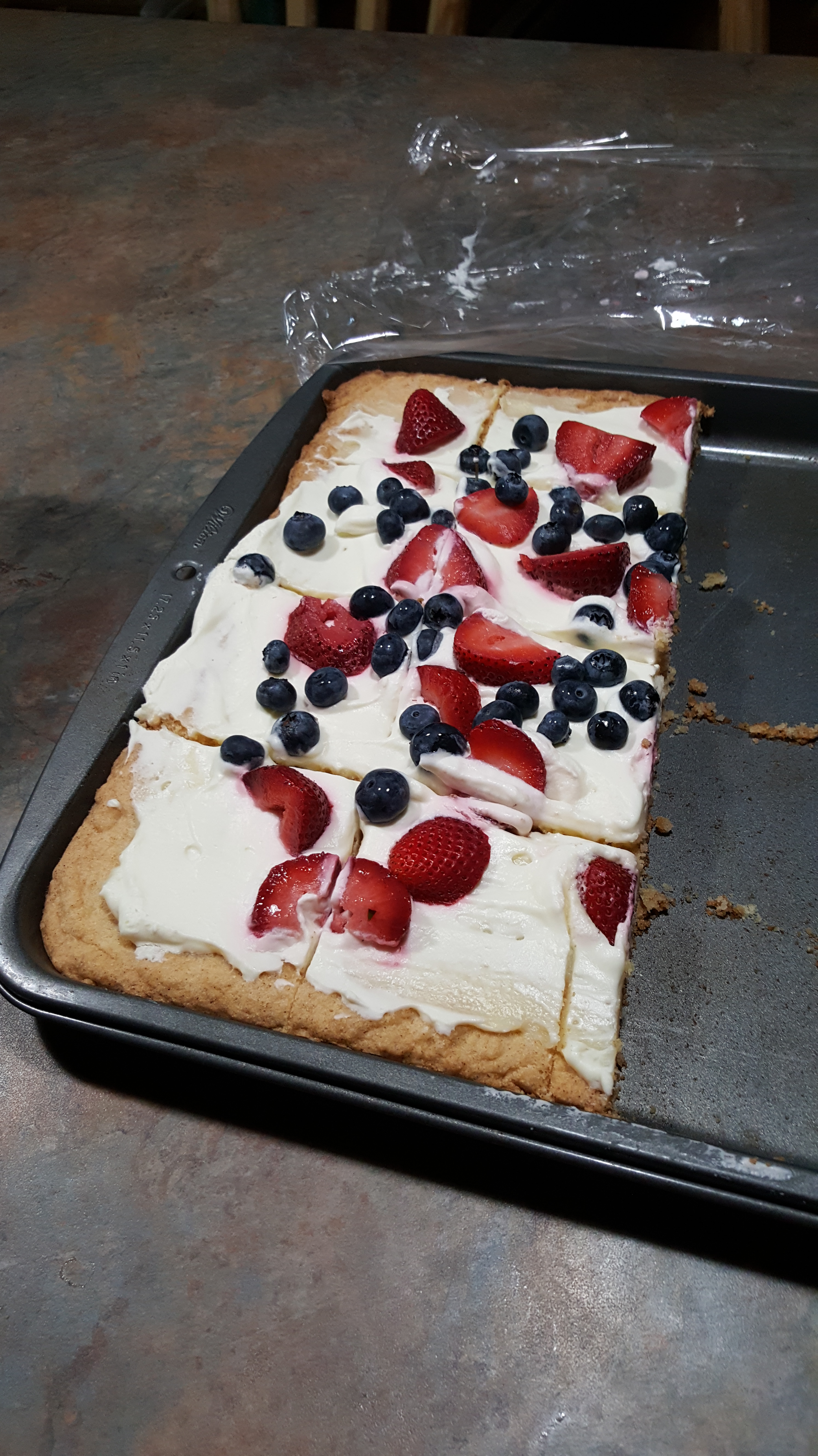 I first had this confection at the baby shower for my second son. My office coworkers organized the event and one of the highlights was this tasting this fruit pizza for the first time. Our venerable administrative assistant, Judy Zomerfelt, baked it and kindly gave me the recipe (and permission to feature it here).
