Guest Post: Eating Invasive Species, A Pandemic Alternative

By Sharon Moen

If you know Marie of “Marie’s Meanderings,” you know a few things. She loves her family, which includes biological kin and people like Russ, Buddy the Wonderdog, and me. She enjoys food and foraging, is committed her job at Sea Grant, and devours books. Knowing these things about Marie prompted me to ask her if I could share some words with you about food and COVID-19.

If you are reading this, then she said, “Yes.”

“No, no, a thousand times no!” That’s what I imagine Marie said when a far-right-wing talk show host spluttered his willingness to eat his neighbors in the aftermath of the pandemic, given the high meat prices and shortages. She is against cannibalism and stuff like that.

Someone like Marie would invite you over FOR dinner, not AS dinner. If you accepted the invitation and whatever COVID-19-inspired guidance was in vogue, Marie might deftly turn a local invasive species into haute cuisine.

Here in Minnesota, invasive species foragers could rustle up a rusty crayfish potpie in a cattail-root crust accented with dandelion salad. If in Florida, they might prepare a double lion: lionfish with dandelion greens.

Posh, eh? I bet someone like Marie would even ferment some dandelion wine to complement the meal, if only there were time. I know for a fact that she recently cooked fern fiddleheads from her local forest.

Speared lionfish

A speared lionfish in Belize. Be careful not to touch the poisonous spines! Image by Mike Sierszen.

I’ve joined Marie for meals and meanderings from Scotland to St. Martin. Believe me, the experiences were memorable! I’ve also had the privilege of tagging along with people trapping rusty crayfish in Minnesota and spearing lionfish in Belize to be used as food.

During these adventures, I learned a few valuable lessons about attracting and handling these pesky invaders:

Pro tip #1: Bait your invasive crayfish traps with fish heads and leave the traps in the water overnight. You’ll likely have a pile of bones and a mess of crayfish by morning.

Pro tip #2: Tie scissors to your spear when hunting lionfish. Use the scissors to cut off the poisonous spines before touching the fish.
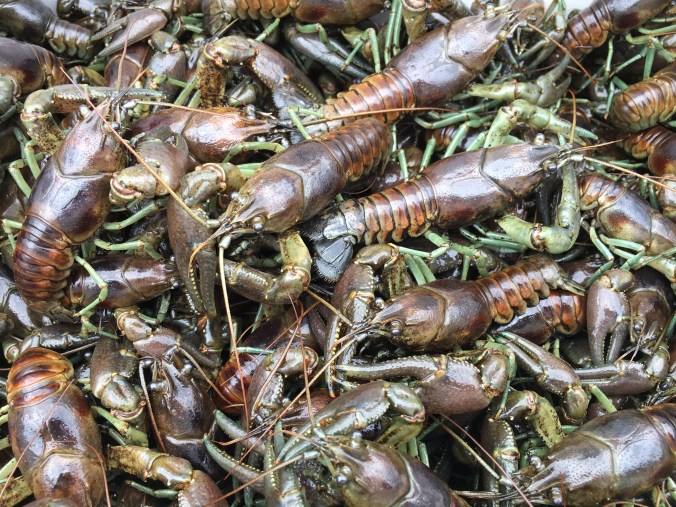
Rusty crayfish S Moen

One night’s rusty crayfish catch on the St. Louis River several years ago, reflects the scale of infestation: 57 traps, 2,140 crayfish. Image by Sharon Moen, Minnesota Sea Grant.

I also learned that as invasive species harvests make their way to tables, people along the way often gain a better perspective about why these species are so economically and ecologically harmful. Aquatic invasive species like rusty crayfish and lionfish tend to outcompete native species and disrupt food webs through their sheer numbers and voracious appetites. Crayfish claws and lionfish spines also make playing in water more hazardous. Their presence can reduce property values, and hurt recreation and tourism industries.

Through her job at Sea Grant, Marie and her colleagues conduct public education initiatives helping to control the spread of aquatic invasive species. During her storied career, Marie even organized an invasive sea lamprey taste test.

While you wait for her to tell you that story, consider reading The Omnivore’s Dilemma in which Michael Pollan challenges readers to understand where food comes from, what’s in it, and the processes involved in bringing it to human lips. The challenges of feeding yourself and those you love have always been real but they are manifesting differently through the COVID-19 pandemic. Be a thoughtful omnivore. Weigh the choices about what could be eaten and what is et.

Our friends at “Northern Wilds” magazine recently published an article on consuming dandelions. You can find many crayfish and lionfish recipes online. There’s even a cookbook published by the Institute for Applied Ecology you could add to your pandemic collection: They’re Cooked: Recipes to Combat Invasive Species.

Someday soon I’m looking forward to inviting Marie and Russ over to share dinner, not to be dinner. I’ll likely include an invasive species in the mix. What would you serve?

Be kind and stay optimistic.

Editor’s note: Sharon is available for freelance writing work. If interested, please contact me through my website and I’ll put you in touch with her.
Mexican Silk Pie

20200321_144225

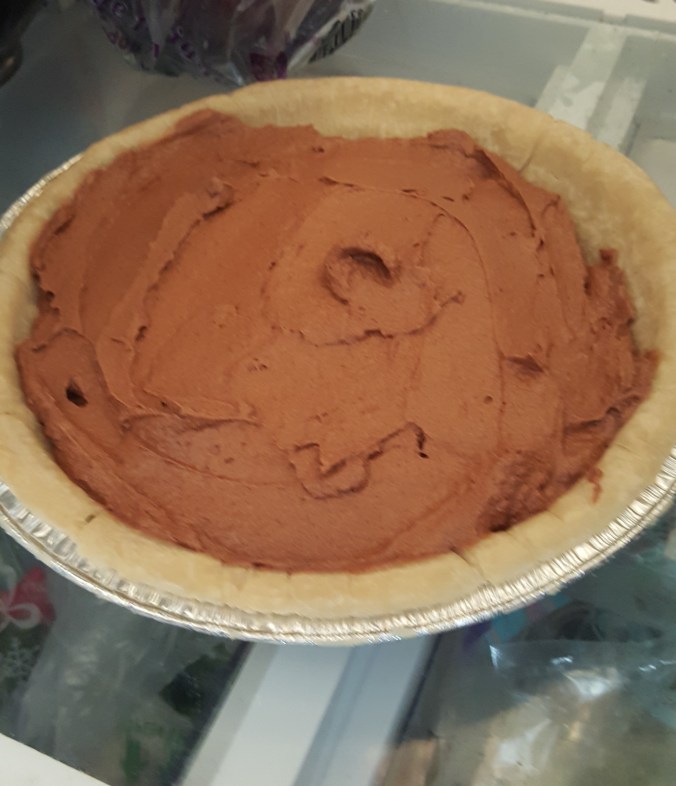
If you’ve ever eaten Mexican chocolate, you know one big thing that makes it different: cinnamon. Here’s my twist to the traditional French Silk Pie recipe, in case you are searching for new cooking adventures during this global pandemic.

Some of my friends joke that they are gaining the COVID-19 pounds from staying at home (and near food) so much. This pie is very helpful if that is your goal, ha ha!

Mexican (French) Silk Pie

9-inch baked pie shell or graham cracker crust
¾ cup butter, softened
1 cup sugar
¼ teaspoon cinnamon
1 teaspoon vanilla
3 eggs
3 ounces unsweetened chocolate, melted and cooled

Cook pie shell, if needed. Melt and cool chocolate. Blend butter and sugar in mixer bowl. Add vanilla and cinnamon. Add eggs, one at a time, beating two minutes after each addition. Blend in chocolate. Spread in pie shell. Chill at least one hour. Garnish with whipped cream and nutmeg, if desired. Keep refrigerated. Makes 8 servings.

A Hidden Seafood Restaurant Gem in Orlando

20190814_183626

Arroz marinero at Casa del Marisco.

We meandered down to Orlando, Florida, last week for a work conference. We stayed at a huge hotel with almost 3,000 people just for our conference, plus thousands of others who were attending other conferences held there.

The hotel housed half a dozen restaurants, but they were incredibly noisy. After a couple of days of hoarse voices from talking over other people, we decided to venture off-site for dinner. After a quick Google search for nearby places, we decided on Casa del Marisco, a seafood restaurant that features Peruvian and Ecuadorian seafood.

The worry began when we arrived. The restaurant seemed to be in the basement of a repurposed hotel. By repurposed, I mean there were tattoo parlors, fast biz cash loan offerings, and other questionable business ventures.

Our sense of dread did not abate when we opened the restaurant doors and found ourselves the only customers. The restaurant was white and clean, yes, but with its mirrored walls and tiled floors, the ambiance harkened back to the 1980s.

We were quickly greeted and seated, however. After perusing the menu, I looked up and could see through a window into the kitchen. The cooks looked like they could be Mexican or Edcuadorian. I suspected that this dining experience could be either very good or very bad.

Our waiter was friendly, and it was obvious that English was a second language to him.

I chose the arroz marinero, a paella rice and seafood mixture served with fried plantains. It arrived as pictured above, with healthy doses of mussels, shrimp, squid and scallops. As my dining companions enjoyed their dinners, it didn’t take long for my taste buds to realize that this was going to be a great dining experience!

The rice was zesty, but not too spicy for my Minnesota palette, the seafood was not overcooked, and the plantains were tender and sweet.

Only one other person entered the restaurant during our dinner, and that was to wait for a to-go order. But the kitchen staff was busy, presumably making other to-go orders. An “uber pick-up” sign made us think the place must do a good take-out business.

When the check arrived, the numbers were in Spanish, with a comma where the decimal point should be. It all seemed thrillingly ethnic to us northerners.

So I am here to say, don’t let the appearance of this place put you off. The food is worth the retro ambiance. In fact, some people might even like the ambiance, since the 1980s are hip once again.

St. Martin Island Princess Cocktail

20190622_173936

This is a drink I spontaneously created while on vacation on the island of St. Martin with ingredients we had on hand. It’s a perfect summer cocktail when you can’t decide whether you’d like a margarita or wine.

I named the drink for the island and for the name the zipline instruction guys called me when I was getting ready to throw myself off the zipline platform. Yes, I am a fifty-year-old “princess!” It became my trip nickname. This is a perfect summer drink.

Ingredients:

White zinfandel wine
Key lime juice (not just any old lime juice, it must be Key lime!)
Simple syrup (a 1:1 cooled mixture of water and sugar that has been heated so the sugar dissolves)
Ice

Pour the wine in a glass until it’s ½ to 2/3 full. Add lime juice (1+ tablespoon, to taste). Add enough simple syrup to sweeten. Add a couple of ice cubes. Enjoy!

Dining in the Dark

20190418_190920

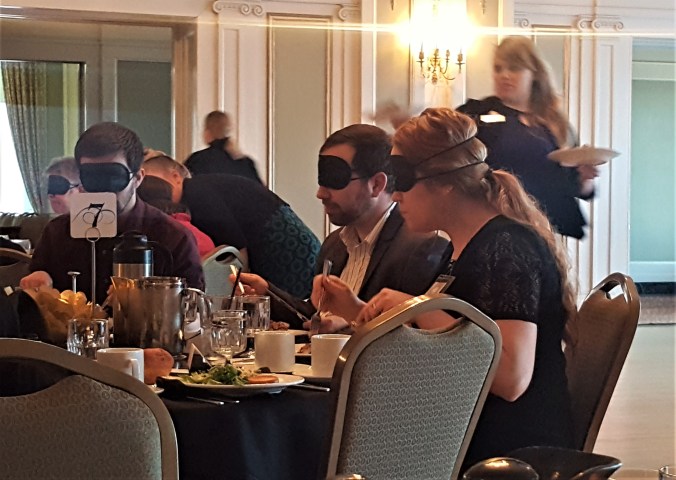
Yesterday, Russ and I paid good money to eat food we couldn’t see. The dinner was a fundraiser for the Lighthouse Center for Vision Loss, a local group that helps people with vision problems. (You may recall that I volunteer for this group by reading the Sunday newspaper aloud over the airwaves once a month.)

The event was hosted by a local TV news personality and the keynote speaker was a man who lost his vision due to retinitis pigmentosa. From him, I learned that blind people make jokes just like the rest of us (imagine that!) and that 66% of visually impaired adults are unemployed.

Another speaker before the dinner was a woman who lost her vision to diabetes. Her best joke was that this was one night when she didn’t have to worry about how awful she eats. (Because everyone else will be blindfolded. Get it? Maybe you had to be there.)

Then two speakers instructed us on how to go about eating when blindfolded. The main tips were: to sit close to the table; put a napkin in your lap or tuck it into your shirt; feel slowly with your hands where your silverware and drinks are first; think of your plate as a clock face and have someone tell you where your food is in relationship to that; use the edge of your fork to circle your meat and determine what size it is; and keep the sharp side of your knife down when cutting meat.

Before the food was brought out, we were instructed to don black blindfolds that were provided near our place settings. Once our plates arrived, I cheated and took mine off so I could tell Russ where his food was on his plate.

I found that cutting meat was the hardest part. I attempted several cuts, but couldn’t tell if my knife was  sharp-side-down or not. I ended up just stabbing a large piece of pork and tearing off pieces with my teeth — not exactly fancy dinner behavior, but hey, it worked. I appreciated the advice about reaching slowly for water glasses and silverware. I am proud to report no spillage or droppage.

Once I mostly emptied my plate, finding the remaining food became more difficult. I can’t imagine having to eat that way all the time. The experience gave me a greater appreciation for the challenges that visually impaired people face and the important work that organizations like the Lighthouse Center do.

Going on a Tongue Adventure at Duluth Cider

20190406_202549The wave of hard cideries that has swept the coasts has finally made its way inland to the shores of my fair burg. So far, one has opened in Duluth (Duluth Cider) and another is planning to open later this month (Wild State Cider).

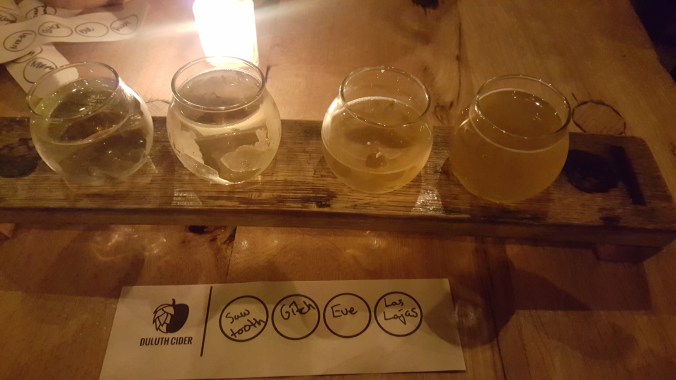
I had a chance to go to Duluth Cider this weekend and have a taste. I ordered a flight of ciders — yes, just like you can at a winery or distillery. I asked the bartender to pick out two sweet ciders and two semi-sweet ones since that mirrors my preferences in wine.

On the sweet side, he poured me Eve and Las Lajas. I have to admit, of all the varieties I tried that night, Eve was my favorite. It tastes like one of the crisp fall apples you’d eat at Bayfield’s Apple Fest. The finish had a lovely little bite.

20190406_202947Las Lajas is flavored with coffee from Duluth Coffee Company. I tried this one first, and didn’t like it because it didn’t have the traditional apple taste I was expecting. But after I tasted the other three and came back to it, my palate had gained a new appreciation. Besides the coffee, it carries hints of caramel and vanilla – rather like a crème brulee of ciders. I joked with my friend that this would make a good breakfast cider.
I did not enjoy the semi-sweet ciders as much. Those were Sawtooth and Gitch. I can’t think of any description for Sawtooth. It just did not inspire my tongue. Gitch was a bit better, but like its namesake lake, was watery compared to the more robust flavors of the sweet ciders.

Instead of ordering a flight, my friend had a full glass of the Palisade — a dry cider that he found “quite pleasing.”

Many in the crowd were drinking a reddish cider called Ruby, which is a sweet one made with cranberries. I’d like to try that next time we go back. We were there on a night that featured a jazz band. The cidery has many events planned in the coming weeks that look intriguing.

The crowd was a mix of ages, but featured a preponderance of men with dark beards, glasses and plaid shirts. So if you’re a hipster, you’ll fit right in. If you’re an oldster hipster like us, even better!

The types of ciders available vary, so you might not find these same ones when you go. Don’t let that stop you from giving your tongue an adventure and trying what sounds good.

I’m glad this wave of ciders has reached the shores of Lake Superior.

Foraging for Wild Pizza

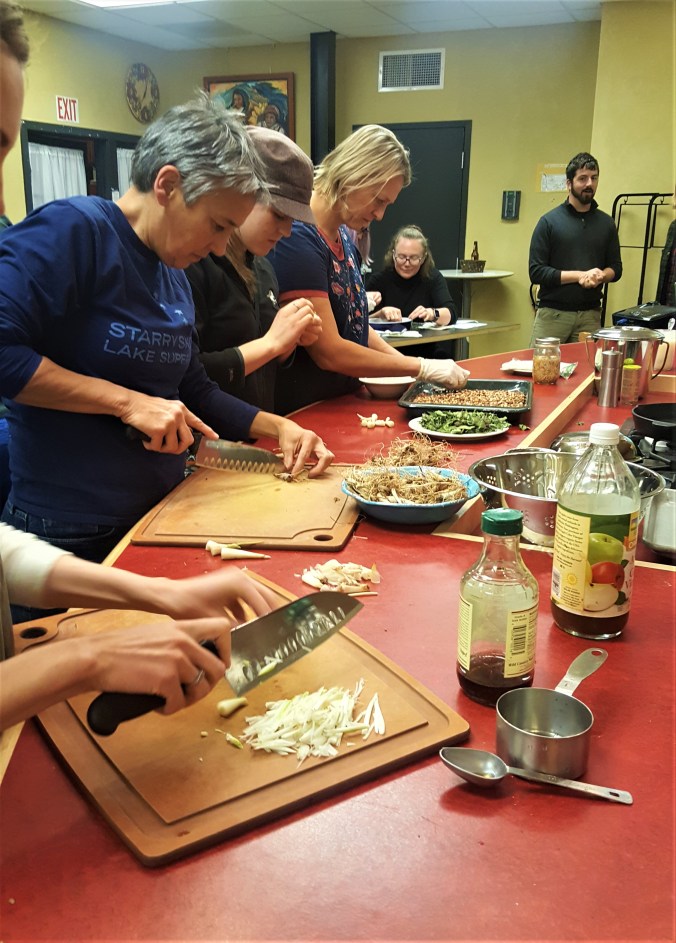
20181023_190519I took a class this week at my local Whole Foods Coop to learn how to make a pizza from foraged ingredients. The crust ingredients included wild rice flour, which is relatively easy to find and make, and acorn flour, which takes more work because you need to soak the nuts to remove the tannins.


Earlier, when I signed up for the class, I was psyched by the idea of making some acorn flour myself. However, the oak trees in my neighborhood do not seem to be cooperating this year. Last year, gobs of acorns were everywhere – so many littered the ground that walking on my neighborhood trail was hazardous — like walking on a bunch of marbles.

Our instructor, Gil Schwartz from Seasonally Sourced Foods in Washburn, Wisconsin, explained that oaks go through boom and bust cycles when it comes to producing acorns. Apparently, in my neighborhood, this year is a bust cycle, and all the trees are busting at the same time. Perhaps next fall I can indulge in my acorn-flour-making fantasy.

Anyway, I digress. While the crust cooked in the oven, we worked on the sauce and processed the other ingredients for toppings. I don’t want to hurt Gil’s business, so I’m not going to divulge his recipe. But I will say that the sauce involved simmering black nightshade berries (which are edible and taste tomatoey), sliced wild leek blubs (also known as ramps), and apple cider vinegar, with salt and dried bergamot (which tastes like oregano) for spices.

The toppings included wintercress (a spinachy-mustardy tasting plant also known as yellow rocket), cooked black trumpet and hen of the woods mushrooms, “cheese” made from the insides of young milkweed pods (boiled), and ground roasted hazelnuts.

After the crust and sauce were cooked, we assembled everything onto the pizza and cooked that for about ten minutes.

Although I only got to eat a small piece of the pizza (we had to divide the pan into twenty pieces since twenty of us were in the class), it was tasty and filling. It made me glad to know that if our society collapses and Domino’s Pizza disappears, a pizza of sorts could still be had.

My classmates joked that with all the work that went into finding and prepping the gourmet ingredients for this pizza, it would cost at least $150 to order off a menu. It made me realize that spending $20 for a class and only getting a small piece of pizza to eat wasn’t such a bad deal, after all!

20181023_194504

Romancing Las Vegas

20180529_204220

I just returned from four action-packed days in Las Vegas. I travelled with my new manfriend, Russ, so it was a chance for us to get to know each other better. We chose activities with an eye toward the romantic. Here’s a quick rundown.

The Nature

20180530_092342

Red Rock Canyon

What could be more romantic than the color red? Lucky for us, the Red Rock Canyon was just a short drive outside of Vegas. It offers plenty of trails for hiking, but if you don’t have time for that, you can drive on the one-way, thirteen-mile road through the reserve to see the spectacular scenery.

20180530_121932

Pictographs at Red Rock Canyon

We hiked two trails and saw lizards, cacti, colorful rocks, kangaroo rat dens, soaring vultures, and even some ancient Native American pictographs.

Tip: Hike in the morning, before it gets hot! During our stay, it was in the upper 90s every day with sun. Bring plenty of water.

Sharks may not be romantic, but they could make your loved one hold onto you for dear life. We visited the Shark Reef Aquarium in the Mandalay Bay Casino. Plenty of rays, sharks, and jellies.

Entertainment

Get up close and personal with your fantasy partners at Madame Toussand’s Wax Museum in the Venetian Casino. Russ and I temporarily ditched one another in favor of Brittany Spears, Celine Dione, Bradley Cooper, and George Clooney. Sigh.

20180531_115559The High Roller Observation Wheel will take you and your date to new heights on a slow spin five-hundred feet above the city. The wheel is so huge, it takes a half-hour for one rotation. Day or night, it’s a great way to get your bearings in a city with so many landmarks. Likewise is the Eiffel Tower Replica at the Paris Casino. Take an elevator ride to the top for a spectacular view.


Any of the Cirque du Soliel performances are romantic since they are French, after all. I would recommend the watery one called “O.”20180530_212209


Celine Dione has recovered from her ear surgery and is back giving concerts at the Colosseum. Somehow, we scored big on our seats. We were supposed to be in the second balcony, but got upgraded to seats on the main floor, only twenty-five rows away from her! How romantic to listen to “My Heart Will Go On” from that vantage point.

Tip: If all our nights hadn’t already been booked with shows, we would have tried a gondola ride outside the Venetian Casino. Don’t make our mistake!

Best Romantic Food

Vegas offers every type of food imaginable. But the most romantic we found was at the Eiffel Tower Restaurant. It is French, no?

If you reserve your table for two at 4:30 p.m., they will automatically seat you at the front window where you can watch the fountain show across the street at the Bellagio Casino. As with the Celine Dione concert, somehow, we mysteriously scored big on our seating. We were shown to the corner table at the front of the restaurant with a 180-degree view.

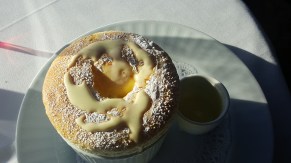
20180601_162112The food and wine is pricey, but oh so worth it! I had the lemon sorrel soup appetizer and veal medallions with morel mushrooms and fiddlehead ferns. So good! Russ had the roasted beet salad and bison with an asparagus add-on. For dessert, we romantically shared a Grand Marnier soufflé. Words fail me.
20180601_175946

Grand Marnier souffle

A Winery Tour in . . . Wisconsin?

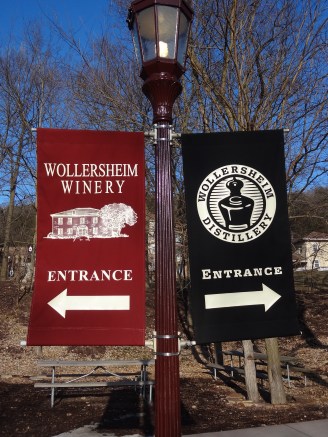
Wollersheim Winery 023Wisconsin is known best for its beer and cheese. The state offers wineries, too, and I took a tour of the most productive facility this past week. Wollersheim Winery sits on the banks of the Wisconsin River in Prairie du Sac, just north of Madison, Wis.

The winery first came to my attention a handful of years ago when I attended a retirement party. At the bar, I decided to be adventurous and try a white wine I had never heard of before, a Prairie Fumé. When the fruity, citrusy wine hit my tongue, the heavens opened wide and I heard angels sing.

I knew I had found a new favorite. I asked the bartender who made the wine, and she told me about Wollersheim Winery. I made a mental note to visit it someday.

A Fumé wine is a close relative of a Sauvignon Blanc. They’re basically the same thing, both made with the same type of grapes and semi-dry, just with different names for marketing purposes. (For the curious, see the story here.) But to me, a Fumé is a bit mellower and melon-y.

Apparently, my taste buds have a lot of company because the Prairie Fumé is Wollersheim’s most popular wine and one of the most popular in the state.

Wollersheim Winery 018The land the winery sits on has grown grapes on and off since the 1840s, whenever the weather has allowed. The vines on the property now were planted in 1972 when the Wollersheims bought it.

Wollersheim Winery 020I found the winery easily and parked in the lot below. The winery’s website says it takes 10 minutes to walk the path from the lot to the winery (which is uphill, BTW), but I estimate it would only take any relatively able-bodied person a couple of minutes. However, I suppose if you stop to read the historical sign along the way that would add more time.

I entered the winery, and to my delight, discovered I was the only one signed up for a tour. My private session commenced with a video that described the history of the winery. Then the tour guide took me to a window overlooking the huge wine vats, where we spoke more and had plenty of time for questions and discussion.

I watched another short video that featured Phililppe Coquard, a Frenchman who married into the Wollersheim Family and now co-owns the business. I had the fleeting thought that it would be fun to meet him while I was here, similar to the chance encounter my friend and I had with the master distiller of Glendronach scotch when we took a distillery tour in Scotland. Although I thought I glimpsed Philippe in the distance during my time on the grounds, I did not get to meet him.

Wollersheim Winery 036I learned that the Prairie Fumé is made from grapes not grown on the property. The grapes come from the Finger Lakes region of New York and are trucked in juice form to the winery, where Philippe works his magic on them.
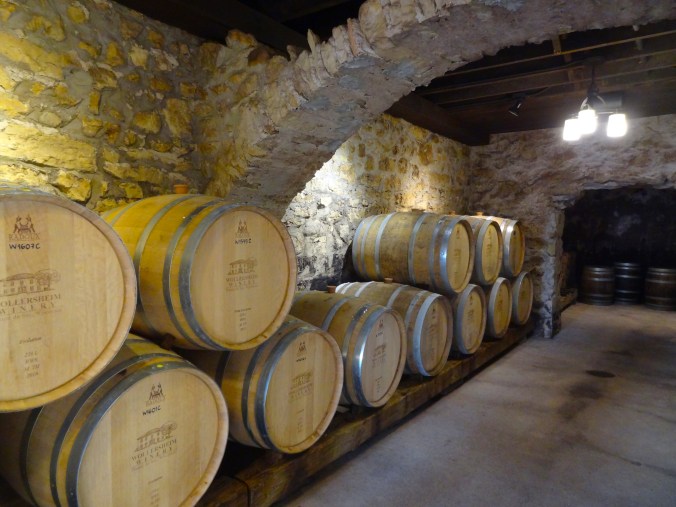
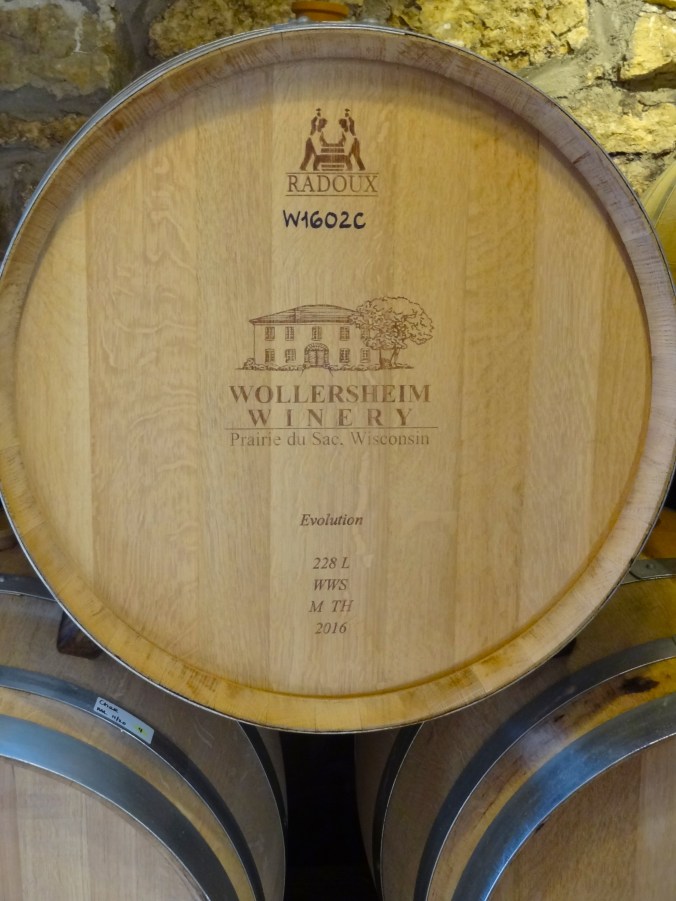
Another thing I learned is that the term “reserve” on a wine label means the wine is grown from the oldest vines in the vineyard.

After the tour came the tasting. I sampled a flight of whites since I have a problem with reds. I asked to try varieties I hadn’t already experienced, so that left out the Prairie Fumé and the River Gold White, which is also quite good.

I sampled their White Port, Dry Riesling, White Riesling, and Eagle White. Notable about the Eagle White is that it is grown on the property, and that part of the sales go toward habitat protection for bald eagles that frequent the area.

Of these, my favorites were the White Riesling and the Eagle White, so I bought a few bottles to bring home. Although I’ve found a source for Prairie Fumé in my area (President Bar and Liquor in Superior), I bought a bottle just because, despite exposure to these new wines, it’s still my fave.

Wollersheim Winery 030

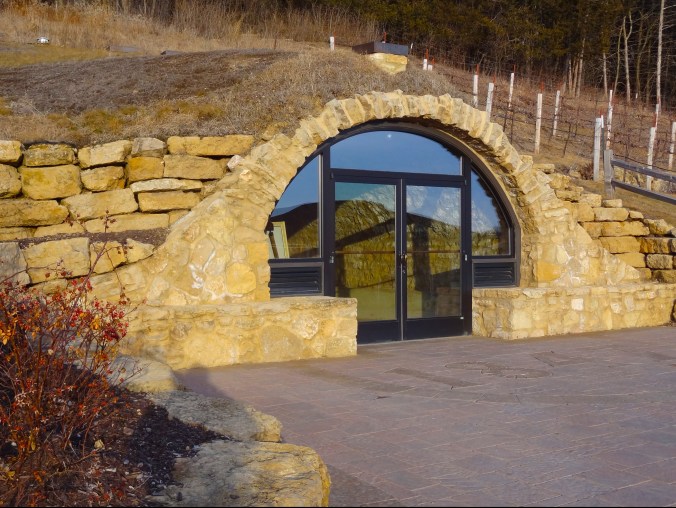
The historic wine storage cave.

Before returning to my car, I meandered around the property. There’s an old cave dug into the hillside where wine used to be stored, which the current owners have preserved and filled with historical placards and implements. I also took a peek into the wine bar on the second floor of the main building, which used to be a ballroom back in the day.

There’s also a distillery on the property, and I made a note to visit that next time I’m in the area.

Wollersheim Winery 017Alas, it was time for me to continue onto my ultimate destination, which was Madison. I was expecting to eat dinner alone there, but things worked out so that a friend from high school was able to meet me. Plus, it was her birthday, so I brought along the bottle of Prairie Fumé for her.
We met at Lombardino’s, an Italian restaurant that’s one of my favorites. As I waited for my friend and for seating, I noticed someone who looked suspiciously like Phililppe Coquard at a table near the back. As fate would have it, the host seated me and my bottle of Wollersheim wine right next to the Philippe look-alike.

While I waited for my friend, I snuck some glances and determined that fate was smiling upon me this day. It was indeed Philippe and part of his family dining at the table next to mine. What are the chances of that?! (I guess I could figure it out if I knew how many restaurants are in Madison and what the population is, multiplied by how many days are in a year.) But I guess it’s a one-hundred-percent chance when you’re following your bliss . . . .

Anyway, I knew I HAD to take advantage of this opportunity. So I mustered my introverted courage and stepped over to their table. They were gracious at my interruption. I let them know I had just visited their winery and then I gushed about how much I love their wine. Philippe mentioned he is giving a presentation at a Minneapolis wine convention soon.

It was all good, and I was so tickled and amazed by meeting them. Soon my friend arrived, and I pointed out who our dining neighbors were. She can vouch that this really did happen!

I look forward to visiting the Wollersheim Distillery in the future, but after this experience, my expectations are probably entirely too high for a fateful experience afterward.

Wollersheim Winery 024

The Taste of Hope

20171126_181632

Chef Sean Sherman

Native American chef, Sean Sherman, visited my fair town several weeks ago to promote his book, “The Sioux Chef’s Indigenous Kitchen.” Given my interest in cooking and gathering wild edibles, I had to go. He spoke to a packed house along with his co-author, Beth Dooley, who is the food editor for the Minneapolis Star Tribune. The event was sponsored by Zenith Bookstore.

One of the first things Sherman did was to disabuse the audience of the notion that Native American cuisine involves any type of fry bread. He works with pre-colonization food made with ingredients the natives grew themselves or foraged. These are things like squash, wild rice, chestnuts, fish, berries, and cedar boughs.

Sherman talked about how natives used all parts of edible plants and animals and how every one of those things had a purpose, “Except for wood ticks. They don’t have a purpose,” he joked.

A member of the Sioux tribe, Sherman grew up in a hardscrabble life on the Pine Ridge Reservation in South Dakota.  He became interested in learning about the foods of his ancestors when he was twenty-nine and was burned out from working as an executive chef in Minneapolis.

He took a year off in Mexico and ended up consulting for a restaurant there that focused on local foods. In his book, Sherman writes, “In an epiphany, I tasted how food weaves people together, connects families through generations, is a life force of identity and social structure. After seeing how the Huicholes held on to so much of their pre-European culture through artwork and food, I recognized that I wanted to know my own food heritage. What did my ancestors eat before Europeans arrived on our lands?”

Re-energized, Sherman returned to the U.S. with a plan in mind. After a lot of research and consulting, he formed The Sioux Chef in 2014 in Minneapolis.  He worked with other indigenous team members to cater events, operate a food truck, host pop-up dinners, and soon they will open a restaurant.

Sherman’s vision for revitalizing indigenous foods reaches beyond the Midwest. He hopes to spread an indigenous food system model across the country, which involves providing education and tools to native communities to reclaim their ancestral cuisines and an important part of their cultures.

And why not? It’s a diet that is hyperlocal and uberhealthy in more ways than just the physical. At the end of his talk at Beaner’s Coffee House (thank you Beaner’s!), samples of cedar tea sweetened with maple syrup were passed around. Man, was that good!

As I drove home with his book on the car seat beside me, I was excited to learn more about Native American cuisine. I could still taste the tangy cedar and sweet syrup on my tongue. To me, it tasted like hope – hope that this movement will undo some of the damage to native cultures, and hope that it will interest more people in taking care of the natural world. You don’t pollute places where you gather your food. If we look on our whole landscape as a big grocery store, perhaps we will take better care of it.