Heavenly Food: Adventures in Northern Arizona – Part 5

20171208_154644

The Cameron Trading Post Restaurant near the Grand Canyon. Note the pressed tin ceiling.

This will be my last installment about Sedona, and it deals with the next best thing to the scenery: the food!

Our first morning in town, we made our way to Creekside Coffee after seeing it advertised on television. What a way to wake up! Perched on the edge of a hill on the second floor of a galleria, the café offers a stunning view along with just about any kind of coffee one would want, plus pastries and organic fare. Wine is also available.

Another great place for breakfast is the Coffeepot Restaurant (near Coffeepot Rock). I didn’t eat there, but my traveling partner did and said it was great. They offer 101 different types of omelets!

We usually ate lunches we packed ourselves. But the one time we ate a restaurant lunch was at the English Kitchen in Jerome. See my previous post about that divine and spooky BBQ experience.

20171207_183824

The mussels and chorizo appetizer from the Mariposa.

We saved the piece de resistance of dining for after a full day of hiking near the end of our trip. We made dinner reservations at Mariposa, a Latin-inspired grill. We chose partly for the scenery — the restaurant has a wall of windows that look out to the red rock hills. The only glitch in our plan was that it was dark by dinner time! Duh.

But our view of the food more than made up for the lack of an outdoors view. And even though something went wrong with our reservation through Open Table, the hostess was able to find a spot for us.

We started off with cocktails. After hiking past juniper trees all day, I opted for a drink made from juniper berries (in the form of gin) called a juniperita. Other ingredients include St. Germain liquer, lemon juice, and agave. The lemony sweetness was the perfect refresher for my desert-worn pallet.

For an appetizer, we shared mejillones con chorizo, a mussel and sausage dish served in a white wine bouillabaisse with charred corn. O.M.G. – the sauce was divine! We dipped our bread in it, and could have been happy just with that. The sausage complemented the mussels surprising well.
20171207_185214

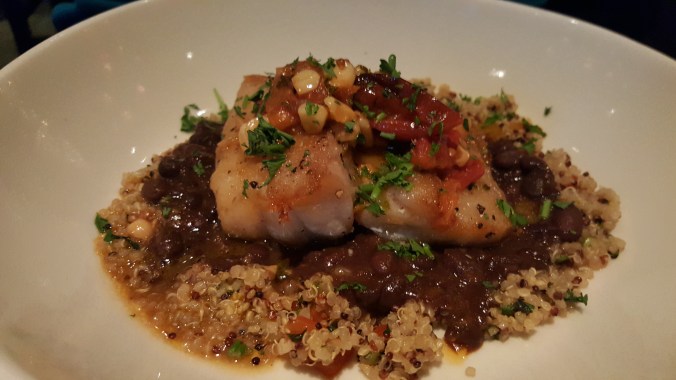
The grouper.

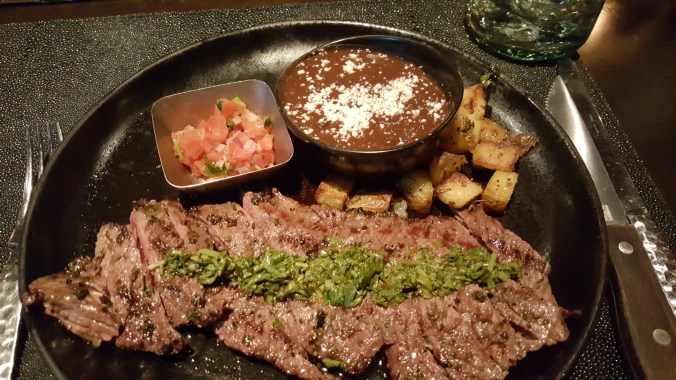
For entrees, Linda had grouper, which was the fish of the day. It was served with Campari fire-roasted tomatoes, charred corn, white wine and herb butter, frijoles negros and quinoa pilaf. She allowed me a wonderful taste. I had skirt steak served with roasted rosemary potatoes and frijoles negros.

Have you ever had a steak that melts in your mouth? It’s a rare thing, and that’s what this was. I had a hard time eating it because I kept making noises of gustatory satisfaction.
20171207_185234

The skirt steak.

Although tempted, we opted out of dessert because we had a plan, and we made our way back to our resort. Although it was only 43 degrees outside, a hot tub awaited steps away from our unit. We hearty Minnesotans donned our swimsuits and ran out to the hot tub with wine, chocolate truffles and mint fudge in hand.

The candy was from the Sedona Fudge Company. Life doesn’t get much better than when it’s spent in a hot tub under the Arizona stars, accompanied by chocolate and alcohol. I truly felt like I was on vacation.

20171208_160219

The Navaho taco (front) and other fare from the Cameron Trading Post.

The last notable eating spot we had a chance to sample was the Cameron Trading Company Restaurant near the Grand Canyon. Want a Navaho taco that’s bigger than your head while viewing Navaho blankets worth thousands of dollars? This is your place then.

Established in 1916, the trading post was the place where Hopis and Navahos bartered their wool blankets and livestock in exchange for dry goods. The restaurant’s ceiling of pressed tin is flanked by walls featuring cabinetry and stained glass from years past. A huge stone fireplace decorated for Christmas warmed us while we ate.

I had a Navaho taco, which is the most popular thing on the menu. It’s composed of a large round piece of fry bread, smothered with a combination of ground beef and beans, topped with lettuce, tomato, cheddar cheese and crowned with chopped green chilies. Spicy salsa is served on the side, but it was too much for my bland Minnesota taste buds.

So ends my accounting of this meander. I would go back in a heartbeat. There are more rocks to see, trails to hike, places to eat, and energy vortexes to experience. Thank you for journeying with me through words.

20171208_154613

The Cameron Trading Post Restaurant fireplace.
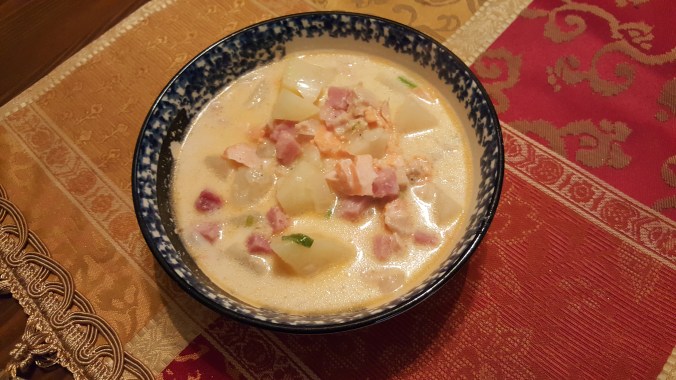
Steelhead and Clam Chowder

Steelhead ChowderThis was my Christmas Eve dinner. Hey, don’t look at me like that! While not typical, this chowder is totally holiday-appropriate, with red and green colors provided by the ham/steelhead and the green onions.


I modified this recipe from a crockpot version. This was the first time I used steelhead instead of cod or haddock because I “accidentally” found a nice fillet for half-price at the grocery store. All I can say is, yum!

20171224_160544

What the soup looks like before the potatoes and milk are added.

1 lb fish fillets (torsk, cod, haddock, steelhead, etc.)
2-6.5 oz cans of clams
3 slices bacon (diced) or 1-8 oz package of diced ham
1 medium onion, chopped
½ cup green onions, chopped
2 large potatoes, pared and cubed
2+ cups water
1-1/2 tsp sea salt
¼ tsp pepper
1-12 oz can evaporated milk

Chop the onions and cube the potatoes. Cut the fish fillets into bite-sized pieces. In skillet, sauté onion and bacon (or ham) until golden in two tablespoons butter. (But if you use bacon, no butter is needed.)

Add all remaining ingredients except evaporated milk. There should be almost enough water to cover the ingredients. (Feel free to add more, if two cups isn’t enough.)

Cover and simmer for 30-40 minutes, or until potatoes are tender. Add evaporated milk and cook 10 minutes more.

Jerome – A Counterculture and Bohemian Mecca: Adventures in Northern Arizona, Part 2

Sedona 2017 041

Jerome, Arizona.

While I was standing in line to rent a car at the Phoenix Airport, the man in front of me asked where my friend and I were staying. He was from Philadelphia and vacationed in Arizona frequently. When I told him Sedona, he said that we had to go visit the nearby town of Jerome. “It’s an old mining town with shops run by a bunch of hippies,” he said.

That’s all it took to convince me that we needed to go there. I’ve found that some pre-planning is fine for vacations, but that the best advice often comes from people you meet along the way. This trip was no exception.

The day we journeyed to Jerome dawned bright and mild, like so many other mornings during our Arizona stay. Linda and I hopped in our rented Nissan Versa, which dutifully took us up and down the northern Arizona mountains (even though the rental agency clerk tried to talk us into getting a larger car to handle the elevation changes).

20171205_111326A large “J” on a mountaintop was the first thing we noticed about Jerome. Then came the hairpin turns as we wound our way up to the town, which is situated precariously on the mountainside that used to yield its copper to miners. We parked in an area close to stores and hopped out to explore.

We purchased some goodies from the Connor Hotel gift shop, marveled at a poster that proclaimed the existence of a Jerome Ukulele Orchestra, and partook of a wine tasting at the Dragoon Mountain/Cellar 433 Winery outlet, which is simply called “Winery” on the outside. We had also visited their tasting room in Sedona, and were interested to see what different varieties of Arizona wine they offered here.

We sampled a flight of whites served by Barry, who wore a bandanna around his head and whose ears sported many heavy earrings. Our favorite was called “Sun.” Like the name implies, it was honey-colored with the warm flavor of roasted nuts. Hints of honeydew melon, white peaches and ginger topped it off. Unlike the Sedona winery, no guitarist serenaded our tasting. But like the Sedona winery, the view was fantastic, plus local artwork graced the walls.

20171205_111348

The view from the winery. The impressive building on the left used to be a hotel, but is now a private home.

Lest we walk around the perilous Jerome pathways in a stupor, we decided to cross the street to the English Kitchen Restaurant to eat lunch to cut the alcohol. That turned out to be an excellent and otherworldly choice.

Sedona 2017 038We sat in an inviting booth and learned about the history of the place from the back of the menu while the smell of hickory barbecue drifted in from the restaurant’s smoker out back. The English Ktichen, also known as Bobby D’s BBQ is the oldest restaurant in northern Arizona. It was built in 1899 by Charley Hong after his original restaurant in the Connor Hotel (where we had just been buying gifts) burned down when the hotel burned. Oh, and by the way, there used to be an opium den in the basement of the English Kitchen.

20171205_125426

The counter in the English Kitchen/Bobby D’s BBQ.

Charley died in booth #3 of the restaurant, where he frequently slept. Apparently, he is still hanging around, his presence manifested by flying salt shakers and misplaced items. The restaurant turned into the BBQ joint it is today in 2011.

When our waitress came to take our order, I asked her where booth #3 was. She pointed to the booth where we sat. “Do you want to know what side he died on?” she said, with the ghost of a smile. I could guess, but asked anyway. She pointed to the side where I sat.

20171205_130233Ewwwww!

But that did not make me lose my appetite. I ordered the BBQ bacon cheeseburger with fries. Oh man, oh man, oh man. That was good! It came with four different barbecue sauce choices. My tastebuds grew up in Minnesota, so that means I chose the non-spicy sweet one. Sorry, I can’t recall the name, but the sauce complemented the meat perfectly.

After lunch, we waddled around town for another hour or so. We found a shop that specialized in kaleidoscopes. Don’t see that every day.

We could have easily spent several days looking through all the shops, but the Sedona hiking trails were calling us, and we had to answer. And besides, we needed to walk off all the barbecue.

Photo Caption Contest!


20171117_184857Crop

My family celebrated Thanksgiving early this year. This is my favorite photo from the memorable occasion. My dog Buddy is looking longingly at the turkey carcass.

It begs a photo caption. Suggest your best one by commenting below. I (the sole judge) will send the winner a free copy of my novel, Plover Landing. I will ship it anywhere in the world, so put your creativity caps on, people!

The contest will be open through Saturday, November 25. I will contact the winner privately for their address.

The Cream Puff of Happiness

004

I meandered over the San Francisco for a work conference and found the best concept for an eatery near my hotel. All they sell is cream puffs. A whole store devoted to the ultimate in decadence!

While growing up, I had heard about cream puffs on television, but had never eaten one. They were not sold in my city at that time. Once I was old enough to cook, I happened upon a recipe in my mother’s Betty Crocker cookbook and promptly went about making them. I was in heaven with the eggy, creamy, fluffy result.

Now cream puffs are less of a rarity. But never in my wildest “I’m a hick from Minnesota” dreams did I imagine an entire franchise devoted to the sweet.

002Beard Papa’s offers several varieties of cream puff shells. At the store I visited, these included original, chocolate-covered and green tea-covered. Filling choices were vanilla, peanut butter, and green tea. (I suppose the green tea ones are for people who are trying to trick themselves into thinking they are eating something healthy.)

I ordered an original shell with peanut butter filling, and a chocolate shell with vanilla filling. Both were divine. The shells were crispy on the outside and fluffy on the inside. The filling was cold and custardy. I preferred the vanilla filling over the peanut butter slightly, but only because it’s more classic.

With everything that’s going on in the world today, it makes me happy that cream puffs have their own store. If I’m 20 pounds heavier once I return home, you’ll know why.

Scallop (or Shrimp) Linguine


20170326_174441

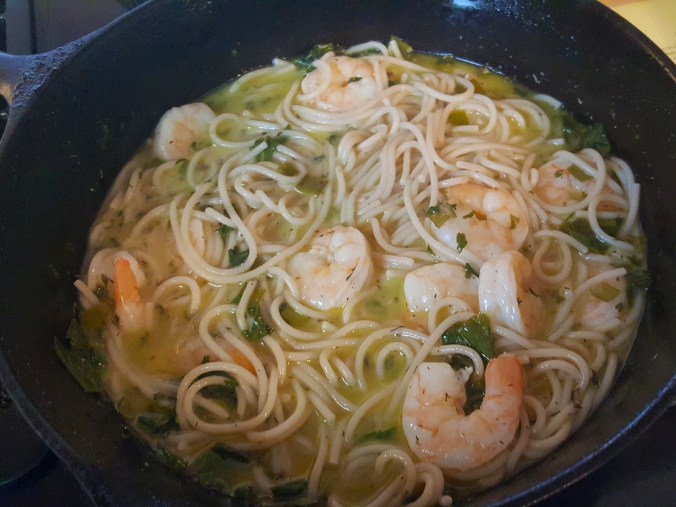
This recipe is modified from one I got off the interweb from the Rachael Ray Food Network. This version is wheat- and corn-free. Although if you really want wheat, you can just use regular linguine noodles.

½ pound linguine noodles (brown rice spaghetti noodles work well)
1 pound scallops or 12 oz shrimp
Sea salt and black pepper
1 T extra-virgin olive oil
3 T butter, divided
2 cloves garlic, chopped
1 bunch green onions, chopped
1 t thyme
3/4 cup white cooking wine
3/4 cup clam juice or seafood stock
25 leaves fresh basil, shredded or torn
1-2 T parsley
1 T lemon juice

Boil pasta in large pot. If needed, thaw shrimp or scallops under cool running water for 3-4 minutes (but fresh is better!) Preheat a large skillet over medium-high heat. Add 1 T olive oil and 2 T of the butter.

For scallops: When butter is melted, add scallops. Brown scallops 2 minutes on each side, then remove from pan and cover loosely with foil to keep warm.

For either: Add the garlic, green onion, thyme, salt and pepper to skillet. Reduce heat a little and saute 1-2 minutes, stirring constantly. Add wine to the pan. Reduce it by cooking (boil) for one minute. Add the clam juice, basil, parsley, lemon juice and the remaining 1 T butter. Stir until the butter has melted.

For shrimp: Add the shrimp now. If raw shrimp, cook in sauce until done. If pre-cooked shrimp, cook less time until warm.

Add the linguine and cook for about a minute to combine and let the pasta soak up the sauce. Divide the pasta between two serving plates and if using scallops, top with the reserved scallops. Serve with shredded Parmesan cheese, if desired.

Superb!!!!

Aruban Dreams (Part 2) – Caves

DSC03902

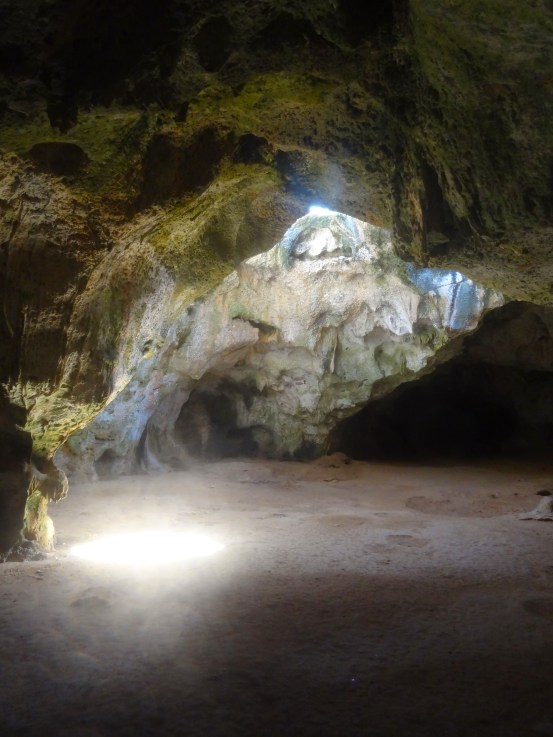
Quadirikiri Cave

In the previous episode, my friend and I were returning from a trip to the Conchi Natural Pool in Arikok National Park in Aruba. After being spared a forced death march through the desert back to our car by some kind folks who had room in their Jeep, my friend and I were set to explore two of the park’s caves.

IMG_7433

What we could see of Fontein Cave through the locked gates. Photo by Karen Brehmer.

The caves are drivable via a paved road that devolves into a gravel road. But first we needed some lunch. Boca Prins Restaurant appeared before us, an oasis in the middle of nowhere – at the edge of a sea cliff where the paved road ends.

I had THE BEST pina colada and fish stew of my life there. The cold drink felt wondrous after our morning adventure and the fish stew was light, fishy, and limey – obviously made by someone who knew what they were doing.

We tarried over lunch so long that by the time we got to Fontein Cave, the gates to it were closed (it closes at 3:30 p.m.). If we had been able to enter it, we would have seen native pictographs dating back 1,000 years, along with drawings by colonialists. Guess I will have to visit it again on my next trip to Aruba.

DSC03910

Quadirikiri Cave

Then we traveled to Quadirikiri Cave, which is known for its two large caverns and bats. The caverns are lit from holes in the ceiling. I could immediately see the appeal of the caves to ancient peoples. They provided shelter from the relentless and ever-present Arubian tradewinds and sun, and they were very roomy. I would totally have lived there 5,000 years ago.

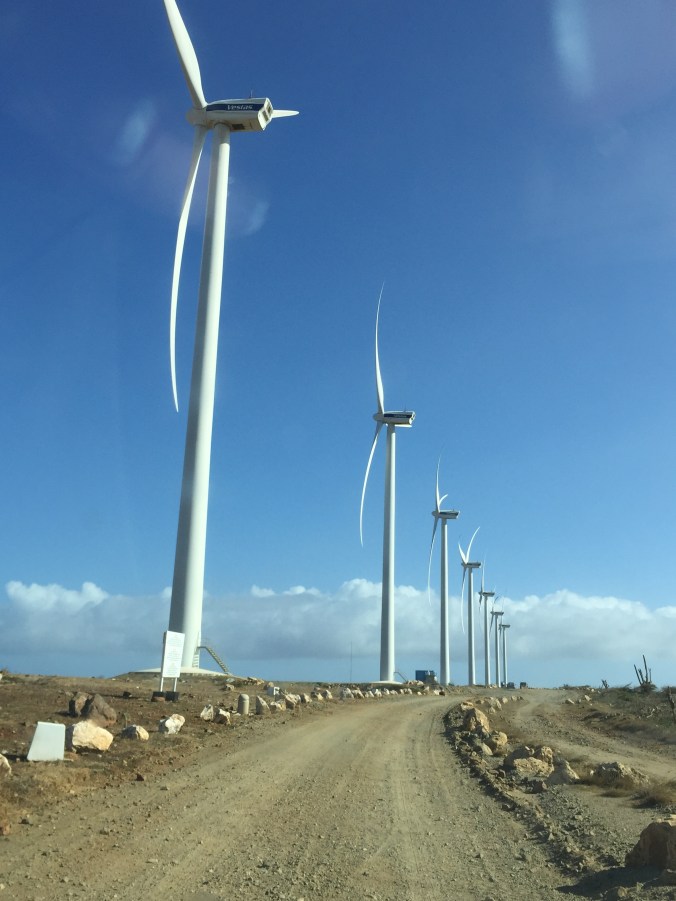
On our way out of the park, we drove past some prominent landmarks that took the form of wind turbines. Aruba gets a good percentage (15%) of its power from renewable sources, with a goal of 100% for the year 2020. The wind-farm we drove past is not part of the park, but it’s just as impressive as some of the natural landmarks.

Thus ends our time in the park. Next up: Beaches and Butterflies.

IMG_1443

Image by Karen Brehmer.

Blueberry Buttermilk Pancake Distraction

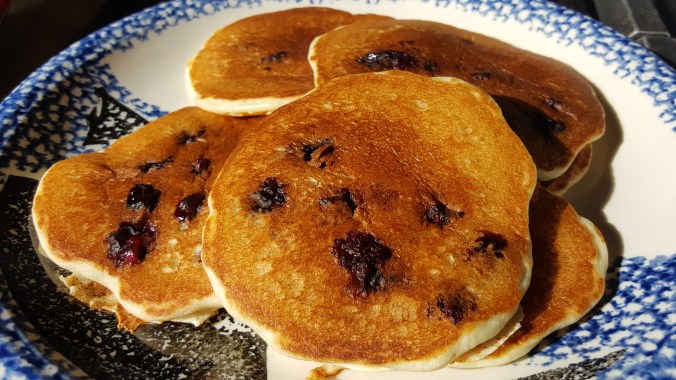
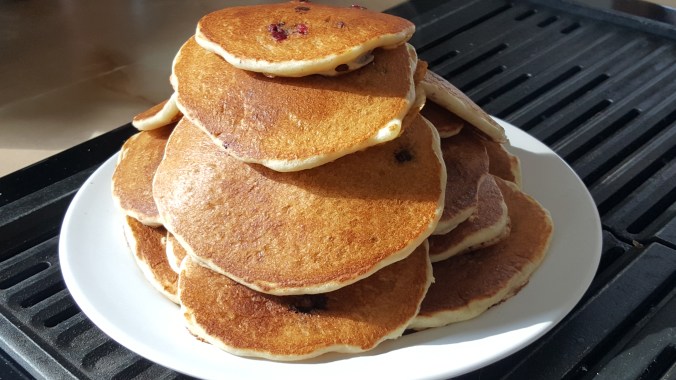
20170304_102544Never mind that President Donald Trump just zeroed out the agency I work for in his proposed federal budget. (I work for the Sea Grant Program under NOAA.) I realized I haven’t shared a recipe lately. Here’s a wheat- and corn-free version of blueberry buttermilk pancakes. I’d much rather think about them than Donald Trump’s budget.
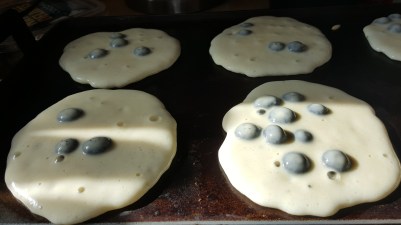
If I let The Donald freak me out too much, he wins. I won’t let him win. But I will tell my friends to write their congressional representatives, and I’m sure I’ll blog more about this situation later. (Oh lucky readers, you!) In the meantime, I’ll cook some luscious pancakes in the sunshine on a weekend morning.

20170304_102057This recipe makes a lot of pancakes – enough for 4-6 people. If you’re sensitive to wheat, make sure to use vanilla extract that contains no grain alcohol. I make mine by soaking several vanilla beans in a bottle of potato vodka for a few weeks. For the gluten-free flour mix, I use Bob’s Red Mill all-purpose gluten-free baking flour.
And if you’re sensitive to corn products, make sure the buttermilk you buy doesn’t have a lot of extra ingredients added to it (like “natural flavor,” which can be secret code for corn syrup). Also, don’t use table salt. It usually has cornstarch added to it to make it flow more smoothly. Use sea salt instead.

Enjoy!

Blueberry Buttermilk Pancakes

2 eggs
2 cups buttermilk
4 T canola oil
1 cup rice flour
1-1/4 cups gluten-free flour mix
2 T cane sugar
½ t cream of tartar
1 t baking soda
1 t sea salt
1 t vanilla
1+ cup blueberries

Whisk eggs. Add remaining ingredients (except blueberries) in the order listed and whisk until smooth. Stir in blueberries.

Pour batter onto hot griddle. Turn pancakes as soon as they are puffed and full of bubbles, but before the bubbles break. Bake other side until golden brown.

20170304_1035230

This recipe makes A LOT of pancakes.

Gingerbread House Catastrophe

20161231_123313

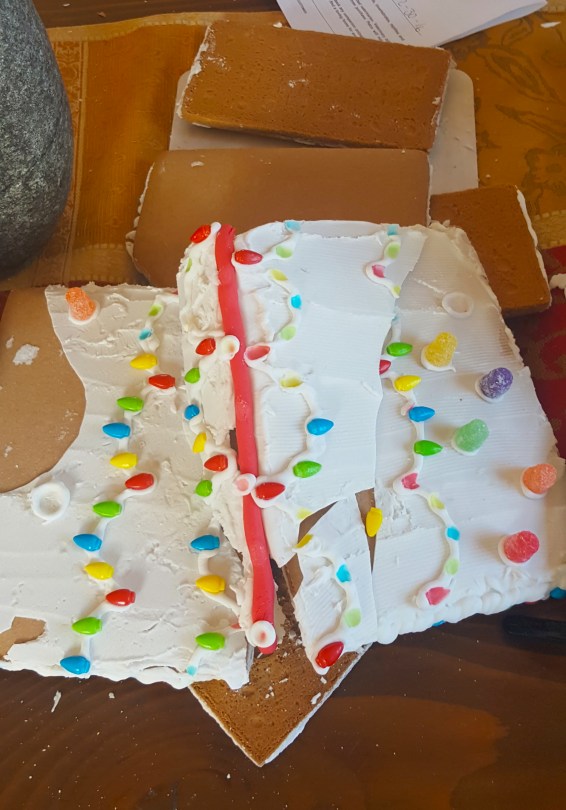
Tragedy struck the Marie household yesterday with the total and spontaneous collapse of a gingerbread house.

“I was in the kitchen doing something at the sink when behind me I heard this terrible crunching sound and a thud,” said Marie. “When I turned around, I saw the gingerbread house that my son and his girlfriend made spread flat out on the kitchen table. I swear, I didn’t touch it!”

Emergency responders on the scene reported that no people or animals were injured in the collapse. Damages estimated at $10.

Marie said that when she told her son about the incident, he instructed her to throw away the sides of the house, which had already been picked clean of frosting and candy, and to save the roof, which still contained candy.

“I sure hope this isn’t a harbinger of doom for 2017,” she quipped.

The Deflowering of a Whisky Virgin: Adventures in Scotland, Part 3

SCOTLAND! 077

Sure, I messed around a few times – kissed the rims of a few whisky glasses in my fifty-something years, took a few sips — but I didn’t know what I was doing.

In my everyday world, most of my experience was with wine, gin, and hard cider. I really can’t have much else due to an intolerance for wheat and alcohol made from grain. But scotch whisky is made from barley, so our trip to Scotland within sight of the Speyside Whisky District provided a prime opportunity to experiment and branch out into a whole new area of sensual delights.

My friend and I visited two distilleries in the Highlands during our week together: Glen Dronach in the town of Huntley, and Strathisla in Keith. As with most sensual experiences, my first at Glen Dronach, was the most memorable.

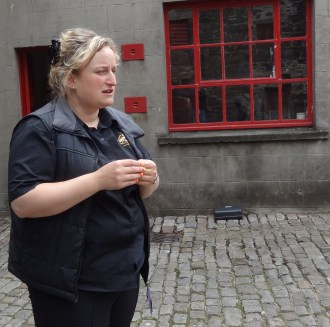
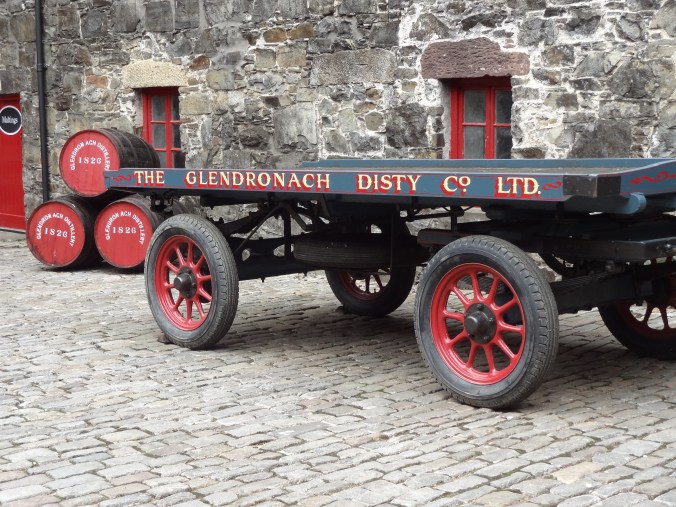
Glen Dronach is renowned as a “distiller of richly sherried single malt whiskies of inimitable and individual character” (according to their web site). Our tour guide, Karen, explained that unlike other distilleries, their whisky is aged in barrels that were once used to store sherry in Spain. The flavor of the sherry seeps into the wood, and seeps back out into the whisky stored in them.

SCOTLAND! 076B

Karen, our distillery tour guide.

The distillery was in full production mode, so we were able to see all the processes, from the malted barley being ground into flour, to the brewing, fermentation, and distillation. The smells of all those processes were earthy and wondrous. I was impressed by how huge the vats were in comparison to a gin distillery I recently visited back home in Minnesota.

As we walked out of the distillery and into the visitor center for our tasting, Karen pointed out an American flag on the lawn amongst several others. She said the flag was new and represented the fact that Glen Dronach and its parent company were recently acquired by the parent company of the Jack Daniel’s brand of whiskey. Others on our tour expressed fears that the new company would come in and change everything. Karen said she hoped that wouldn’t happen. “Why buy something that you like and then change everything?” Those Highlanders and their traditions. I expect that even if the new company wants to change things, they’ll run into a bit of resistance. 🙂

An interesting thing we learned on the tour is that while it is aging, some of the scotch evaporates from the barrels. This is unavoidable. The disappearing drams are called the “angels’ share,” since it’s the angels that get to drink it. Karen said she’d like to be one of those angels someday.

Onto the tasting. I chose the basic tasting, which featured eight-, twelve-, and eighteen-year-old scotch samples. My friend (who was our driver) took the driver’s tour, which, alas, featured no on-site tasting, but she was given a dram of twelve-year-old scotch to take home. Since the distillery is sort of in the middle of nowhere, it makes sense that they would offer this option because the only way to get there is by driving. I suppose there are legal reasons, too.

As I was sampling, my friend asked our guide what her favorite whisky was. Karen said when she has company at home, she brings out the twelve-year scotch. “But,” and here she cradled a bottle between her breasts like a child, “for my family, I save the eighteen-year scotch.”

She was right to save the oldest for her closest kin. The younger whiskies were fine, but when the eighteen-year-old version touched my tongue, I felt things I never had before. (Smirk.) No really, the flavor was so much more full-bodied and warm. The whisky assaulted my entire tongue, not just a part of it. Tastes of sherry, oak, barley fields, Highland air and Speyside water made me stop and take a step back from the table.

“Oh, that’s good,” I said, promptly ignoring the dregs of my other two whiskies, and concentrating on the eighteen-year-old.

We talked for a while more and then a blond-haired gentleman walked into the room. Karen introduced him as Billy, the master distiller. She told him about my reaction to his eighteen-year-old scotch. He smiled and looked pleased that he obviously still had the right touch.

Of course, now that I’m back in America doing research for this posting, I find out that Billy (Walker) is pretty much head of the whole frikin’ company. I can’t believe we met him!

We left Glen Dronach with a good feeling about the family atmosphere of the distillery, and with a supply of scotch to celebrate that night’s Solstice back at Crovie Cottage #13.

031

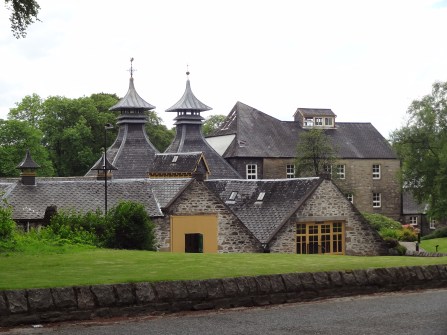
Strathisla Distillery in Keith, Scotland.

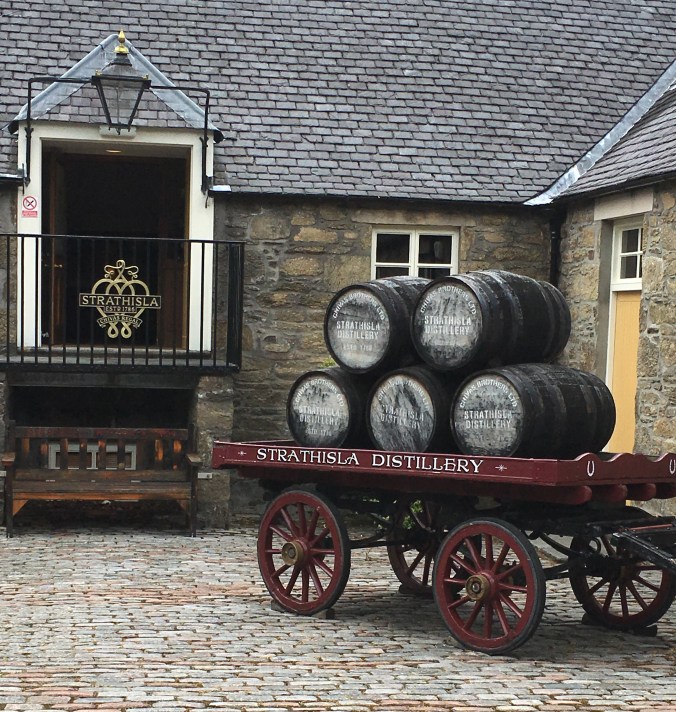
A few days later we visited Strathisla (pronounced Strath-ila), the oldest operating distillery in the Highlands, and the spiritual home of Chivas Regal scotch. Like Glen Dronach, Strathisla was purchased by an American company that had already been using Strathisla’s single-malt scotch as the basis for its blended whisky products. Strathisla’s parent company also owns The Glenlivet and Aberlour distilleries.

Unfortunately, the distillery was down for cleaning, but we decided to take the tour and do a tasting anyway since we had time. The size and scope of Strathisla were similar to Glen Dronach. But at Strathisla, we had the additional experience of going into one of the warehouses to see where the barrels rest. We learned that distilleries often warehouse other distilleries’ barrels as a kind of insurance in case some disaster befalls the parent distillery.

Another fact our tour guide mentioned is that there are 20 million barrels of whisky in Scotland. Wow! Even though there’s so much of it, it has to age at least three years before it is used. She said the distilleries are having a hard time meeting demand for their product worldwide, and that China is home to most of that demand.

All but one of the whiskies offered at their tasting was blended with grain alcohol, so I only tried the twelve-year-old single-malt Strathisla. (Besides that, I was the driver this time.) It was very good, but did not have quite the same effect on me as the eighteen-year-old Glen Dronach.

I left glad that I had lost my whisky virginity to Glen Dronach and the skillful hands of Billy Walker. Now I know a little bit more what I am doing when it comes to scotch.

As if whiskey virgin deflowering weren’t exciting enough, my next entry will focus on some of the wilder pursuits in Northeastern Scotland.

IMG_1020