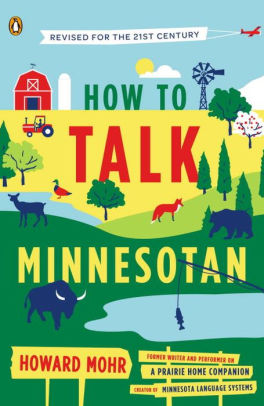
Book Review: How to Talk Minnesotan, Revised for the 21st Century

9780143122692_p0_v3_s550x406The first version of this book, published in 1987 and later made into a video, helped me understand my own culture. Before reading it, I never understood that the “long good-bye” was something unique to my state of Minnesota. (The long good-bye is where it takes at least three tries to leave a friend’s home before they will actually let you go.)

Also helpful was the “angle rule,” which describes how many Minnesotans talk to each other without actually looking at each other. Instead, they stand at 90-degree angles, looking off at some mysterious distant point while conversing. I had seen that many times and just thought that’s how everyone did it. I was not conscious that these were Minnesota “things.”

I watched the “How to Talk Minnesotan” video so many times, I had the lines memorized. So when I heard the book had been updated (in 2013), I put it on my list to read.

In reading the recent edition, it didn’t seem like a whole lot had changed. Although it now contains sections on Tweets, Facebook, and smart phones, the same lines from the video are there on the page.

However, in reading this new version, I realized something that nagged me with the first version, which is that this is not a book that encompasses the whole of my dear state. The traits described in it are more common in farm country. I’d say that’s about from Hinkley, Minnesota, and south. With token mentions of smelt and lutefisk, this book has a bit of relevance to northern Minnesota, BUT, there’s not one mention of a sauna etiquette, iron ore mining, Lake Superior, Ole and Lena jokes, or wilderness camping. It lacks northern nuances.

A more accurate title for this book would be “How to talk Mid- to Southern-Minnesotan.” If you live north of Hinkley, reading it will be helpful, but it won’t get you the whole way. If a third version is ever done, the author should come on up here and talk to us northerners for some new material, don’t cha know.

Forest Bathing: A Secret to Better Health

20190622_135935A recent New York Times article described results from a study that quantified how much exposure to nature people need to impact their health in a positive way.

The researchers found that people who spent about 120 minutes per week in nature (like a park or a forest) were less stressed and healthier than people who didn’t get outside at all. Spending less time (60-90 minutes) did not have as significant an effect. Even spending more time (5 hours) offered no additional benefits.

From this post’s title, perhaps you thought I was going to describe how to get nekkid and take a bath in the forest. Sorry, “forest bathing” just means immersing yourself in nature.

The study’s results made sense to me. As a species, we evolved in the outdoors. It’s what we’re made for. Spending time by water is also beneficial.

20190622_133733I am happy to report that I spend at least 140 minutes in nature per week. I am lucky to have a huge city park by my home where Buddy the Wonderdog and I walk every day.
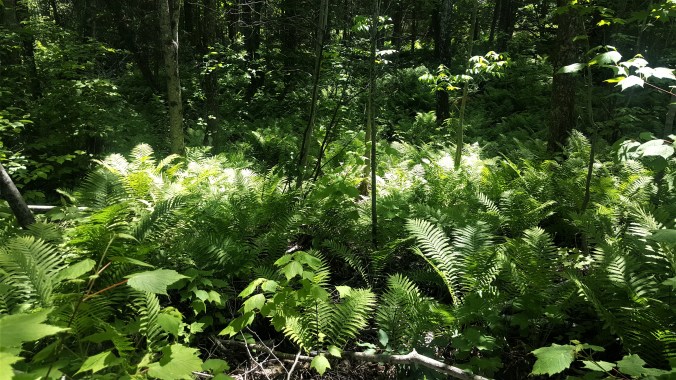
I took some photos from my last walk through the park. At 640 acres, the park is large enough that you’d never know you were in the middle of a city while walking its trails. Signs of civilization are few, even from the rocky knob that features a view of Lake Superior.

My photo walk was longer than usual – over an hour. I returned home feeling serene, indeed. Have you had your dose of nature today?

20190622_132014

Happy Belated Birthday Bob (Dylan)

20190525_153633

Bob Dylan’s childhood home in Duluth.

Last Friday was Bob Dylan’s birthday. My hometown of Duluth does it up right by holding an annual Dylan Fest — a week of events that features song, poetry, lectures, tours, and birthday cake.

This year, we attended the launch of a new book of poetry inspired by Dylan. “Visiting Bob” contains 100 poems by U.S. and international poets. A half dozen of the poets read their works and other poets’ works. Some of the poems were beyond me but others I understood. One that stuck was by local poet, Connie Wanek. Its theme was Dylan sightings in Duluth — are they false? Are they true? It ends on a hopeful note that perhaps someday the poet really will see him back in this town where he was born.

We also attended a lecture by one of the poets from Texas, David Gaines. Because he wrote a book about Dylan, he attracted media interest when Dylan won the Nobel Prize. Gaines described his experience being interviewed by Swedish public television and other major media outlets. He also got to travel to Stockholm to attend the airing of a Swedish public television story in conjunction with the prize ceremony.

On our way home from the lecture, we decided to stop by Bob Dylan’s home on the hillside, since it was on our route and we’d never seen it. A fan owns it and has spiffed up the duplex. Dylan lived in the right-hand side. A plaque on the front of the home proclaims its significance.

It’s hard to believe that I’ve lived here over five decades and never looked it up before. ‘Bout time, I guess.

When I posted the house photo on Facebook, one of my friends said they had a chance to rent the place in the mid-1970s, but turned it down. They didn’t know the home’s significance, however. When they found out afterward, they deeply regretted their decision because they were fans.

Another friend said she walked by the place thousands of times but it took years before she learned who had lived there.

These are typical instances of  “Duluth” to me. It’s a big small town. It’s large enough to get lost in if you want, and to never see parts of it. But it’s small enough that everyone has friends in common through one means or another, whether they went to school with them, or worked with them, etc.

Even after all this time, this town still has hidden gems to discover for those who take the time to look.

Going on a Tongue Adventure at Duluth Cider

20190406_202549The wave of hard cideries that has swept the coasts has finally made its way inland to the shores of my fair burg. So far, one has opened in Duluth (Duluth Cider) and another is planning to open later this month (Wild State Cider).
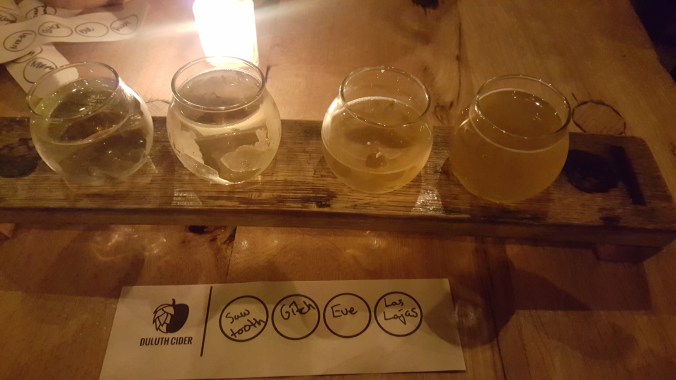
I had a chance to go to Duluth Cider this weekend and have a taste. I ordered a flight of ciders — yes, just like you can at a winery or distillery. I asked the bartender to pick out two sweet ciders and two semi-sweet ones since that mirrors my preferences in wine.

On the sweet side, he poured me Eve and Las Lajas. I have to admit, of all the varieties I tried that night, Eve was my favorite. It tastes like one of the crisp fall apples you’d eat at Bayfield’s Apple Fest. The finish had a lovely little bite.

20190406_202947Las Lajas is flavored with coffee from Duluth Coffee Company. I tried this one first, and didn’t like it because it didn’t have the traditional apple taste I was expecting. But after I tasted the other three and came back to it, my palate had gained a new appreciation. Besides the coffee, it carries hints of caramel and vanilla – rather like a crème brulee of ciders. I joked with my friend that this would make a good breakfast cider.
I did not enjoy the semi-sweet ciders as much. Those were Sawtooth and Gitch. I can’t think of any description for Sawtooth. It just did not inspire my tongue. Gitch was a bit better, but like its namesake lake, was watery compared to the more robust flavors of the sweet ciders.

Instead of ordering a flight, my friend had a full glass of the Palisade — a dry cider that he found “quite pleasing.”

Many in the crowd were drinking a reddish cider called Ruby, which is a sweet one made with cranberries. I’d like to try that next time we go back. We were there on a night that featured a jazz band. The cidery has many events planned in the coming weeks that look intriguing.

The crowd was a mix of ages, but featured a preponderance of men with dark beards, glasses and plaid shirts. So if you’re a hipster, you’ll fit right in. If you’re an oldster hipster like us, even better!

The types of ciders available vary, so you might not find these same ones when you go. Don’t let that stop you from giving your tongue an adventure and trying what sounds good.

I’m glad this wave of ciders has reached the shores of Lake Superior.

Free Poetry Project

free poetry dnt

Image by the Duluth News Tribune. That’s my poem that’s pictured!

The city of Duluth has a poet laureate. The current laureate’s name is Gary Boelhower. One of the ideas he put forth during his nomination process was to organize a free poetry project in our community. He made it happen, and now people can pick up poetry printed on cards at a dozen locations around town, including bookstores, coffee shops, and cafes.

Eleven local poets offered poems, including me! I offered several poems that haven’t been published yet. I chose fun ones that I thought would have popular appeal. One of them, titled “My Facebook Identity,” happened to be featured in a newspaper photo that accompanied a story about the project. To learn more, read the story.

I’m honored to take part in this sprinkling of poetry across our city!

In Which My Writing Inspires Theft

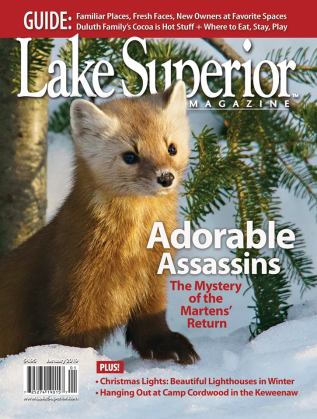
45400919_10155548206416386_4915007419303591936_nHere’s a peek into the glamorous life of a local author. I was at the mirror in my church bathroom today when a lady going into a stall stopped and said she enjoyed reading the cover story on American martens that I wrote for Lake Superior Magazine recently.

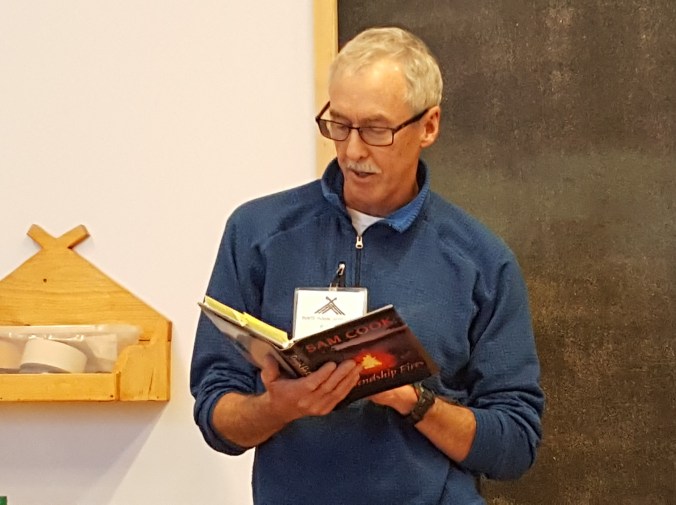
She saw the magazine in her doctor’s office and since she knew a new issue of the magazine was coming out soon, she thought it would be okay to take the magazine so she could send it to her grandchildren in Japan who love learning about northern wildlife.

I thanked her and told her that there are martens in Japan, too.

Afterward, the more I thought about it, the more tickled I became that she valued my story enough to steal it. Although, perhaps she needs to listen harder to the moral messages during the church service!

The Case of the Headless Bunnies

bunny1naturehaven

A cottontail rabbit. Image courtesy of naturehaven.com.

Almost every day, I walk Buddy the Wonderdog in the woods by my home. This past summer, I was creeped out to see two dead rabbits on the edge of the woods. The incidents happened at separate times but in almost the same locations. The rabbits’ heads were gone, but much of their bodies was still there.

Then yesterday, I saw a headless rabbit again along a different edge of the woods. It lay in the snow with its fur ruffled at the beginning of the trailhead — almost as if someone had placed it there on purpose. A bloody mangled mess of muscle marked where its head and one of its legs had been. No animal tracks led to or from the body. It was as if the rabbit dropped from the sky.

Mysterious.

I finally got curious enough to investigate. I searched the internet for “animals that eat rabbit heads.” I came up with a story from the Toronto Star in Canada that described the horror some schoolchildren felt when they found headless bunnies near their schoolyard. The children thought a person with evil intentions decapitated the rabbits.

However, people familiar with the ways of wild animals responded that the bunnies were the work of an owl, not a Satanic Cult. They explained that owls can’t carry the whole rabbit, so they only take the head.

That’s the same explanation my woods-wise friends gave me when I described the gruesome scene from my dog walks. Also, brains are made out of fat, so I suppose owls get more energy from eating them than from eating other parts of a rabbit.

Similar to the situation mentioned in the news article, the rabbits’ bodies I saw this summer were near the same location each time. I think that makes sense. Animals tend to hang out in the same places. If an owl found a rabbit in a certain place one time, it must be a good place for rabbits, so they are likely to hunt there again.

The lack of tracks also makes the case for an owl doing the killing (or some other type of raptor) versus a human or an animal. The owl attacked from above, so of course it wouldn’t leave tracks.

I am glad to learn that the headless bunnies are just a case of nature taking its course, and not the work of twisted humans. But I am still sorta creeped out.

The Neighborhood Rezoning Zombie Apocalypse

WalkingDead-963583AMC

Image from The Walking Dead television series, courtesy of AMC.

One of my blog readers warned me it might not be dead, but I didn’t want to hear. I plugged my ears, closed my eyes and started singing (“La la la la la…”)

But he was correct. The rezoning issue for my neighborhood wasn’t dead. It rose, like a zombie, from the Duluth City Planning Department even though the planning commission voted it down. (See Part 1, Part 2, and Part 3 for more info about this six-month-long saga.)

As it turns out, this is common practice in my city. The planning commission actions are just considered “recommendations,” not the final word. I wish someone had explained this to us from the beginning.

Thinking you’ve won a fight only to find you need to fight it all over again is disheartening. It also seems like a waste of effort to have every zoning issue heard by two civic groups. Why even have a planning commission then?

Anyway, once I heard that the proposal to rezone our Duluth residential neighborhood for commercial development was going before the city council, I admit, I tucked my head and legs inside my shell and hid for a while. However, in hiding, I regathered my gumption and eventually fired off yet another letter of protest to the city council. But that, and writing blog posts, didn’t seem like enough.

The city council heard the issue during two meetings. I couldn’t make the first hearing (because it happened while I was being a turtle). The same couple of neighbors who spoke before the planning commission spoke before the council. I decided it would be good to add a new voice for the next meeting, and that voice should be mine. If I was going to come out of my shell, I might as well do it up good.

The city council chambers was packed – standing-room-only. Most people were there for another contentious issue that involved a proposal for a new downtown apartment building that did not have any affordable housing units included. Along with a lack of single-family homes (like those in my neighborhood), a lack of affordable housing is a big issue in our city.

The hearing for the apartment building and other city council issues took 3-1/2 hours. We sat there at 10:30 p.m., boiling in our long johns, awaiting our turn. Once the affordable housing protesters left, a good number of my neighbors remained in the chambers.

I ended up as the first signed up to speak for our issue. When my name was called, I took a big gulp, stood, and did my thing. I was too nervous to speak without notes, so I used those as an aid. They also helped me stay within the three-minute speaking limit. My speech went fine, and I was sure glad once it was over! Several other neighbors also spoke.

The city councilors asked questions and a few explained their positions. In the end, they voted UNANIMOUSLY (7-0) to reject the proposal to rezone my neighborhood. I am so thankful that they listened to us and to the planning commission.

Is the zombie rezoning war over? Not if the planning commissioner has his way. He said he plans to bring it up again in a few years because he wants to see “orderly development” of my neighborhood. We neighbors would rather see no development. We are a neighborhood that works. Like I said in my speech, our neighborhood ain’t broke, and this won’t fix it.

This fight seems to have renewed people’s appreciation for our neighborhood. This Christmas, for the first time, carolers came to my door. Another neighbor made luminaries (ice candles) and placed them all along the road to her house, providing a special festive touch.

The zombie is dead for now, but it seems as if the issue is biding its time, waiting for another chance to strike. I hope we’re ready to rally then.

Let’s have some fun with this. Feel free to comment with your favorite zombie-killing techniques. They could come in handy later!

Tips from Outdoors Writer Sam Cook

20181116_152952CropI meandered up the North Shore of Lake Superior last month for a writing workshop offered by Sam Cook, noted book author and outdoors writer for the Duluth News Tribune. The workshop was offered by North House Folk School in Grand Marais, Minnesota.
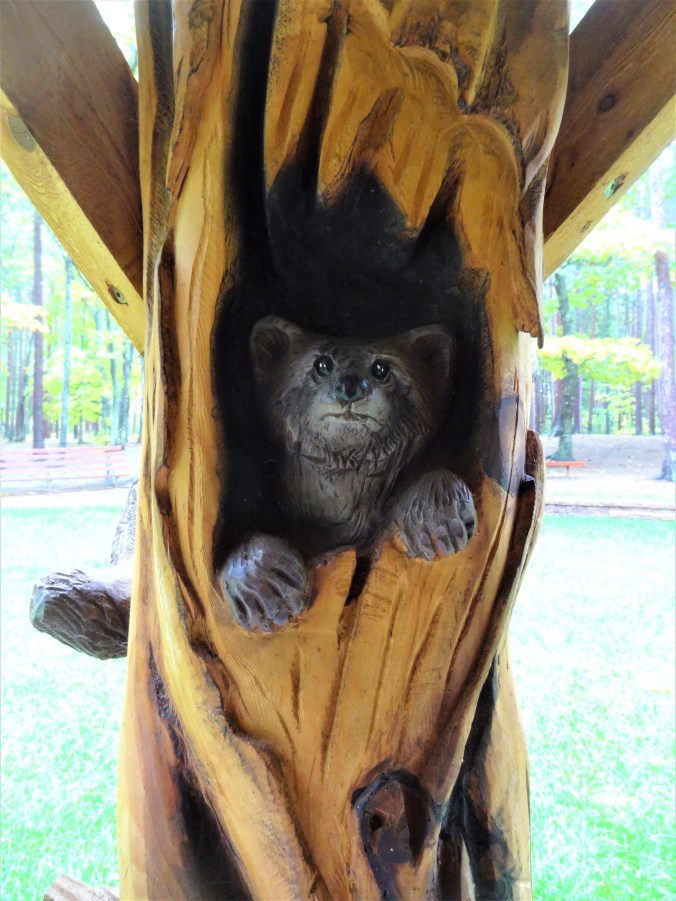
As he stood in front of us in the classroom, Sam’s eyes grew misty as he read this passage from Aldo Leopold’s “A Sand County Almanac:”

A dawn wind stirs on the great marsh. With almost imperceptible slowness it rolls a bank of fog across the wide morass. Like the white ghost of a glacier the mists advance, riding over phalanxes of tamarack, sliding across bogmeadows heavy with dew. A single silence hangs on the horizon.

Out of some far recess of the sky a tinkling of little bells falls soft upon the listening land. Then again silence. Now comes a baying of some sweet-throated hound, soon the clamor of a responding pack. Then a far clear blast of hunting horns, out of the sky into the fog.

High horns, low horns, silence, and finally a pandemonium of trumpets, rattles, croaks, and cries that almost shakes the bog with its nearness, but without yet disclosing whence it comes. At last a glint of sun reveals the approach of a great echelon of birds. On motionless wing they emerge from the lifting mists, sweep a final arc of sky, and settle in clangorous descending spirals to their feeding grounds. A new day has begun on the crane marsh.

“Sometimes it makes you depressed to read really good writing,” Sam said. However, I suspect he was moved by Leopold’s writing, and just wanted to hide how sentimental he truly is.

Sam was talking to us about the power of details in writing and how they can draw a reader into your story. Other writers he quoted from included Leif Enger, Barry Lopez, John McPhee and Dennis Olson.

I won’t give away all of Sam’s secrets, but I would like to share a few bullet points from his class that you might find useful.

  • Good writing makes people feel like they’re in the experience with the author. Incorporate all the senses into your writing (taste, touch, smell, etc.) Be a sponge, soak it all in when you’re gathering information.
  • Read your story aloud during the editing process to smooth out awkward wording.
  • In bad weather, pencils work better outdoors on paper than pens (or electronics!)

Sam passed around a stack of his reporter’s notebooks to show us how he processes information for his stories. He also read from some of his own works, notably, a story about how he – a Kanas native – became a true northerner by sticking his tongue on metal in the middle of winter.

I learned new ideas for writing story openings from Sam. If you ever get a chance to take a class from him, don’t miss it!

Marten Mania

DSC05086Edited

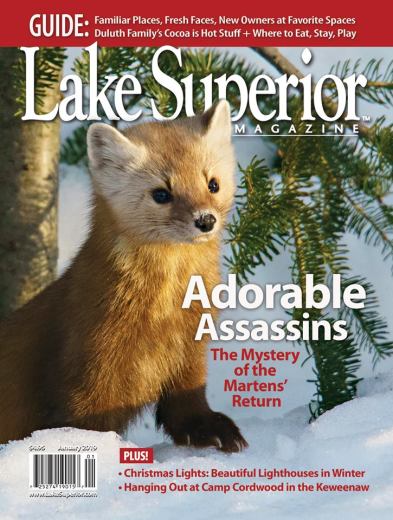
A marten carving graces the post of a Keweenaw Bay Indian Community pow wow shelter in Michigan’s Upper Peninsula. The marten is one of the Ojibwe clan symbols.

I’m in the planning stages for my third eco-mystic-romance novel. In my previous novels I’ve focused on endangered animals from the Lake Superior region, like the wolves of Isle Royale or piping plover shorebirds.

During a trip I took to the Apostle Islands a few years ago, the American marten (also referred to as the pine marten) came to my attention. It’s the only endangered mammal in Wisconsin and has mysteriously started showing up on Lake Superior islands where it was once thought extinct.

Sounds like a good topic for an eco-mystic-romance novel, right? To beef up my knowledge about martens (Martes americana), I attended the 7th International Martes Symposium in Bayfield, Wisconsin, this past fall. I was able to speak with marten researchers from all over the world and to interview ones who are doing local projects. I also took a field trip out to the Apostle Islands with the Wisconsin researchers and learned more about their methods.

45400919_10155548206416386_4915007419303591936_nTo cover the cost of the symposium and field trip, I wrote two magazine articles about martens. They are both out on newsstands now. The first ended up as the cover story for the December/January issue of Lake Superior Magazine. It focuses on the Apostle Islands martens and other populations found around the lake.

The second is in the “Around the Shore” section of the November Northern Wilds Magazine (on page 6). It focuses on the Isle Royale martens.

Take a read about these magical and mysterious animals of the north!

thumbnail_IMG_0294Cat Is

A marten climbs a tree on Cat Island of the Apostle Islands National Lakeshore. Trail cam image courtesy of Northland College, the University of Wisconsin-Madison, and the National Park Service.