Wowed by a Pow Wow

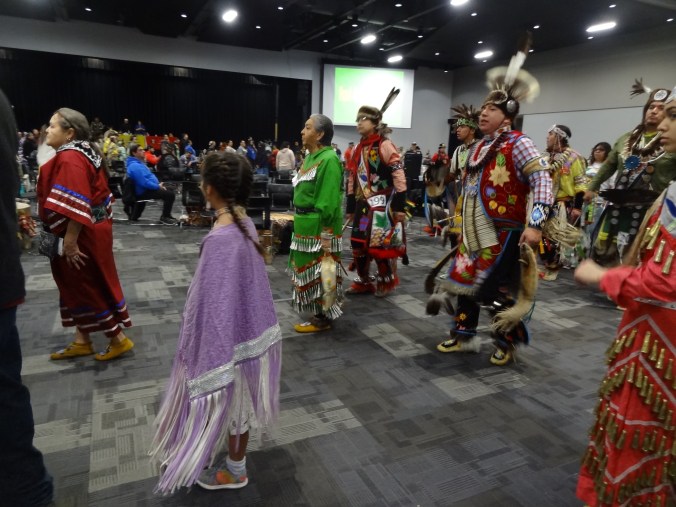
DSC05701I meandered just a bit south to Carlton, Minn., to attend an Ojibwe pow wow for work. More like I white-knuckled it on the drive due to a snowstorm.

I made it to the venue and ended up glad I endured the stressful drive. Why? Because pow wows are fascinating and fun! If you ever have the chance to attend one, you should.

I’ve been to a handful in various locations across the U.S. Every time, I come away impressed by their friendly vibe and the dose of a different culture.

It’s also refreshing to be in the minority for once. Being outnumbered by Native Americans for a few hours administers a dose of empathy for what they must feel most of the time in larger society. And the regalia the dancers wear is so impressive. I could tell they spent a lot of time and effort to make and choose their dress.

I attended the pow wow as part of a teacher workshop I’m doing a story about for work. The workshop offered educators from Wisconsin and Minnesota the opportunity to learn more about Ojibwe culture and their relationship to water to bring into their classroom lessons. Attending the pow wow was part of the experience for the educators.

Before the pow wow, we were given an etiquette sheet so we could avoid making clueless-white-person faux pas.

20200118_134851 (2)I thought I’d share a few of the more interesting points with you. The first is that a pow wow dancer’s clothing is called “regalia,” not a costume. The info sheet says, “Costumes are worn to present yourself as something you are not.”

The sheet does not say what regalia is, but one could assume from the definition of costume that regalia is clothing that reflects a dancer’s true identity. Think of a queen. Her ceremonial clothing wouldn’t be called a costume (unless someone who was not a queen wore it.) It reflects her regal status.

The dictionary offers three definitions of regalia. One is, “the emblems, symbols, or paraphernalia indicative of royalty.” The other is, “decorations or insignia indicative of an office or membership.” The last is, “special dress (especially finery).”

I suspect the last two definitions are the most appropriate when thinking of pow wow clothing – the dancer’s clothes reflect their membership in the tribe(s), and they are clothes not worn every day.  But I also like the idea that their clothing shows their true identity, and that identity is royal.

Another interesting guideline is not to touch a dancer’s regalia. It’s considered rude. I can see how having someone else’s hands all over something so personal could be an invasion of personal space and privacy.

The last is not to pick up an eagle feather that has fallen off someone’s regalia, or take photos of it being retrieved. The etiquette sheet states: “If you see a feather or regalia on the ground, do not touch it but do inform one of the dancers. They will take care of it properly.”

Eagle feathers are sacred to Native Americans, as is their regalia, so it makes sense they don’t want just anyone’s grubby hands on them. I also assume some ceremonies must be associated with retrieving a fallen feather.

End of lesson. Now you know few rules. Go out and find yourself a pow wow! It will be good for you.

Mountie Art Memories

Russ and I meandered over to the Tweed Museum of Art on the University of Minnesota Duluth Campus last week. Russ had never been there, so we figured it was time for him to get some “cultcha,” even if it is only a Duluthy version of culture.

The museum currently features an exhibit of Russian art (Art in Conflict), which was interesting. You don’t often see Lenin in artwork displayed in America.

D81.x333

Image courtesy of the Tweed Museum of Art.

My favorite collection in the Tweed, however, is the Canadian Mountie illustrations. My father used to get calendars from a local paper company that showed red-suited Mounties in all sorts of exciting and helpful situations, fueling my childhood imagination. There were Mounties petting sled dogs, Mounties building a snowman with native children, Mounties tracking bad guys – you get the drift.

Something I didn’t realize back then was that more than one artist drew the illustrations. The most prolific was Arnold Friberg, noted for his religious and patriotic art. But fifteen others tried their hand at it, as well.

The Mountie art came about during the Depression when the Minnesota Paper Company chose it as their advertising theme because it evoked a strong and dependable product. It was an instant success and continues until this day, although the company’s name has changed several times over the years.

D81.x348

Image courtesy of the Tweed Museum of Art.

While I suspect that real Mounties have committed their fair share of atrocities like any arm of law enforcement, I don’t want to know about it. As a child, I was totally sold on their Dudley Do-Right goodness, and, as I looked at the paintings in the Tweed, I realized I want to keep my childlike innocence where Mountie art is concerned.

If you’re ever in Duluth and want some culture, try the Tweed! Admission is free, although donations are appreciated, and there’s a box for that by the door.

The Cat Who Liked to Swim

Canoe Cat_Page_1

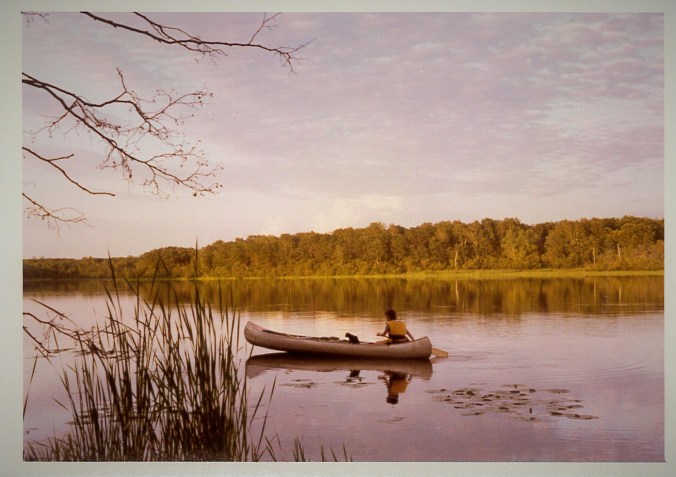
Inky and me, Star Lake, Minn., July 1977. Image by Dorothy Pramann.

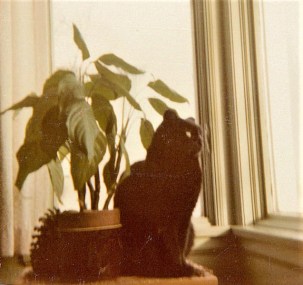
I grew up with a black cat named Inky. She was a stray a neighbor boy brought to us because he knew we recently lost a cat. That previous cat was a calico we named Muffin. Alas, Muffin ran away when we were on a camping trip while she was under the care of a neighbor. Perhaps because of that, we took Inky along on all our camping trips.

She did not enjoy car rides – she would disappear under the driver’s seat and not emerge until we’d reached our destination – but she liked being outdoors in the campgrounds where we stayed. We’d leash her to a picnic table so we wouldn’t lose her.

One place we liked to stay for extended periods was Star Lake, a Methodist Church Campground in northern Minnesota. Because we’d stayed there several times and we didn’t need to travel the next day, we’d let Inky off her leash to come and go as she pleased, like she did at home.

We owned an old Grumman aluminum canoe that I used to paddle around the lake. One day, I got the idea of bringing Inky along.
Canoe Cat_Page_2

Inky at home, 1975.

She seemed to like the canoe ride better than a car ride. She perched on the gunwale a few feet in front of me, leaning out over the water.

With each canoe outing, she’d lean farther and farther over the side. It seemed like she wanted to go into the water. One day, I tipped the canoe slightly, giving her some “help.”

Plop! Into the water she went.

We weren’t far from the shore of our campsite – only about 30 feet — and she swam in that direction. I can’t recall if she meowed as she swam, or if she swam silently. (My memory has fuzzed during the four decades since this occurred.) She made it to shore just fine and seemed no worse for wear.

The next time I took Inky out for a canoe, as we neared our site again, she jumped out of the canoe by herself!

Could it be, she liked to swim? I’d never heard of a cat who liked to swim, but apparently, I had one. By the end of our stay, her swims from the canoe to our campsite were a regular thing.

Inky the swimming black cat lived to a ripe old age, despite getting hit by a car once, breaking her leg. I’ve had other cats since then, but none who liked to swim like she did.

I just researched swimming cats. Although most cats would rather avoid water, some do like it. (Read stories here.)

My youngest son is allergic to cats, so I have since switched to dogs. But in my home, I keep this photo my mother took of Inky and me canoeing. I think of my swimming cat whenever I pass it.

Star Lake was the only place I ever took her canoeing. I wonder what she would have thought of the Boundary Waters Canoe Area Wilderness? I bet Inky would have liked it.

Another Random Act of Decorating Kindness

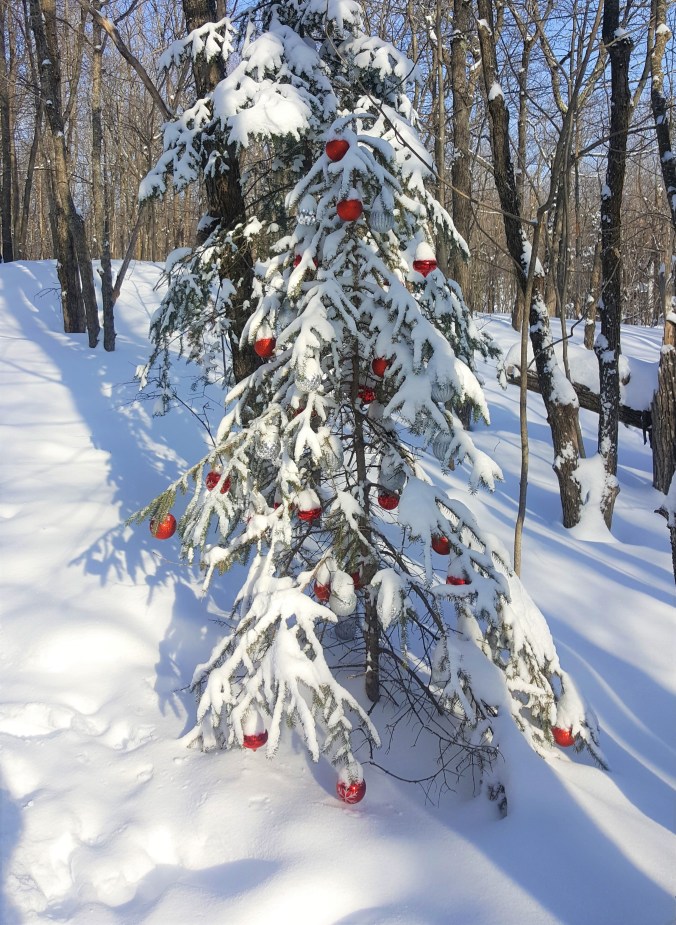
20191210_121551Someone is decorating outdoor trees in my neighborhood. If you have an excellent memory, you may recall that in 2015, I came across a small tree decorated on a trail where Buddy and I habitually walk. This unexpected act of decorating kindness lifted our spirits, and no doubt, the spirits of others who walk the trail.
The problem was, nobody undecorated the tree. As the winter wore on, some of the ornaments broke. Eventually, I ended up freeing the tree of the clutter at winter’s end. The next two years, no mysterious decorations appeared. I missed them, so last year, I ended up decorating the same small tree with several old ornaments that I no longer had room for on my personal indoor Christmas tree.

Well, somebody beat me to it this year. Red and silver ornaments magically appeared on a larger tree. And these weren’t just a few cast-off decorations like el-cheapo me used. They are numerous and new-looking. Plus, Buddy and I noticed another tree sporting similar decorations on a roadside in our neighborhood.

Could the same little elves have decorated both trees? Perhaps.

I don’t want to think about it too hard. I just want to enjoy the gesture. And I would like to wish a Merry Ho Ho to all and to all a good night.

Book Review: Hawks on High

20190915_141115_001

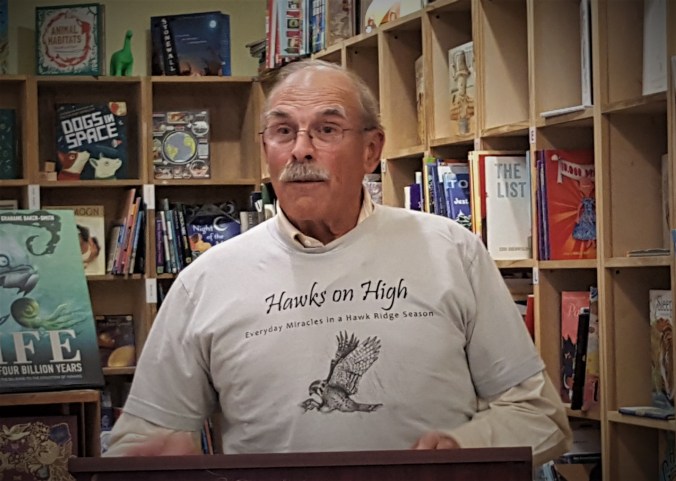
Phil Fitzpatrick talks about his book “Hawks on High” recently at Zenith Bookstore in Duluth, Minn.

It’s about time someone wrote a book of poems about Hawk Ridge in Duluth. And it took a newcomer to do it. Author Phil Fitzpatrick (Hawks on High: Everyday Miracles in a Hawk Ridge Season) has only been coming to the popular bird migration counting station on the ridge for two years. However, with his “new eyes,” that was long enough for him to amass enough poems for this book. His poems are combined with pen and ink drawings by artist Penny Perry.

My favorite poem is “Pringles Prize.” It describes how the hawk ridge workers use Pringles potato chip cans to contain the hawks they catch in mist nets on the ridge. Once the hawks are slipped into the cans, their legs can be easily banded for later identification. Before a hawk is released, the birder eases it “from its cardboard confines” for a short show-and-tell to the gathered bird-watchers. Then it “lifts above wide-eyed kids who now love hawks even more than Pringles.”

Love the wonder and subtle humor of that ending! I gave “Hawks on High” five out of five stars on Goodreads.

New Story in the Boundary Waters Journal

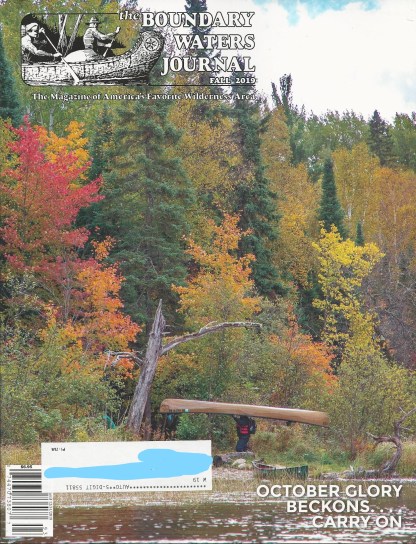
InkedBWJCover_LIMy story, “Tuscarora Enchantment,” is in the latest issue of the Boundary Waters Journal. It’s the first article I’ve written for them in many years, and it’s good to be back!

The story is based on the experience that Russ and I had during our trip that I mentioned in this blog last year. We took one of the most rugged routes in the wilderness, retracing steps (and paddling) I took in college with my newspaper reporter cronies.

You can look for the fall issue on newstands or you can order my article for a nominal fee direct from the magazine. Follow this link for info about how to do that: https://www.boundarywatersjournal.com/archives

Author Reading: North Shore Readers and Writers Festival

NS Writers Fest logoI’m going to meander up the North Shore of Lake Superior to Grand Marias, Minnesota, this November. I’ve been asked to give a reading as part of a panel of local writers during a lunch session of the North Shore Readers and Writers Festival on November 9.
I’ll be reading an excerpt of my Lake Superior-inspired story from the “Going Coastal” anthology along with two of my favorite local writers: Felicia Schneiderhan (“Newlyweds Afloat”), and Eric Chandler (“Hugging This Rock: Poems of Earth & Sky, Love & War”).

Best of all, this is a free event! You can bring your own lunch and attend at no cost, but you do need to register through the festival website. There are also options to buy lunch.

The festival looks like an awesome way to meet published authors and learn from them. Check out the course schedule and see if anything strikes your fancy. All the classes are available ala carte, so that keeps costs down.

Book Review: How to Talk Minnesotan, Revised for the 21st Century

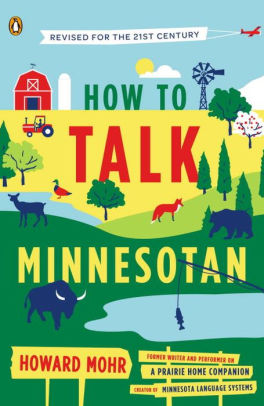
9780143122692_p0_v3_s550x406The first version of this book, published in 1987 and later made into a video, helped me understand my own culture. Before reading it, I never understood that the “long good-bye” was something unique to my state of Minnesota. (The long good-bye is where it takes at least three tries to leave a friend’s home before they will actually let you go.)

Also helpful was the “angle rule,” which describes how many Minnesotans talk to each other without actually looking at each other. Instead, they stand at 90-degree angles, looking off at some mysterious distant point while conversing. I had seen that many times and just thought that’s how everyone did it. I was not conscious that these were Minnesota “things.”

I watched the “How to Talk Minnesotan” video so many times, I had the lines memorized. So when I heard the book had been updated (in 2013), I put it on my list to read.

In reading the recent edition, it didn’t seem like a whole lot had changed. Although it now contains sections on Tweets, Facebook, and smart phones, the same lines from the video are there on the page.

However, in reading this new version, I realized something that nagged me with the first version, which is that this is not a book that encompasses the whole of my dear state. The traits described in it are more common in farm country. I’d say that’s about from Hinkley, Minnesota, and south. With token mentions of smelt and lutefisk, this book has a bit of relevance to northern Minnesota, BUT, there’s not one mention of a sauna etiquette, iron ore mining, Lake Superior, Ole and Lena jokes, or wilderness camping. It lacks northern nuances.

A more accurate title for this book would be “How to talk Mid- to Southern-Minnesotan.” If you live north of Hinkley, reading it will be helpful, but it won’t get you the whole way. If a third version is ever done, the author should come on up here and talk to us northerners for some new material, don’t cha know.

Forest Bathing: A Secret to Better Health

20190622_135935A recent New York Times article described results from a study that quantified how much exposure to nature people need to impact their health in a positive way.

The researchers found that people who spent about 120 minutes per week in nature (like a park or a forest) were less stressed and healthier than people who didn’t get outside at all. Spending less time (60-90 minutes) did not have as significant an effect. Even spending more time (5 hours) offered no additional benefits.

From this post’s title, perhaps you thought I was going to describe how to get nekkid and take a bath in the forest. Sorry, “forest bathing” just means immersing yourself in nature.

The study’s results made sense to me. As a species, we evolved in the outdoors. It’s what we’re made for. Spending time by water is also beneficial.

20190622_133733I am happy to report that I spend at least 140 minutes in nature per week. I am lucky to have a huge city park by my home where Buddy the Wonderdog and I walk every day.
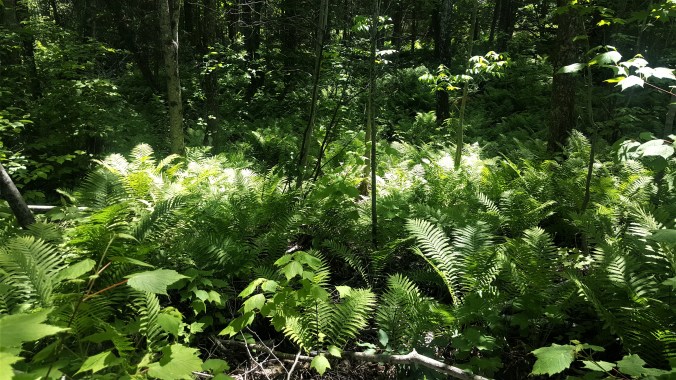
I took some photos from my last walk through the park. At 640 acres, the park is large enough that you’d never know you were in the middle of a city while walking its trails. Signs of civilization are few, even from the rocky knob that features a view of Lake Superior.

My photo walk was longer than usual – over an hour. I returned home feeling serene, indeed. Have you had your dose of nature today?

20190622_132014

Happy Belated Birthday Bob (Dylan)

20190525_153633

Bob Dylan’s childhood home in Duluth.

Last Friday was Bob Dylan’s birthday. My hometown of Duluth does it up right by holding an annual Dylan Fest — a week of events that features song, poetry, lectures, tours, and birthday cake.

This year, we attended the launch of a new book of poetry inspired by Dylan. “Visiting Bob” contains 100 poems by U.S. and international poets. A half dozen of the poets read their works and other poets’ works. Some of the poems were beyond me but others I understood. One that stuck was by local poet, Connie Wanek. Its theme was Dylan sightings in Duluth — are they false? Are they true? It ends on a hopeful note that perhaps someday the poet really will see him back in this town where he was born.

We also attended a lecture by one of the poets from Texas, David Gaines. Because he wrote a book about Dylan, he attracted media interest when Dylan won the Nobel Prize. Gaines described his experience being interviewed by Swedish public television and other major media outlets. He also got to travel to Stockholm to attend the airing of a Swedish public television story in conjunction with the prize ceremony.

On our way home from the lecture, we decided to stop by Bob Dylan’s home on the hillside, since it was on our route and we’d never seen it. A fan owns it and has spiffed up the duplex. Dylan lived in the right-hand side. A plaque on the front of the home proclaims its significance.

It’s hard to believe that I’ve lived here over five decades and never looked it up before. ‘Bout time, I guess.

When I posted the house photo on Facebook, one of my friends said they had a chance to rent the place in the mid-1970s, but turned it down. They didn’t know the home’s significance, however. When they found out afterward, they deeply regretted their decision because they were fans.

Another friend said she walked by the place thousands of times but it took years before she learned who had lived there.

These are typical instances of  “Duluth” to me. It’s a big small town. It’s large enough to get lost in if you want, and to never see parts of it. But it’s small enough that everyone has friends in common through one means or another, whether they went to school with them, or worked with them, etc.

Even after all this time, this town still has hidden gems to discover for those who take the time to look.