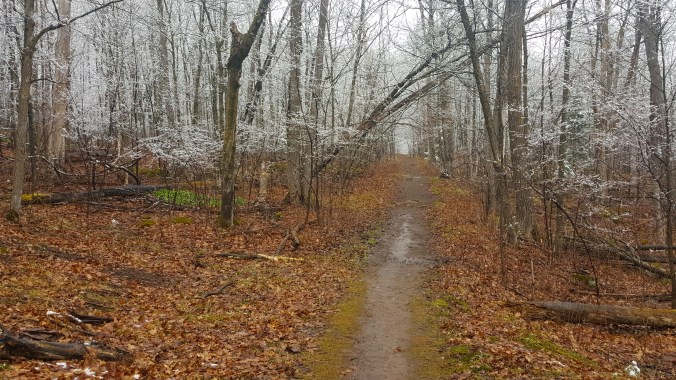
Winter is holding on in the Northland. We had a snowfall recently that melted on the ground, but not on the tree branches. Greenery is starting to show. One of these days, spring will be here . . . .
Winter is holding on in the Northland. We had a snowfall recently that melted on the ground, but not on the tree branches. Greenery is starting to show. One of these days, spring will be here . . . .

Marchers for Science in Duluth, Minn.
Last weekend I marched with about 1,200 other people along the shores of Lake Superior in support of science. This was a cause I could easily get behind since I work for a water science research organization (Please refer to my previous post, “Why Sea Grant is a Kick-Ass Program (And Not Just Because I Work There)”).
I walked with a few other Sea Granters and recognized many of the researchers our organization funds among the crowd. It was encouraging seeing so many people upholding the value that science brings to our society and supporting full federal funding for scientific programs.
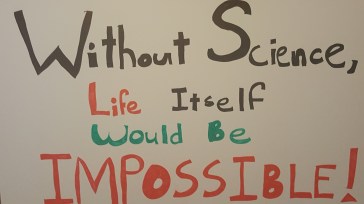 The sign I made for the march said, “Without Science, Life Itself Would be Impossible!” Does that ring a bell with anyone? I wanted something unique, but maybe it was a bit too unique.
I meant it as a play on a terribly blatant propaganda campaign that Monsanto ran in the 1970s in support of the idea of manmade chemicals. Their slogan was, “Without Chemicals, Life Itself Would be Impossible.” It featured a cute Aryan-haired little boy and his doggie. Surely, Monsanto-produced chemicals are just as harmless as this adorable duo. (NOT!)
 I figured only people alive in the 1970s might “get” my sign. I tested a few of my age-appropriate friends as we made our way to the march, but nobody spontaneously recalled the Monsanto campaign. After explaining it, a few remembered, but they did not immediately start applauding my brilliance. I suspect they just thought my sign was saying that medical science is important to human life. That’s okay. My friend had a sign that was as obvious as mine was obtuse. Hers said “Marching for Science.”
You know these events are all about the signs. If you have a boring sign or one that people can’t understand, you might as well stay home.
While sitting on a bench waiting for the march to start, I was mulling over the lameness of my sign when I noticed a TV news crew filming it from afar as it rested on the ground propped up against the bench legs. Maybe it was my sign’s pretty colors or maybe it was the pithy message – anyway, it lured the reporter and cameraman over to our small group. The reporter asked if she could interview us for a story. My friend, her mother, and I readily agreed.
Little did the news crew know, but they had stumbled into a nest of trained media relations professionals. We were able to espouse our key messages and put in a plug for Sea Grant. We ended up being the only ones interviewed for their story. (Which turned out pretty well, given that it was Fox News.)
What didn’t get into the story was my friend Sharon’s explanation about her year-long climate change art project, “Penguins with a Purpose.” She’s a ceramic artist and after the presidential election, decided to put her skills and frustration to use by making large clay penguins to draw attention to one of the issues the president is trying to silence, namely, climate change.
Her goal is to make 100 penguins by the end of the year, which she will sell and donate part of the proceeds to climate science and policy. Each penguin is unique and has a purpose.
She carried one of her heavy penguins for the whole march. We saw dozens of people we knew and had many side conversations along the way. Even though the march took energy, I completed it feeling energized by the crowd.
For now, hopeful noises are coming out of Washington D.C. that my Sea Grant colleagues and I will still have our jobs after next week. It’s sounding like Congress will pass a continuing resolution on the budget for the rest of the year instead of going with President Trump’s plan to fund his wall on the Mexican border with the entire Sea Grant budget (and those of other agencies).
This may just delay the wall-funding issue until the next budget cycle at the end of the year, but it’s comforting to think we’ll have our jobs for a few more months. Thank you to everyone who’s written their Congressperson. Every little bit helps.

Standing strong for science in Duluth.

A book project I’ve been working on for about a year-and-a-half is complete! Copies of the book arrived this weekend, so I feel like it’s Christmas even though it’s really Easter.
The book is called “Going Coastal.” It’s an anthology of Lake Superior-inspired short stories written by nine local (northeastern MN and northern WI) authors, including myself. My story, “Water Witch,” is the first short story I’ve ever written, so I feel honored that it’s included.
All of the writers are members of Lake Superior Writers, a local nonprofit group that “supports the artistic development of writers and fosters a vibrant literary arts community.” Proceeds from book sales support this group.
The idea for the anthology started with a conversation I had with the manager of a bookstore in Duluth. She asked me what I was working on and I told her “short stories.” She said, “You know what customers come in and ask me for? Short stories about Lake Superior. I have to tell them I don’t have any.”
**Bing** Lake Superior Writers has an annual contest. What if we made the contest theme this year about Lake Superior? And what if we were able to find a publisher for the stories? And what if the book could be sold in this bookstore? (And others, of course.)
I’m a board member of the group and brought the idea up at a meeting where we were discussing the contest. The other board members thought it was a great idea, too. And a project was born. After the contest was over and the judges had chosen the winning stories, I started contacting publishers about the project. Several were interested, but I ended up going with North Star Press, the publisher of my novels.
The name of the writing contest was “Going Coastal,” and the board thought that was also a good name for the anthology, and so did the publisher, so it stuck. Then came the need for a cover image. I’m on Facebook probably way more than is healthy for me, and I recalled seeing an image there by a local photographer who often gets into Lake Superior to take his photos. His stunning photo showed the iconic Split Rock Lighthouse seemingly swamped by a large Lake Superior wave. Perfect!
I worked with the authors to edit their stories, and then needed to decide how to organize them in the anthology. I offered the other board members the opportunity to help with this task (which was new to me) but they said I could have the “honor.”
Shoot – how was I ever going to decide? Well, a couple of the stories had Native American themes in them. Some were more mystical than others. A couple focused on ships. A couple others were about rocks. One was about a lighthouse. Another was about a family drama and had a super strong ending. Some stories were short, others were long.
I finally decided to organize them along themes, but I also kept story length in mind and tried to switch that up for variety. Figuring out the story order was as much an art as writing one of the stories itself, and was a fun exercise. I hope it worked.
If you like lighthouses, ships, beaches, ghosts, road trips, history, storms, agates, islands, family drama, and the mystical power of Lake Superior, you’ll enjoy this book. It costs $12.95 and is available from North Star Press, but also Barnes and Noble and Amazon, which have it as an e-book, too. Take a read!
Anthology authors are Theresa Allison-Price of Superior; James Brakken of Cable; Evan Sasman of Ashland, Johnna Suihkonen of Lakeville; and Judy Budreau, Eric Chandler, Phil Fitzpatrick, Maxwell Reagan and me of Duluth.
We’re having a book launch sponsored by The Bookstore at Fitger’s on Sat., April 29 from 4-6 p.m. in the August Fitger Room on the third floor of Fitger’s Mall (600 E. Superior St., Duluth). There will be free appetizers from The Boat Club Restaurant and a cash bar. Each author (except for one who can’t make it) will read from their story.
Come on out and keep that Christmas spirit going through April!
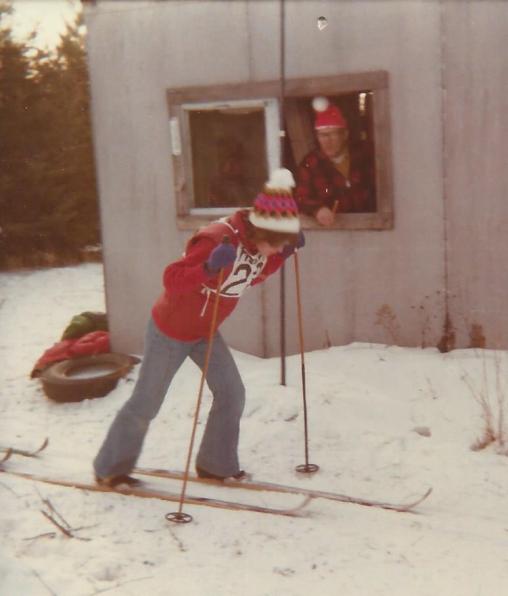
Marie at the start of her first cross-country ski race, waiting for Charlie Banks to signal the start.
Last weekend, a friend and I revisited the Korkki Nordic Ski Trail, where I competed in my first cross-country ski race forty years ago. The year was 1977 and I was in eighth grade, part of my junior high school’s ski team. My equipment included wooden skis and bamboo poles with black rubber baskets. Clad in bell-bottom jeans and a ‘fashionable’ down vest, my head protected from the cold by a knit hat with a huge ball atop it, I ended up winning the race and the city championship for my grade.
Winning the first race I ever entered – you would think it would be a good experience and I’d return to the same trail dozens of times to relive the glory. But I didn’t. Why did it take me four decades?
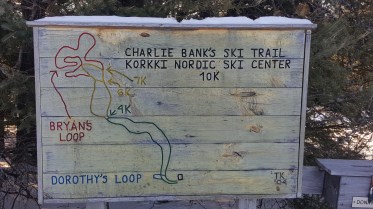 That’s what I was trying to figure out as I shooshed down the trail on my fiberglass skinny skis (waxable ones) last weekend.
Now, the thing you need to understand is that Korkki Nordic is Old School. Only one track winds its way through pines on land tucked in the highlands along Lake Superior’s North Shore. And the trees are close enough to lean over and kiss as you go by – not ten feet away on either side like most ski trails. Classic skiing only; none of that fancy-schmancy skate-skiing.

My friend, on the trail.
The trail system is maintained by a nonprofit organization and was started by the very man who kept time during my first ski race. Charlie Banks is no longer with us, but his legacy lives on.
The trail is sort of out of the way. With so many good ones in Duluth, that could be one reason why I didn’t come out here. It wasn’t a place my parents usually skied, and they were the ones driving the car when I was young. But still, why didn’t I come here when I was older?
As my friend and I started skiing, I noticed the timekeeping house was still near the trailhead. After we traveled down the trail a ways, I recalled how clueless I was during my race. Our “coach” didn’t even ski himself, and he did little to prepare us. I only knew that racing meant going as fast as you could until you reached the finish line, so that was my strategy after the staggered start. This led to overtaxed lungs and leaden arms and legs. But I kept going, although I was alone and scared by this new experience and unfamiliar trail. Finally overcome, I paused a time or two to catch my breath on the uphills, terrified that another skier would pass me, but I never saw anyone.
My friend and I continued skiing and I recognized the feel of the trail – lots of small hills, nothing too scary — especially if you take the easy route options, which I did, having nothing left to prove. We skied four kilometers, which I suspect was the same distance as the race. The finish line banner we crossed under looked suspiciously like the exact same one from my stressful race.
Was that it? Even though I won the race, was the stress of it so unpleasant that I had no desire to return to the scene until forty years later? Could be. I recall that in subsequent ski races, somehow I learned more about pacing and didn’t get as burned out.
As I crossed under the banner last weekend, I realized that whatever kept me away for so long, I’m finally over it!
I’m gonna return soon to this little woodland ski trail gem.
Two other local writers have written about their memories of Korkki Nordic, read here for Eric’s and here for Eddy’s.


My grandchildren
will never see
the lighted tunnel
with the penguin for wishing.
(Rub its head.)

Image by Amanda Jo Dahl.
They will never see
the sugarplum fairy
high in the tree;
the unicorn that changes colors;
Cinderella’s carriage
bedecked with white lights.
They will never walk
the driftwood path
to the dark and quiet lake;
the stars overhead
dimmed by green laser lights on the sand;
city lights pulsing on the hillside beyond.

Image by Amanda Jo Dahl
They’ll never drink hot cider
in the garden house;
never roast marshmallows
in the outdoor fire here;
never laugh at their reflections
in the low slung, slanting mirrors.
When they are older,
they will never kiss that special someone
under this frosted mistletoe.
My grandchildren
will never know this tradition
unless
I spark the light
behind their eyes
with words.

This is a tribute to a Christmas lighting display on Park Point in Duluth, Minn. Marcia Hales (seen lighting a wish lantern in my photo from 2015) has invited the public to enjoy the display in her yard for years. She recently announced that 2016 will be the last year for her display. I wrote this poem very quickly after spending last evening in her lights.
UPDATE: Jan. 7, 2107 was proclaimed Marcia hales Day in Duluth. It was supposed to be the last day for people to visit her light display, but after the proclamation reading, Marcia announced the lights will go on! She’s getting a lot of community support to keep them glowing into the future.
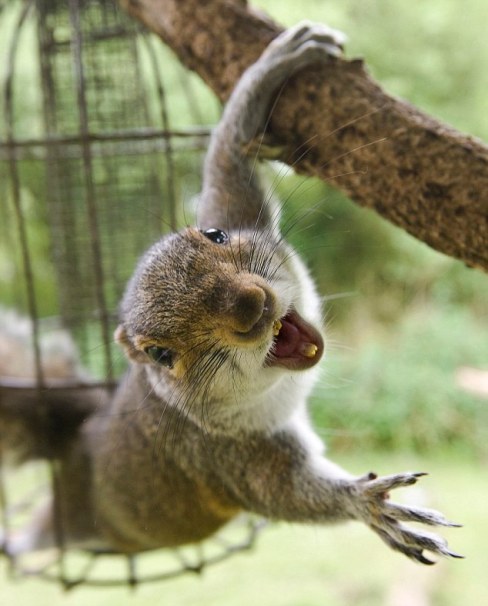
Image credit: DailyMail.com
My daily noon dog walk yesterday began like many others. Buddy and I took off down my street, heading toward the woods. Snow was falling with a few inches accumulating on the ground. As we neared the intersection at the end of my street with the forest beckoning beyond, I noticed what looked like a pile of brownish-gray leaves on the curb.
Buddy immediately perked up, and before I knew it, he was running at the leaf pile. His retractable leash played out its full fifteen feet, and my shoulder jerked in its socket as Buddy kept trying to run at the leaf pile, which had unfurled into the form of a gray squirrel.
I have learned the hard way that when it comes to my dog and squirrels, the health of my shoulder muscles is more important than trying to save the squirrels from his hunting instincts, so I let the leash go. By this time, Buddy was behind the squirrel, which came running out into the snowy intersection.
One would think that the squirrel would run anywhere but toward another threat (me). But this squirrel headed right at me, my dog on its heels. The squirrel hopped through the snow sluggishly. Whether this was because of the snow depth or because there was something wrong with it, I couldn’t tell.
As the squirrel came closer, its course stayed true — right toward me. I remembered a time when I was young and a wild squirrel climbed up my leg to get my peanut butter sandwich.
I spread my legs a bit wider to discourage the squirrel from any leg-climbing ideas. Did it think I was some sort of stumpy tree? The squirrel kept coming, passing directly between my boots. Buddy was a few feet behind, his leash dragging through the snow.
Uh-oh. Buddy was headed directly between my legs, too. He is a very tall, eighty-pound dog. I lifted up one leg so he could pass under.
Then I heard the tires of a vehicle slowly crunching through the snow. I looked away from Buddy and saw a white pickup truck approaching. More chaos. Just what we needed!
The squirrel continued its sluggish trajectory to a tree in a neighbor’s yard. In the meantime, I was able to grab Buddy’s leash and command him to “Leave it!” (As in leave the squirrel alone.) The command actually worked. He stopped and I grabbed up the slack in his leash, holding him tight and out of the truck driver’s way. The squirrel was now high in the tree.
The driver, seeing that all was under control, eased into the intersection. Beneath my scarf I began laughing at the scene that must have confronted him. Through his frosty window, I saw that he was laughing, too.
We waved at each other and he continued on his way.

The World’s Largest Rubber Duck turns its back on me.
Duluth is hosting a Tall Ships Festival this weekend. A newcomer to the event is the “World’s Largest Rubber Duck.” I put that in quotes because equally large or larger rubber ducks exist in the world overseas. It’s just that the U.S. creator (who happens to be a Duluthian, too) of this particular duck trademarked the phrase.
Even so, I was intrigued to view this giant yellow floating bathtub toy – in part to see if it could nudge me out of my doldrums following my father’s death – but also just because it’s novel. Like others who have attended these festivals over the years, I’ve seen plenty of tall ships, but never a sci-fi movie-sized duck. Also, I needed to attend the festival for work, to deliver some keys to a co-worker who was on one of the tall ships (the Denis Sullivan).
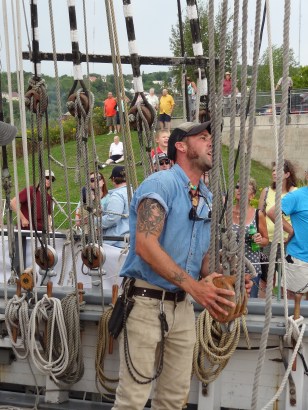
A crew member barks orders on the Denis Sullivan.
The duck was participating in the opening ceremony for the festival, called the Parade of Sail. For this spectacle, all of the ships sail into the Duluth-Superior Harbor through the ship canal and under Duluth’s iconic Aerial Lift Bridge.
I left in what I thought was enough time to catch the parade. But I didn’t anticipate the number of other people who also wanted to attend. I expected a lot of people, and planned my travel route to the festival via a back way, but there were not just a lot of people. There were HORDES.
After being turned away from one event parking lot because I didn’t pre-pay a parking ticket, I ended up waiting in line for 40-something minutes for another lot.
I knew I was going to miss the beginning of the parade, so enterprising me got out of line to bribe a local business to let me park in their lot. They weren’t open to my bribe (or perhaps it was not large enough!), so I got back in line, even father back.
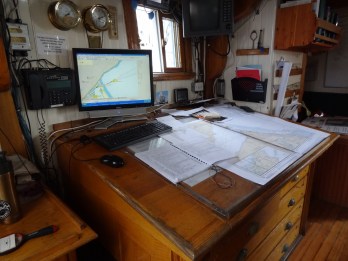
The chart room, below decks in the Denis Sullivan.
As I was waiting, and gazing out my car window through a fence and a tangle of tansy weed, I saw the head of a large yellow duck gliding past in the nearby harbor. I was missing the duck!
Alas, failed bribery attempt already past, there was nothing more I could do to improve my situation. I could only hope the duck would still be around once I made my way to the event grounds.
By the time I got to the parking lot entrance, the attendants were only letting cars in once other cars came out. After another 15 minutes or so, I finally got to park my car in a swampy spot and hoof it to the harbor.
The duck apparently did not like that I was late, and would not show its face to me. It was far away by this time, across the harbor at its docking site — its back turned in disapproval at my lack of strategic event attendance planning skills. Sigh.
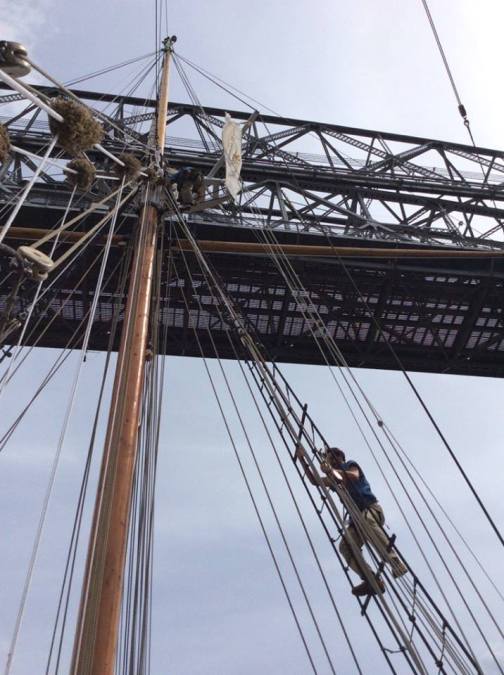
A crew member climbs the rigging on the Denis Sullivan as it sails under Duluth’s Aerial Lift Bridge. Image courtesy of Kathy Kline, Wisconsin Sea Grant.
But my spirits lifted when I ended up getting a free tour of the Denis Sullivan. I found my co-worker among the hordes and she let me aboard. The Sullivan’s home port is Milwaukee, and the ship is used for educational purposes. My co-worker had just completed a five-day sail with about a dozen Great Lakes teachers, instructing them on lake ecology and maritime history.
Enjoy the photos!

What the duck looked like to everyone else. Image courtesy of WDSE-TV.
I had to wait for some work colleagues on a pier on Duluth’s Ship Canal last week. They were late. I had a camera. Enjoy the fruits of my boredom!


Duluth’s Aerial Lift Bridge (from a different perspective than usual.)
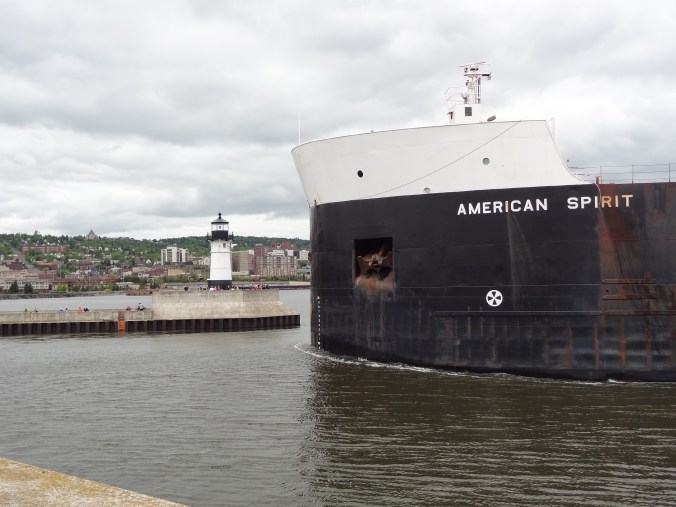
A ship, the American Spirit, enters the ship canal. Looks like it’s going to crash, doesn’t it?

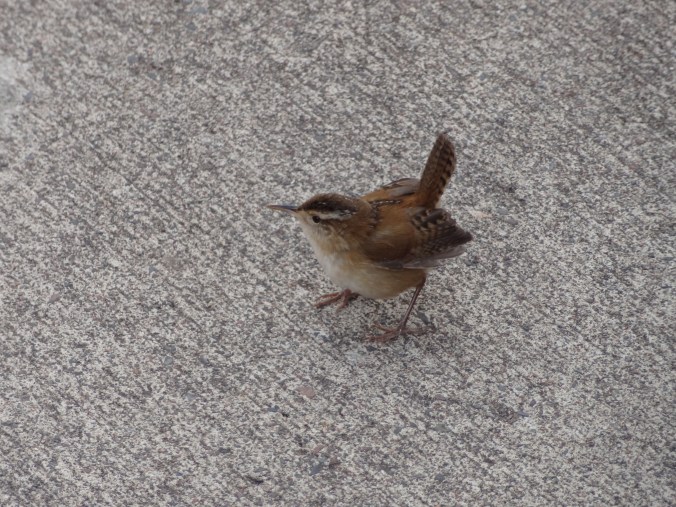
A friendly little house wren kept me company. It was catching bugs behind the lighthouse on the pier.

When my colleagues arrived, they installed a wave gauge pressure sensor off the pier that will be used to help detect and predict the presence of rip currents, which can sweep unwary swimmers out into Lake Superior. The local newspaper wrote a (front page!) story about the project. Read it here.
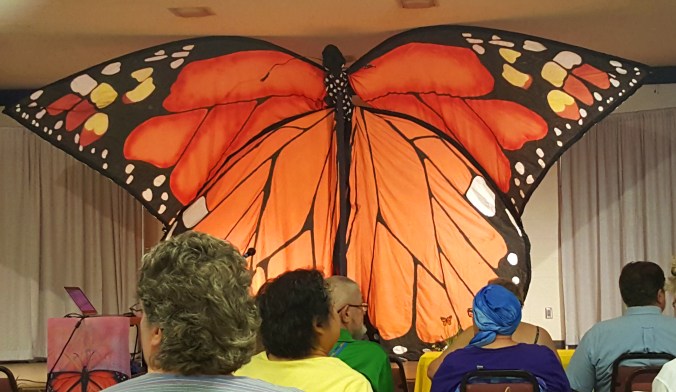
Any minute now the first monarch butterflies will wing their way into the northland on their annual migration. Thanks to the first-ever Duluth Monarch Festival this weekend, I learned that the butterflies that return to Minnesota aren’t the ones that left in fall for Mexico, but are their offspring that grew up in early spring somewhere in the southern U.S.
If they aren’t the butterflies that left here, how do they know to return? How can an insect that weighs about the same as a paperclip survive the long flight? These are just some of the intriguing questions that surround monarchs.
On the street where I grew up, milkweed (the monarch caterpillar’s favorite plant food) flourished in a vacant lot kitty-corner from our house. I had a little round wire mesh insect container where I would grow the caterpillars into butterflies indoors. I can’t recall exactly how I learned to do this, but suspect my older brothers taught me. I raised dozens, fascinated by the transformations the caterpillars went through in becoming the beautiful black, orange and white butterflies that are so distinctive and a joy to see.
My attachment to the creatures even extended to the schoolyard. On one of my first days on the kindergarten playground, a boy killed a monarch caterpillar. I thought he was the cruelest person on the planet, and begged him not to kill it because, “These are the ones that make butterflies!” Other than that, I lacked the communication skills to tell him why I was so upset. I ended up burying the caterpillar underneath a pile of playground pebbles. Now I understand his actions were just the casual cruelty of boys (and because he had probably never raised caterpillars), but for the rest of my grade school career, I shunned him as The Boy Who Kills Caterpillars.

A monarch caterpillar on a milkweed plant.
Playground killings aside, the monarch population has dropped significantly over the years due to habitat loss, pesticide use, and a wacky climate — to the point that the fall migration to Mexico is in danger of disappearing. The last two years have had the lowest counts in history. Instead of taking up 18 hectares of roosting forest in Mexico (1996), the butterflies now only take up 2-4 hectares.
One relatively painless way to learn more about the plight of the monarch is to read “Flight Behavior,” a novel by Barbara Kingsolver.
The monarch festival I attended is one effort to help this beleaguered bug, and the organizers hope to make it an annual event. The goal was to educate citizens about monarchs and to help people become involved in restoring monarch habitat. One of the speakers was Prof. Karen Oberhauser from the University of Minnesota. She said an estimated two million more milkweed plants are needed for the monarch population to stabilize. To that end, a local group (Duluth Monarch Buddies) was giving away milkweed seeds. Milkweed plants and other butterfly-friendly plants were available for sale.
They were also encouraging people to sign up to be monarch larva (caterpillar) monitors. The Monarch Larva Monitoring Project is a citizen science effort where volunteers track how many monarch eggs and caterpillars are in a local milkweed patch. How I would have loved to do this when I was a child! Heck, I intend to do it now. Monitors visit their sites once a week and enter observations onto a data sheet. The goal is to better understand the health of local monarch populations and how they change over time.
I picked up a packet of milkweed seeds. I can’t wait to plant them and do my small part to save the monarchs. Take that, Boy Who Kills Caterpillars!

Bob Dylan
Duluth is gearing up for Dylan Fest this coming week. For those unaware, singer Bob Dylan was born here and lived in northern Minnesota through his high school days. Although some local controversy exists about Dylan’s perceived slights of his hometown, many people here like his music and I expect the events will be full.
Not long ago on the radio I heard Dylan performing Rodgers and Hammerstein’s “Some Enchanted Evening.” Hearing him sing it in his nasally voice was funny and sort of surreal. It made me pull off the road and start a list of “Songs that Should be in Movies.” Who knows, such a list could come in handy if movies are ever made from my novels. (Grin.) I can see Dylan’s song accompanying a slow dance scene.
Other songs I’ve heard since then that I’ve added to my list are:
“Running with the Wolves,” by Cloud Cult. This would make a good road trip song.
“From a Payphone in the Rain” and “Me, You & the Universe,” by Teague Alexy. The payphone song is so heart-wrenching, it made me glad that Teague doesn’t record such songs very often. (Just stab me in the heart with a pencil and twist it, why don’t you?!) These songs are stories in themselves – maybe too specific for a movie soundtrack — but they’d make for good closing credits songs; ones to hear while you’re feeling the after-effects of a movie and you want to prolong the agony (or ecstasy) of the story and chill out before you stand up and go out into the real world.
That’s it for my list so far, but I’m still adding to it. Any suggestions?
 Marie's Meanderings