The Making of a Minnesotan at the State Fair

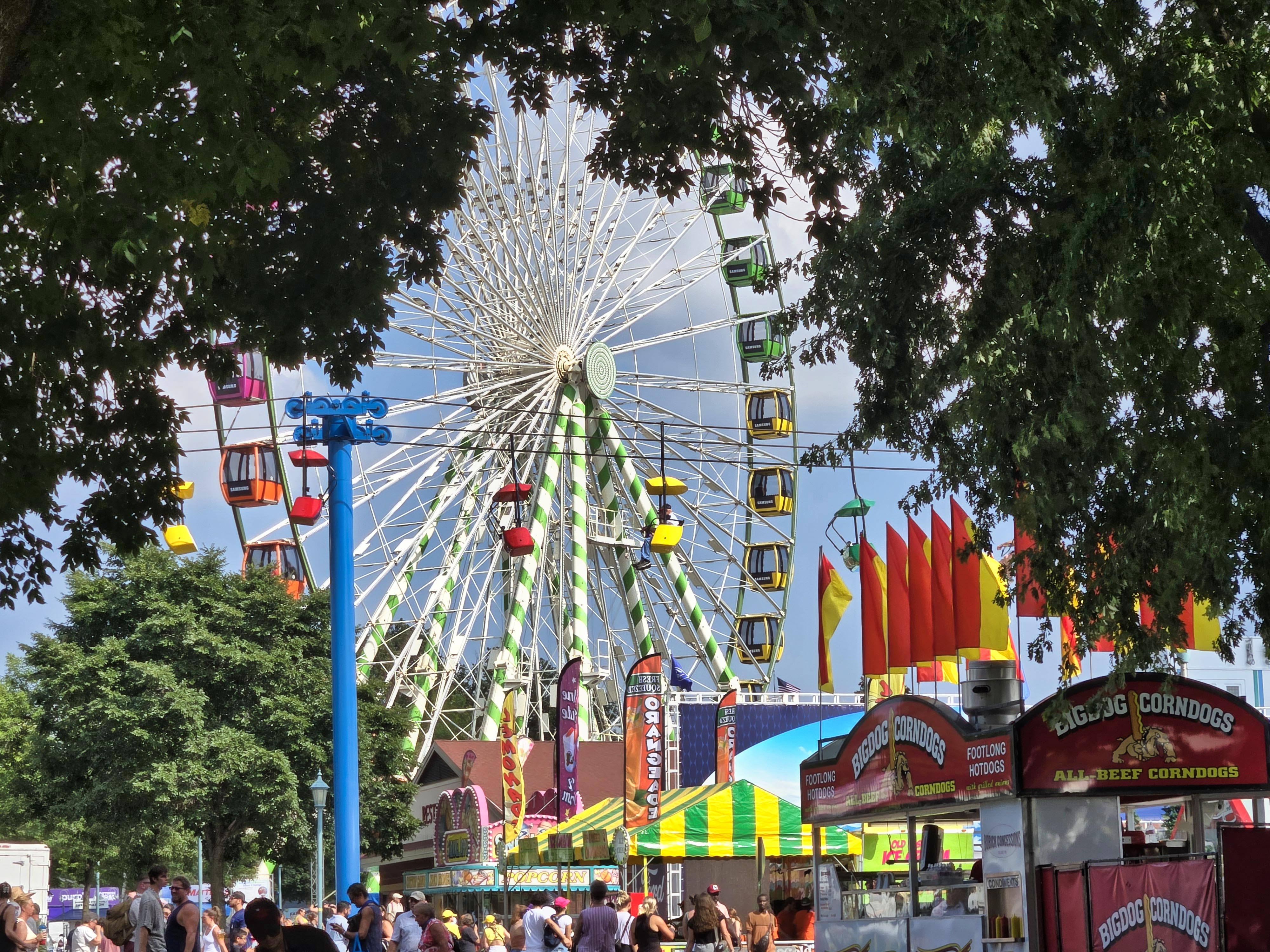
The Great Big Wheel at the Minnesota State Fair

I am interrupting my U.K. meander to cover some exciting developments since we returned home. I’ll resume with our trip to Scotland in a few posts.

My husband Russ has lived in Minnesota for 23 years, raised two children here, trekked the Boundary Waters Canoe Area Wilderness, biked gravel roads, sailed Lake Superior’s North Shore, cross-country skied, and snowboarded. He also volunteers his medical expertise for the local ski patrol. About five years ago, he married a Minnesotan: me. But when people hear that he’s originally from New England, they call him a Yankee.

Thanks to our recent meander to the Minnesota State Fair, I can correct that misconception now. Despite all his time in Minnesota, Russ had never been to the fair. I was aghast at hearing this and decided it’s the one last quest he needed to do to call himself a real Minnesotan.

So, we went last week with a busload of other people arranged through our local community education organization. If we had been traveling on our own, we might have picked a different day because the heat index was 103 degrees!

We survived traipsing around the fairgrounds with the help of plenty of lemonade, water, and root beer floats. The merry-go-round is my favorite ride at the fair. Even though I’m in my 60s, I had to go on it. Russ was a good sport and accompanied me. I think he had fun! We wanted to have new experiences on other rides, as well. We hopped aboard the Great Big Wheel (think Ferris wheel) and the Space Tower (think Space Needle).

Russ makes a rare blog appearance, riding on the merry-go-round and being a good sport about it!

Then it was lunchtime. Russ sated his hunger at the Hamline Methodist Church Dining Hall. My extended family goes to that church and has a long history of volunteering in the hall for the fair. Russ had ham loaf with corn and a corn muffin. I carried in my Spam burger with cheese from an outside vendor. I do have a fondness for Spam and usually use it during camping trips once or twice a year, but why not the state fair, too?

The Spam food stand.

As we were dining, I noticed that NY Times bestselling Minnesota author William Kent Krueger was at the head of the serving line, taking food orders. He attends that church and was a friend of my aunt who also worshipped there. I’ve met him a few times over the years. I caught Ken’s eye and gave him a wave. He waved back!! He’s such a great guy, and his books are pretty darn good, too.

After lunch, we wandered over to the animal barns. In the horse barn, huge draft horses were getting prepped for the afternoon competition. Percherons, Clydesdales and Belgians stood docilely still outside their stalls while people groomed them. They’re about twice the height of a regular horse. We watched in awe as two women stood on tall stools to brush a Percheron’s black coat and braid its tail. I’m not sure I would want to stand behind those powerful legs and haunches and fiddle around with a horse’s tail! Another person worked on its hooves.

A Percheron being groomed for competition.

We returned to the arena a few hours later to watch the draft horse wagon-pulling competition in the coliseum. Sixteen teams of six horses competed, trotting in circles around the arena with harnesses jingling, and then showing their prowess at backing up and doing figure eights. Seeing the powerful beasts with rippling muscles high stepping in synch was like watching poetry in motion—mesmerizing.

In the end, all the horse teams lined up in the arena for final judging. It’s not every day you get to see 96 huge horses standing around in front of you. I was particularly impressed by a team of Percherons pulling a red wagon. They seemed more in synch and stepped higher than the other teams. I told Russ my bet was on them to win.

The draft horse teams lined up for final judging.

Apparently, I have a previously unknown talent for judging draft horses because in the end, that team won! They took a victory lap and accepted a trophy. They were a team from Minnesota, which made their victory all the sweeter.

We capped off the day with a trip to the department of natural resources fishpond, which sports all sorts of native species, and we took in parts of several music shows. We also ate ice cream and funnel cake and visited “tractor hill.” Unlike my past memories of it, there’s no hill anymore; and it’s more like riding lawn mower land—not so many tractors on display.

By the time we clambered back on the bus, our shirts were drenched with sweat. But we had survived both the heat and the crowds! More to point, Russ had survived his first Minnesota State Fair experience and earned his long-awaited induction into Minnesotahood. Welcome, Russ.

Ireland, Day 6: Newgrange, the Eden and Wombs of Ireland

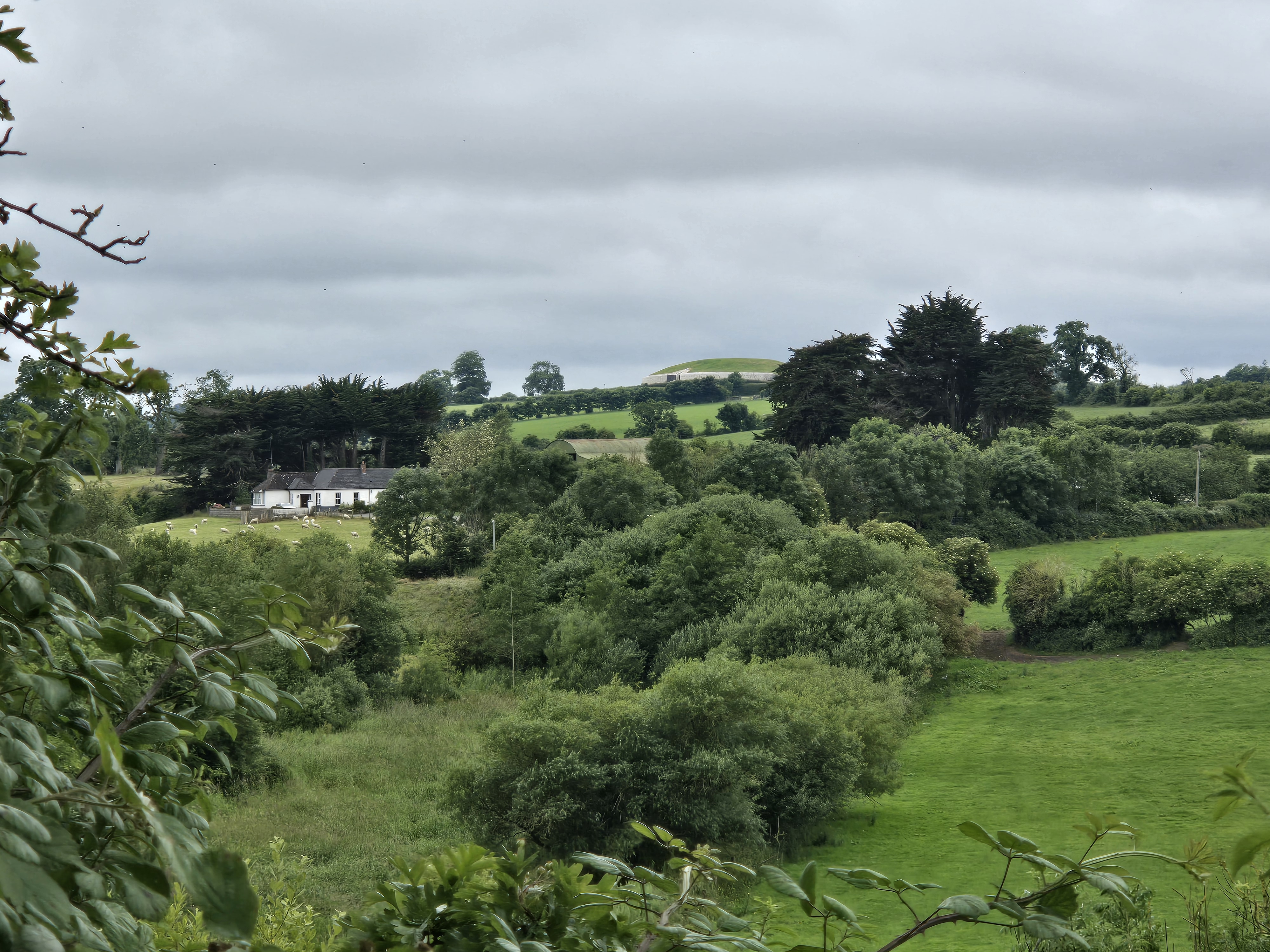
Newgrange seen in the distance from the banks of the River Boyne.

Surprises and mystery lay in wait for us on our final day in Ireland. We took a long cab ride from Dublin to the World Heritage Site of Newgrange, also known in Gaelic as Brú na Bóinne. Newgrange is like the Stonehenge of Ireland. It’s actually older than Stonehenge (and the Egyptian pyramids) and is likewise one of those mysterious Neolithic sites where during the Solstice the sun shines through the stone doorway and lights up the interior. Never having been to Stonehenge (yet), this version was a must-see for our trip.

Surprise No. 1 had come a few weeks before when we made reservations for a tour of the inner chamber at Newgrange. I had thought there was only one passage tomb mound at the site, but discovered there are two other large ones (Knowth and Dowth), plus standing stones and henges. We chose the main tour option, which includes entrance to the visitor center, a guided tour of the Knowth mound, and access to the chamber at Newgrange.

The visitor center does a great job of interpreting the site and it has a gift shop, which we appreciated more after our tour and learning about the significance of the symbols on the passage tombs. The shop sells jewelry and other things with those designs on them.

The River Boyne

We spent about 45 minutes in the visitor center before the start of our tour. Our tour began with a walk across the fabled River Boyne to a bus stop. I was excited to see the river in person. Our former minister, who was of Irish descent, often referred to the river in his tales of the “salmon of knowledge” from his trip to Ireland. Crossing the river on a small bridge, I was struck by the sheer lushness of the landscape and all the life that the river brings to it. Other than for some nearby farms, the area is largely undeveloped. It’s like an Irish Garden of Eden! I could imagine what it must have looked like in those Neolithic days (3200 BC).

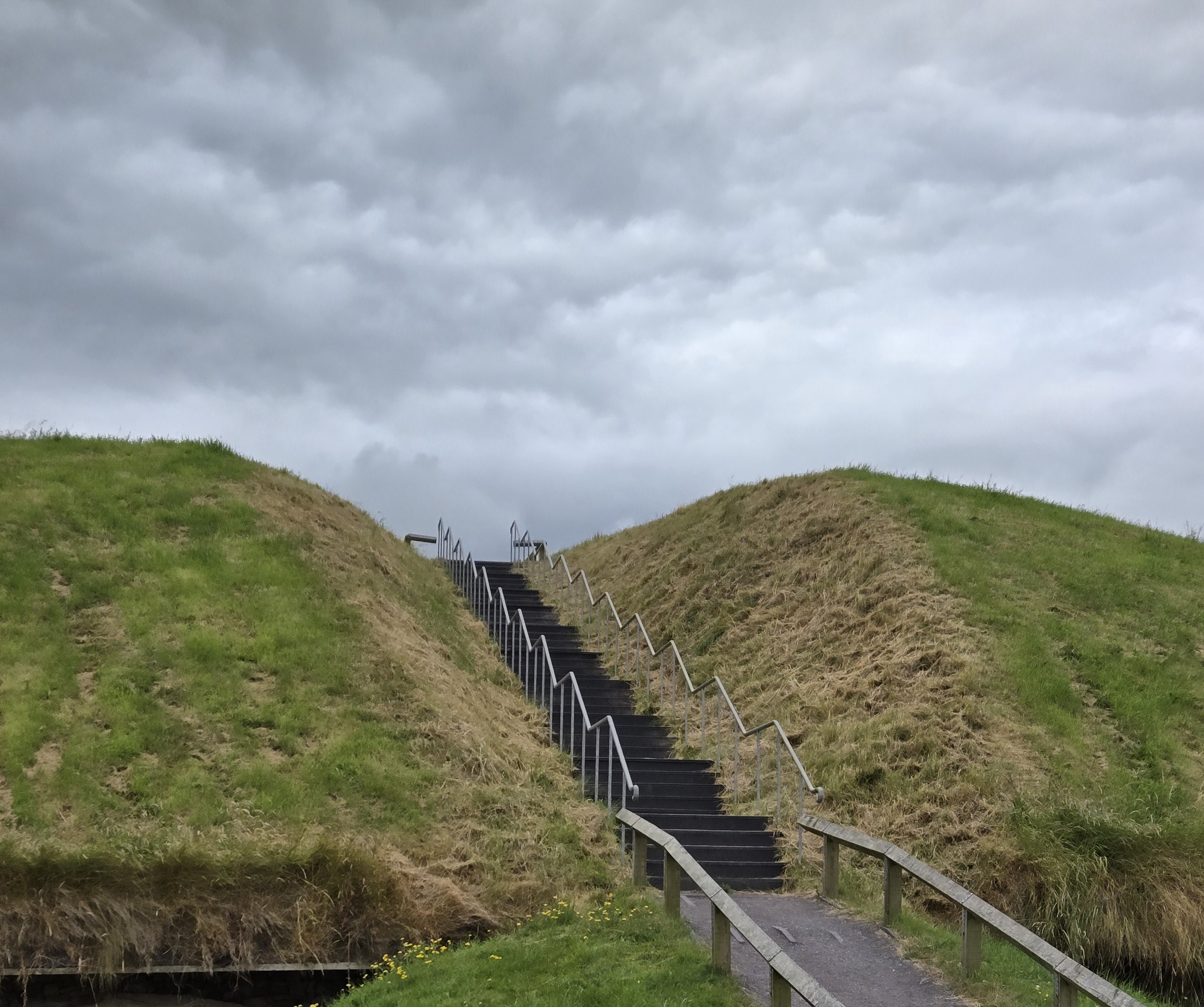
After waiting at the bus stop with two dozen other people, our bus arrived. We boarded and rode through narrow rural Irish roads to the first stop at Knowth. It featured a large mound surrounded by 17 smaller mounds. Although no tours of the interior of the large mound are offered, a stairway is cut into its side, and we could climb atop it.

The stairway to the top of Knowth mound.

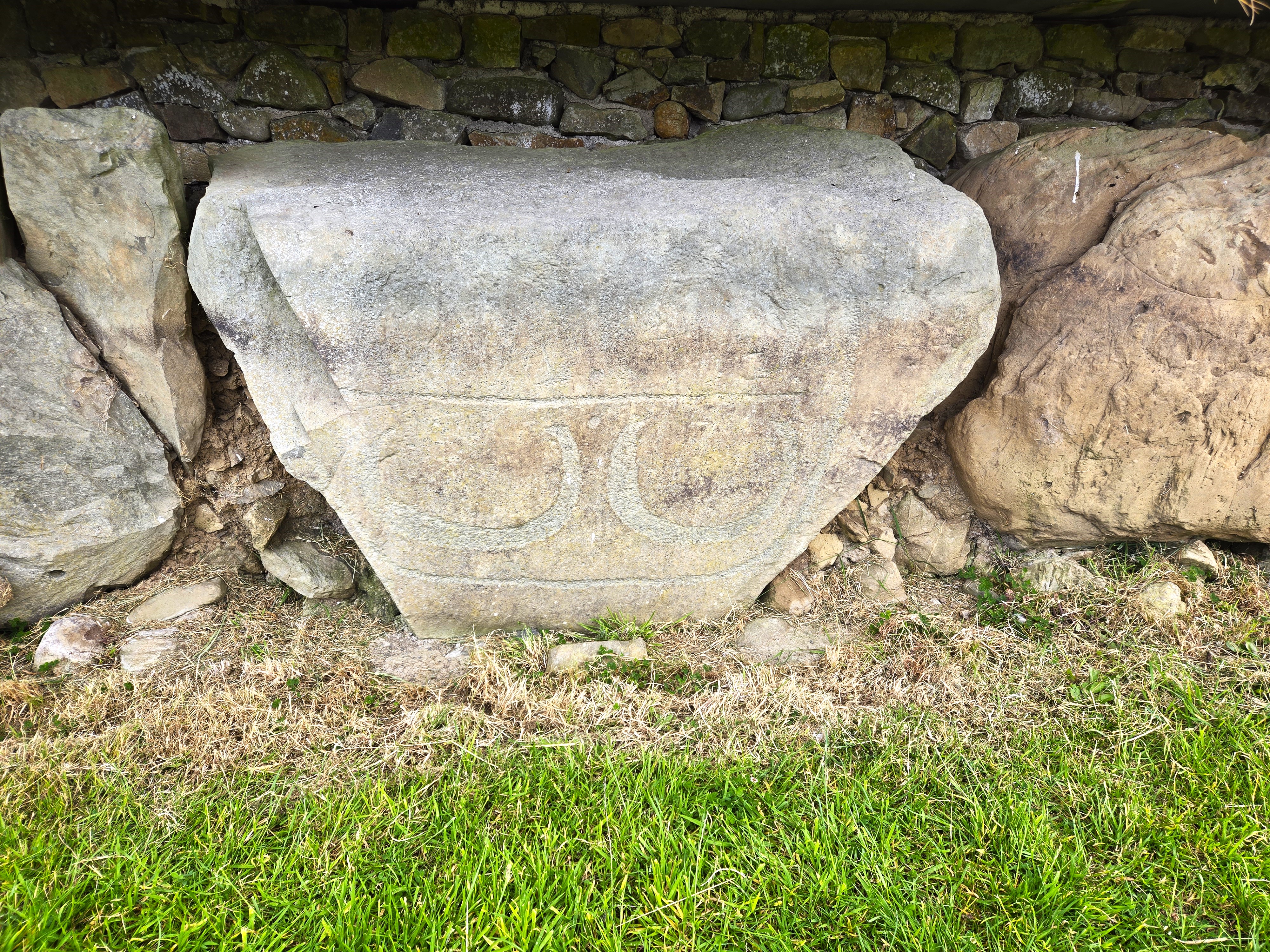
But first, we walked around the mound, admiring the largest assemblage of megalithic art in Europe. Designs were hand-carved (of course) into the stone. Unlike the main mound of Newgrange, every stone at Knowth seemed to be carved. They’re called kerbstones and there are 127 of them. Most interesting to me was the Mirror Stone, which sports two U shaped carvings. When the sun shines on them during the equinoxes, the shapes are mirrored below the originals. Some theories suggest they represent crescent moons. So cool!

The Mirror Stone, Knowth.

The tour guides didn’t come right out and say it, but I learned that these mounds are like human-made wombs. Knowth features two independent stone slab passages built along east and west lines. The passages were covered with layers of soil and stone. They end at cruciform chambers—think the end of a cross or a uterus and ovaries. Cremated remains of the ruling class were placed in these side chambers, along with bones.

Surprise No. 2 was that the kerbstones are also carved on the inside—the sides that faces the mound. Our tour guide said this was so the dead could “see” the carvings also, but other things I’ve read suggest the stones were already carved elsewhere and were just reused for the mound. I prefer the first explanation. The huge stones were transported from surrounding areas by boat, or they were pulled on ox hides over the river ice.

The view atop the mound was amazing! This area is steeped in so much lore. If you ever go on the tour, interpretive signs atop the mound will describe the sites you are seeing. During the Middle Ages, a royal residence was built on the mound, but it’s no longer there.

View of the wood henge from atop Knowth mound.

Close to the Knowth mound and off to one side is a wooden henge. Surprise 3 to me was that there used to be such things. I thought all henges were built of stone. The original henge was made of oak trees, but the modern recreation features spruce tree trunks. Our guide said that when the site was used for rituals, tables were in the middle of the henge sheltered by a tarp. The bodies of the dead were laid on the tables for decomposition, I assume before they were moved inside the mound. The guide also said that the remains or cremains of 200 people have been found in the mounds and that Knowth mound was used as a giant refrigerator.  Nine “sutrains” — things like little root cellars—were dug into the sides of it for food storage.

After our tour, we boarded the bus for the short drive to the Newgrange mound. It’s the largest mound in the area and is thought to have taken many years to build. Who built it? Our guide said that DNA testing on the remains in the mound shows a relationship most closely to people of Sardinian descent. Surprise 4 is that these people weren’t the ancient Irish! I’m sure they became the ancient Irish as they had families here, but huh. I wonder if that’s where the “dark Irish” come from?

Newgrange mound

During the time the Sardinians came to Ireland, the culture was changing from hunter-gatherer to farming. It would make sense that knowing the cycles and location of the sun would be important to farmers. Perhaps the Sardinians were ousted from their land in a royal feud or something. They were obviously highly intelligent and became a ruling class in their new land.

A large oblong stone lays on the ground at the entrance to the Newgrange chamber. It features at least spiral designs, which are thought to represent different life stages: birth, death, rebirth; or birth, adulthood, and old age.

The spiral stone and the entrance to Newgrange.

The guides warned us that the stone chamber is very narrow and low, and that larger people might not be able to make it all the way inside to the end chambers. We entered single file. Russ said that a couple people on our tour did have to turn back because they couldn’t fit. We made it to the end, however, and were treated to the sights of more spiral stones and basin stones that used to hold the bones and cremains.

Once we were all gathered, our guide turned off the lights. Another guide outside shined a light to simulate the sun during the Solstice so we could see what the chamber looked like on its banner day. A hush fell over us and I’m sure I’m not the only one who was awestruck.

Once the lights came back on the spell was broken. If you are a person of average dimensions, I highly recommend the chamber tour! Emerging from the chamber did feel like a kind of rebirth through time and history. We wandered off into daylight, returning to the modern world.
A few of the smaller mounds around Newgrange.

Ireland, Day 5: Emigration, Famine, Cobblestone Bar

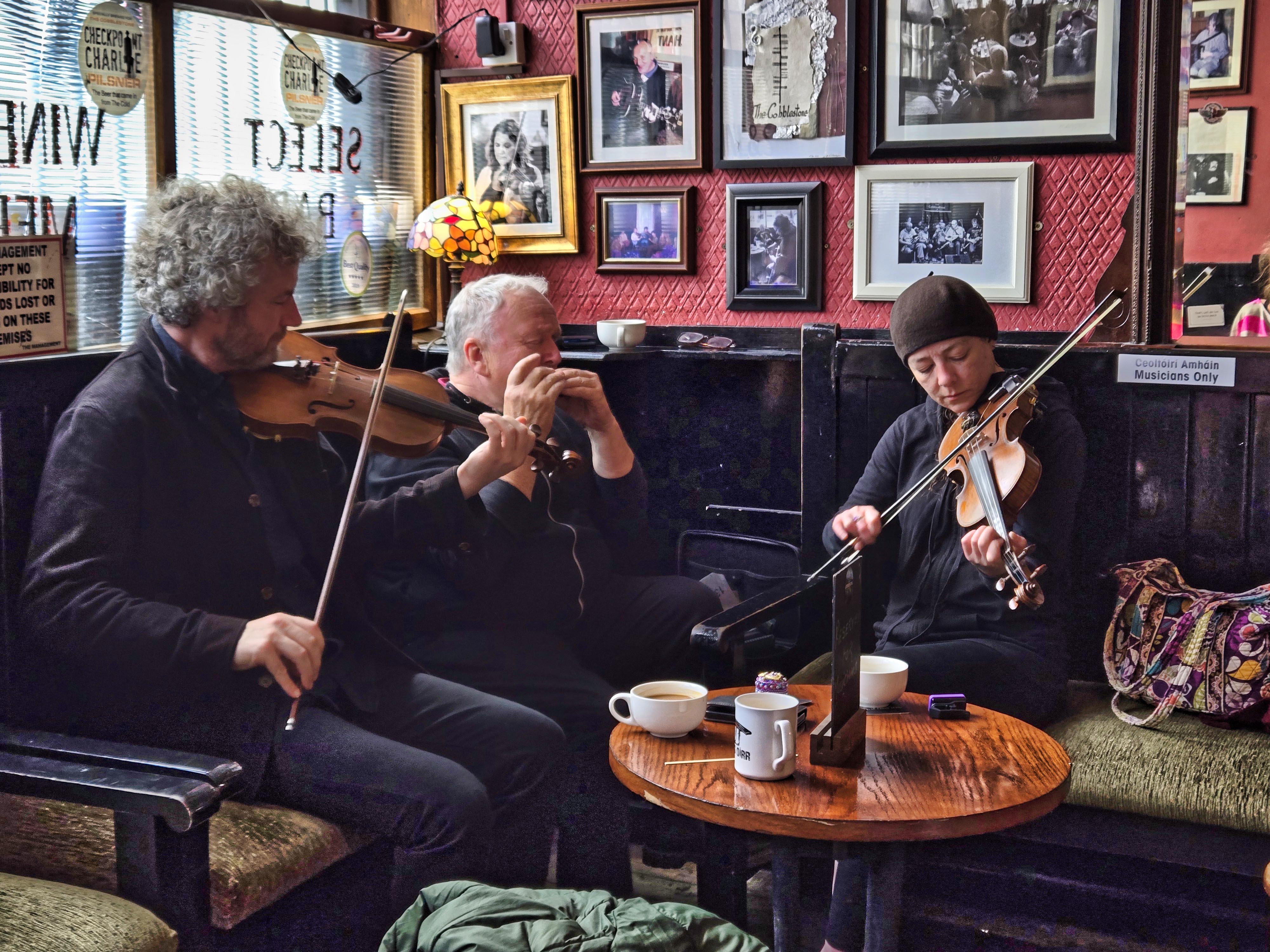
Musicians at the Cobblestone Pub

Our second-to-last day in Ireland, we bused to the city center and visited EPIC, the Emigration Museum. I never discovered just what EPIC stands for, but the experience truly was extensive in scope. There are walk-through exhibits on famous Irish people, personal stories about why people left for other countries (usually Canada, America, and Australia), what their emigration experience was like, and how they felt about leaving their homeland. People had many reasons for leaving including famine, economics, and conflicts.

The current population of Ireland is about 5 million, but it’s estimated (on Wikipedia) that 10 million people have emigrated and 50-80 million people around the world have Irish forebears. This is the largest amount for any one country in the world.

As mentioned in a previous post, Russ’s family were tax collectors and most likely flax farmers. They emigrated to the U.S. to reside in Connecticut and worked in silk and velvet factories. Perhaps their move was for economic reasons. Also, other relatives had already emigrated there.

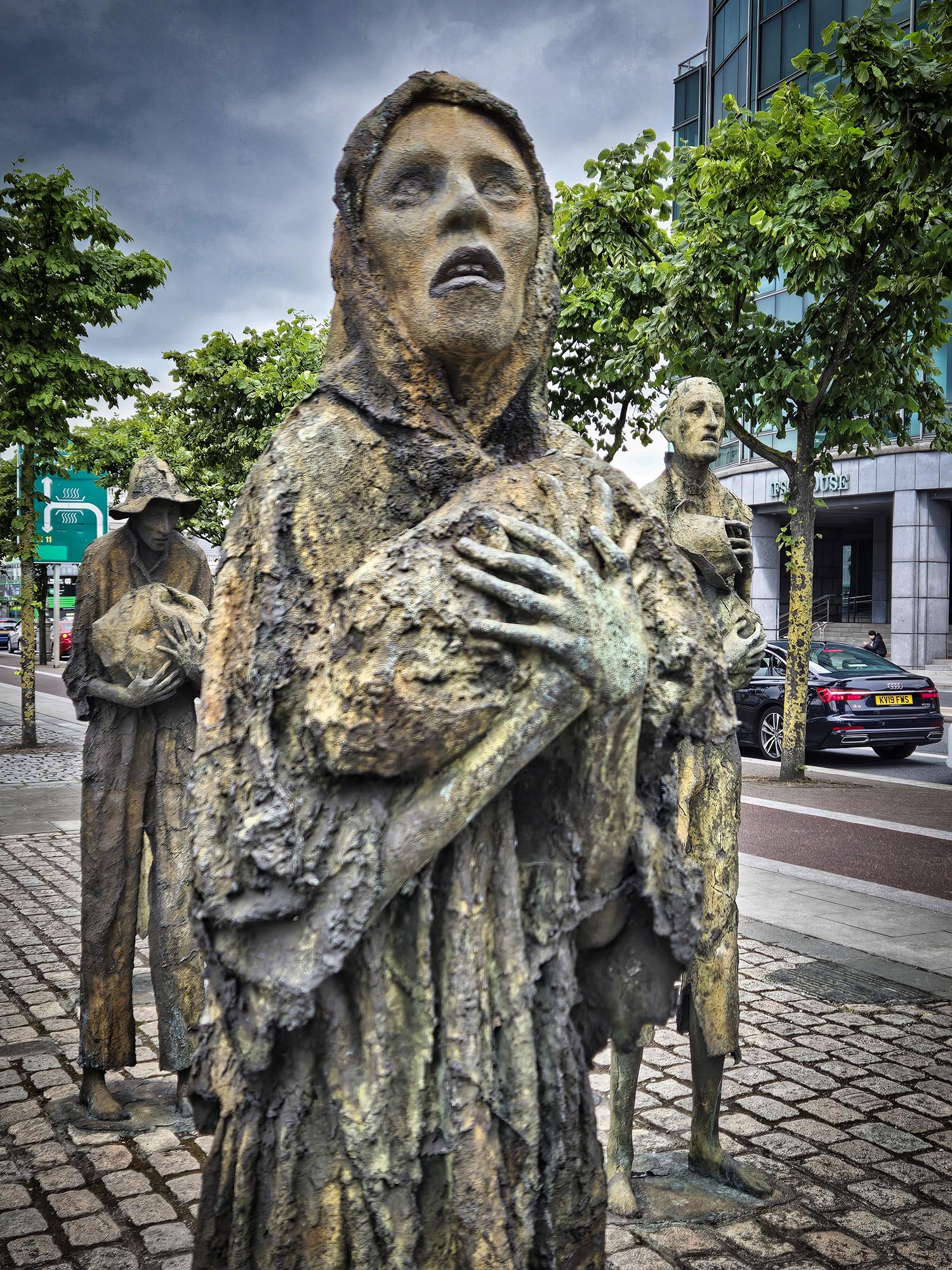
The Famine Memorial Statues, Dublin

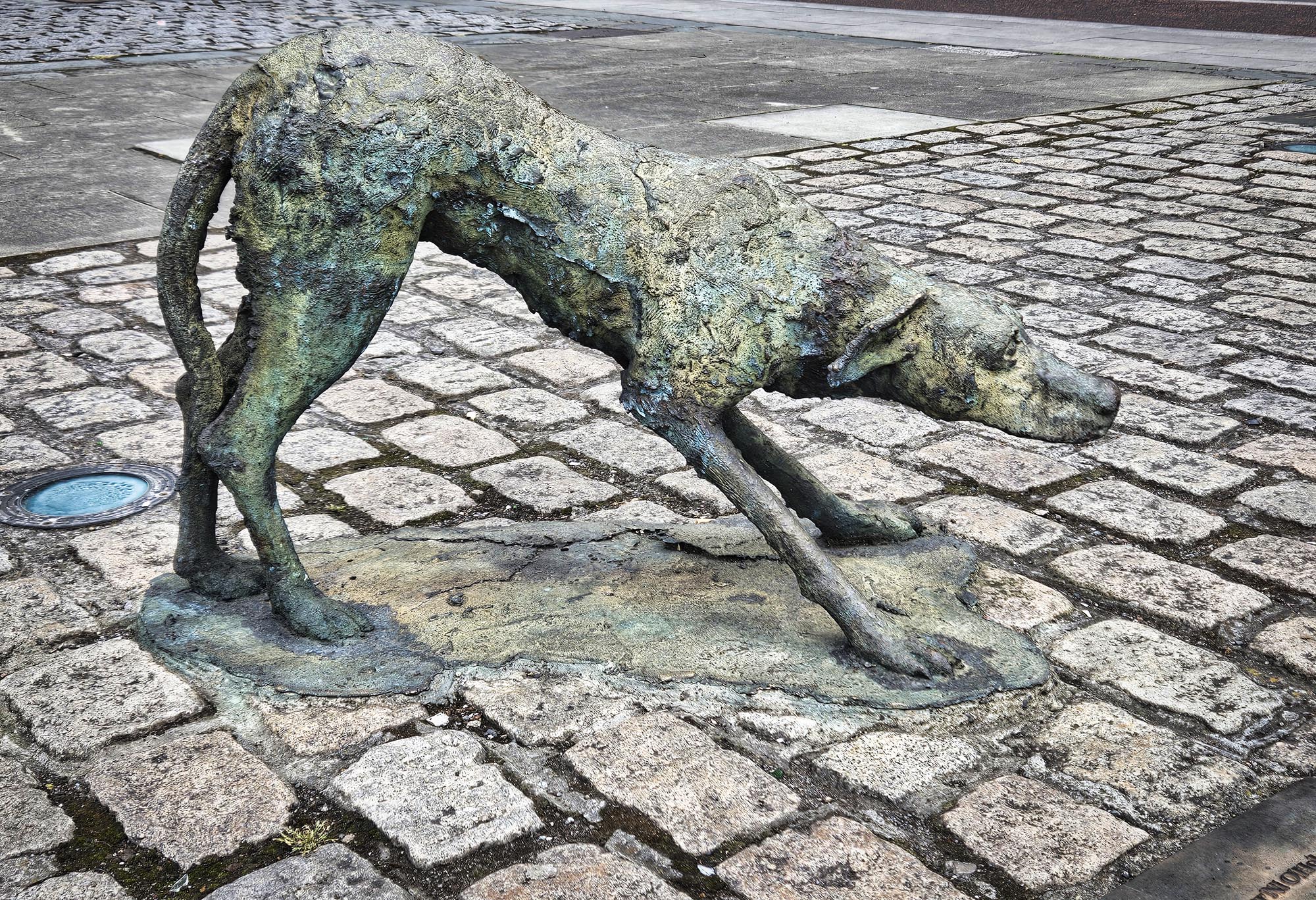
After leaving the museum, we walked to the Cobblestone Pub, which had been recommended to us by several friends for its authentic ambiance and live music. Along the way, we passed the famine memorial statues, which commemorate when more than one million Irish people (half the population at the time) died of starvation during 1845-1849. The famine was due to a potato blight, but also because too much of their food was being exported to England. The haunting, skeletal figures are shown clutching their meager possessions on their way to a ship to leave the country.

Even the dog was hungry….

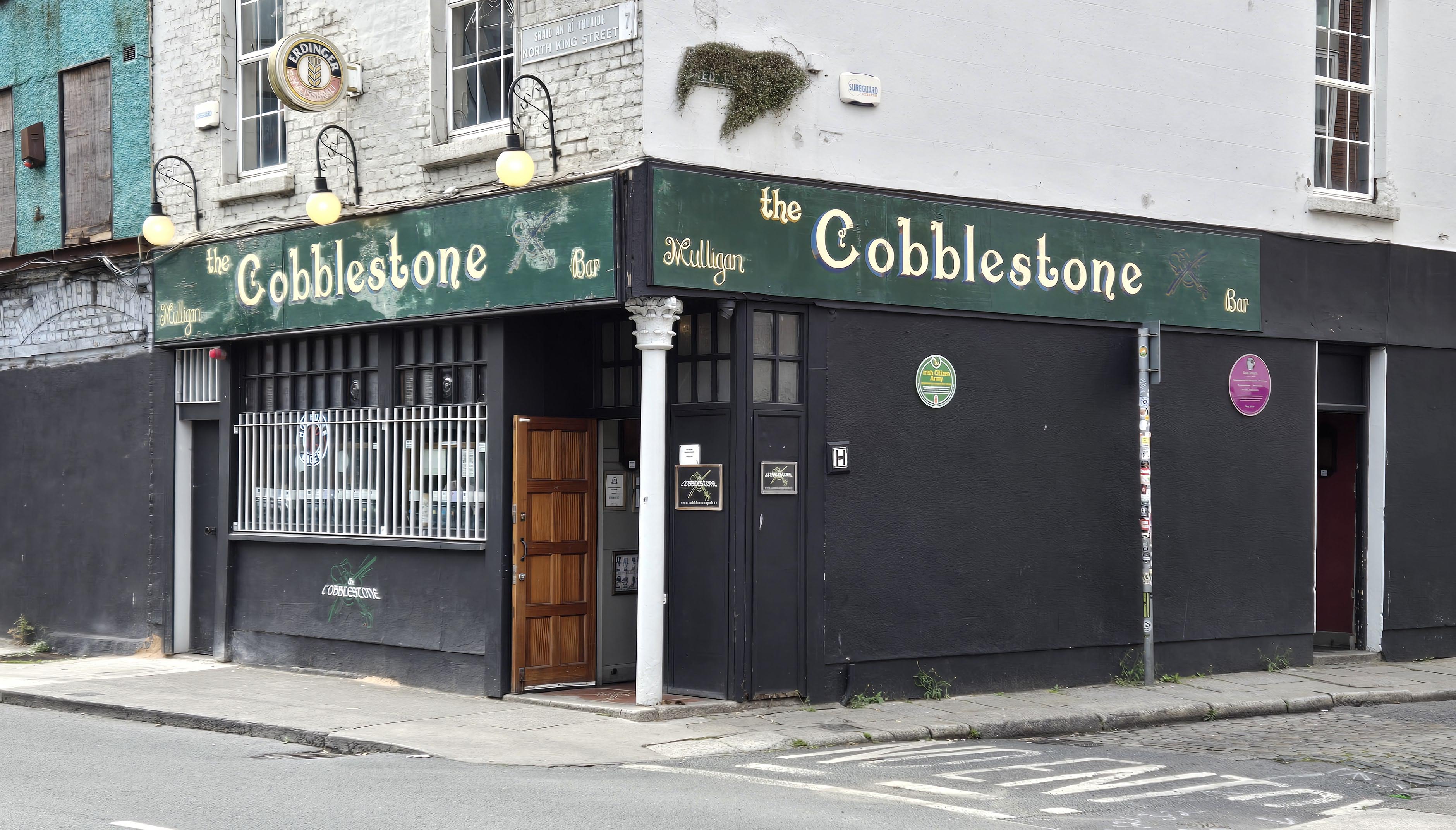
The Cobblestone Pub doesn’t look like much from the outside, but don’t let that fool you. Four musicians were playing in the front alcove as we entered. We found seats at the bar. They don’t serve food, but of course, there’s Guinness and hard cider, of which we partook. A few patrons stood in the entry, blissing out on the music, drinks in hand. Previously, we had visited the famous Temple Bar, but bailed due to the crowds and noise. The Cobblestone experience was much more to our liking.

Afterward, we visited a nearby Mediterranean café (The Oasis) for lunch (very good!) Sated, we walked back to the city center to catch a bus to our hotel. We felt comfortable enough with knowing our route to sit on the upper deck this time, and we called it a day.

Next up: Our final day in Ireland finds us at Newgrange, a series of Neolithic burial mounds.

Ireland Day 4, continued: Taxi Driver Wisdom, Molly, and Trinity College Library

The Gaia art exhibit in Trinity College’s Long Room Library.

I can’t believe how much Russ and I meandered around Dublin on this day! We certainly felt grateful for our good fitness and working legs. Also, we learned that the buses in Dublin require exact change. You can put extra in, but you won’t get change back.

Taxi Driver Wisdom

The times we took cabs in Dublin, most of the drivers were talkative and friendly, but some weren’t, and that was okay, too. From them, we learned such gems as:

  • Although Guiness is seen as Irish, it’s actually an English-owned company. But that’s okay because the beer is so good!
  • Although the Irish band U2 is seen as lead singer Bono’s band, it’s actually the drummer’s band. The drummer is who hired Bono.
  • Dublin is synonymous with Las Vegas for the British. What happens in Dublin stays in Dublin.
  • One way to relieve arthritis knee pain is to soak a rag in whiskey and wrap it around your knee.

I have not fact-checked these claims, so take them as you will. We truly enjoyed our conversations with cab drivers both here and later in Scotland.

Molly Malone

The Molly Malone statue, Dublin

In my previous post, Russ and I had just finished visiting the Temple Bar.  From there, we walked to Trinity College to fulfill our reservation to enter its famous Long Room and view The Book of Kells. We had plenty of time before we needed to be there, so we took a short side trip through the ever-present drizzle to see the Molly Malone statue.

Molly is a semi-historical, semi-mythical lady commemorated in the song “Cockles and Mussels,” which has become an unofficial Dublin anthem. Molly worked as a fishmonger but also as a working girl. She died in one of the outbreaks of Cholera that regularly used to sweep the city. The statue of Molly and her cart is affectionately nicknamed “The Tart with the Cart” by Dubliners, no doubt due to her highly visible cleavage. About ten years ago, someone got the bright idea that rubbing her aforementioned cleavage would lead to good luck. Now the patina on that part of the statue has been rubbed off and brightened by the hands of hundreds, if not thousands, of people. Currently, there’s been some talk of trying to protect the statue from this practice.

Trinity College

Shelves that still contain books in the Long Room. It also features busts of many great historical minds — mainly men, but a few token women have recently been included.

In the heart of Dublin, Trinity College is home to the legendary Book of Kells – a 9th-century gospel manuscript famous for its illustrations. We reserved the Book of Kells and Old Library experience, but there are also other tour options that interpret the Book of Kells more. We were more interested in seeing the library based on amazing images I’ve seen online and in other’s blogs.

I have to admit the Book of Kells was rather underwhelming, since it’s in a glass case and you can only view a few pages. I guess that’s why they’ve developed the additional tour experiences that offer digital views of more of it.

The long view of the Long Room, Trinity College.

The Long Room in the library, however, lived up to the hype! Currently, an art exhibit called “Gaia” is featured in it: a floating illuminated globe of the Earth that looks like it’s in outer space. Ironically, many of the books in the library are off the shelves. They’re being restored (and dusted, I suppose !)

We spent a lot of time in the Long Room, just soaking up the literary silence and beauty of it.

Day 5 found us still in Dublin. Next up: the famine statues, the emigration museum, and Cobblestone Pub.

Ireland, Day 4: Bog Bodies, Yeats, and Pubs

We explored Dublin, feeling more connected to this land after our previous day’s adventure seeing where Russ’s ancestors lived. Our first stop was the National Museum of Archaeology. We saw golden artifacts and a huge dugout canoe crafted over 4,000 years ago (the Lurgan canoe). But the things I most wanted to see were the bog bodies.

Gallagh Man

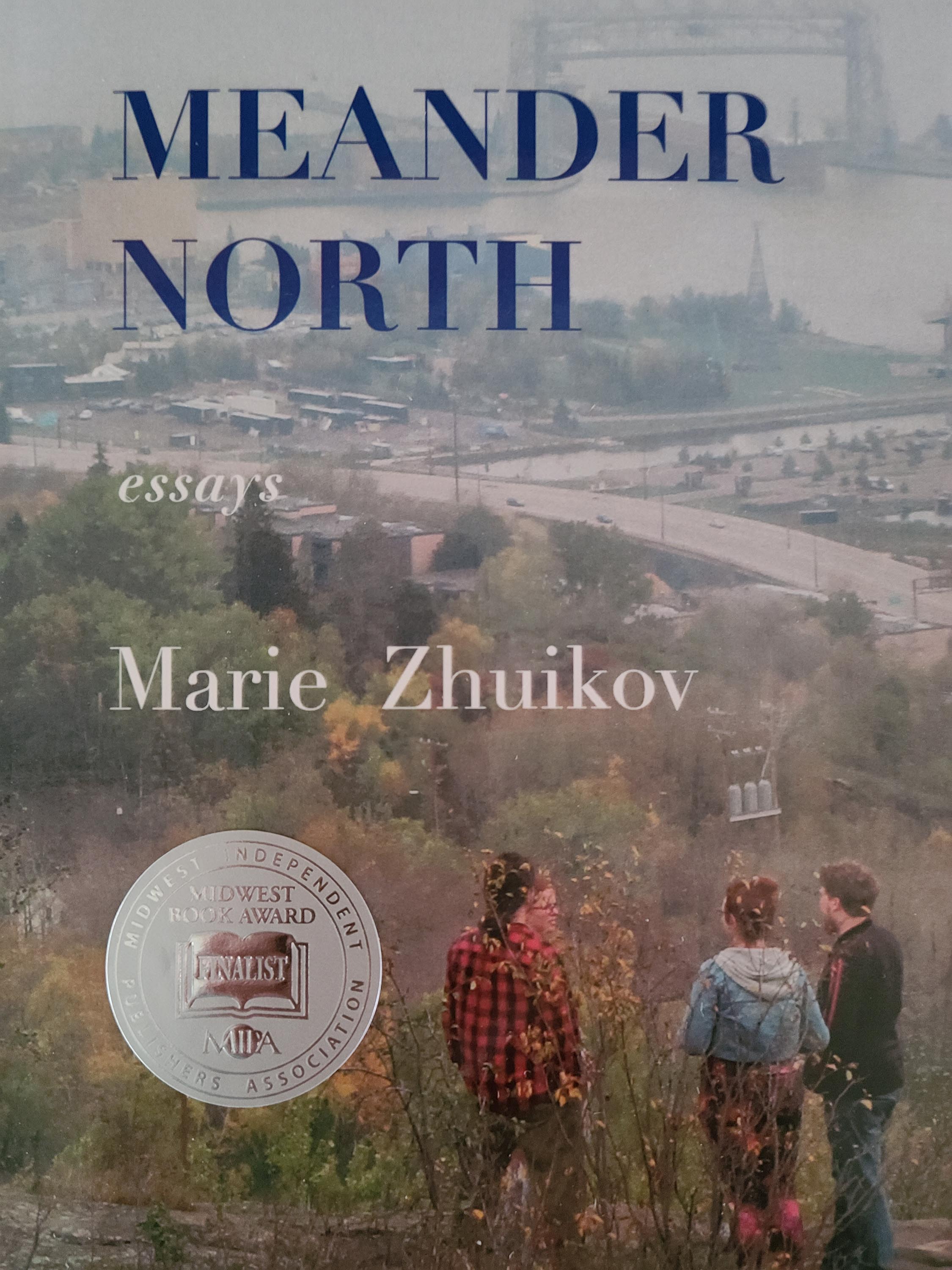
If you’re not familiar, bog bodies are the corpses of unfortunate people who were either murdered or ritually sacrificed and buried in the boglands of Ireland and other countries. There are five bodies (or parts of bodies) on tasteful display in the (free to enter) museum. I’d only seen photos of them in magazines before. I wanted to see the bodies in person because I wrote a short story about a bog body, which will be featured in my book that’s slated for publication this fall. I’m in the middle of editing the manuscript and wanted to see if this museum experience would give me any new ideas.

I only took photos of two of the bodies: Gallagh Man and Clonycavan Man. Gallagh Man was a six-foot-tall, healthy man with reddish hair who lived sometime between 470-120 BC. He was found in County Galway, Ireland, in 1821 by laborers digging peat for fuel. The twenty-five-year-old was most likely strangled before being buried in the bog.

Clonycavan Man

Clonycavan Man was found in County Meath in 2003, also by peat harvesters. Alas, they were using a machine that cut the body in half, and only the upper torso and head remain. He was between 20 and 40 years old when he died sometime between 392-201 BC. At five-foot-two, he was shorter than Gallagh Man. One of Clonycavan Man’s most distinguishing characteristics was his hair. He had what may have been the first man bun! Perhaps it made him look taller. Scientists even discovered an ancient form of hair gel in his hair, made of plant oil and pine resin. The presence of this gel indicates he was fairly wealthy during his lifetime; it was made from materials found in France and Spain. His injuries suggest a grisly death, which may have been the result of torture. I’m not going to go into them here!

One theory proposed is that these men were failed kings or failed candidates for kingship who were killed and placed in bogs along tribal boundary lines. Their bodies served as offering to the goddess of the land to whom the actual king was “wed” in his inauguration ceremony.

I was particularly excited to see Clonycavan Man’s hair bun, since I gave the bog body in my short story a similar attribute. Seeing the bodies did not give me new ideas; rather the experience enforced what I’d already written. But it was very interesting to see them up close.

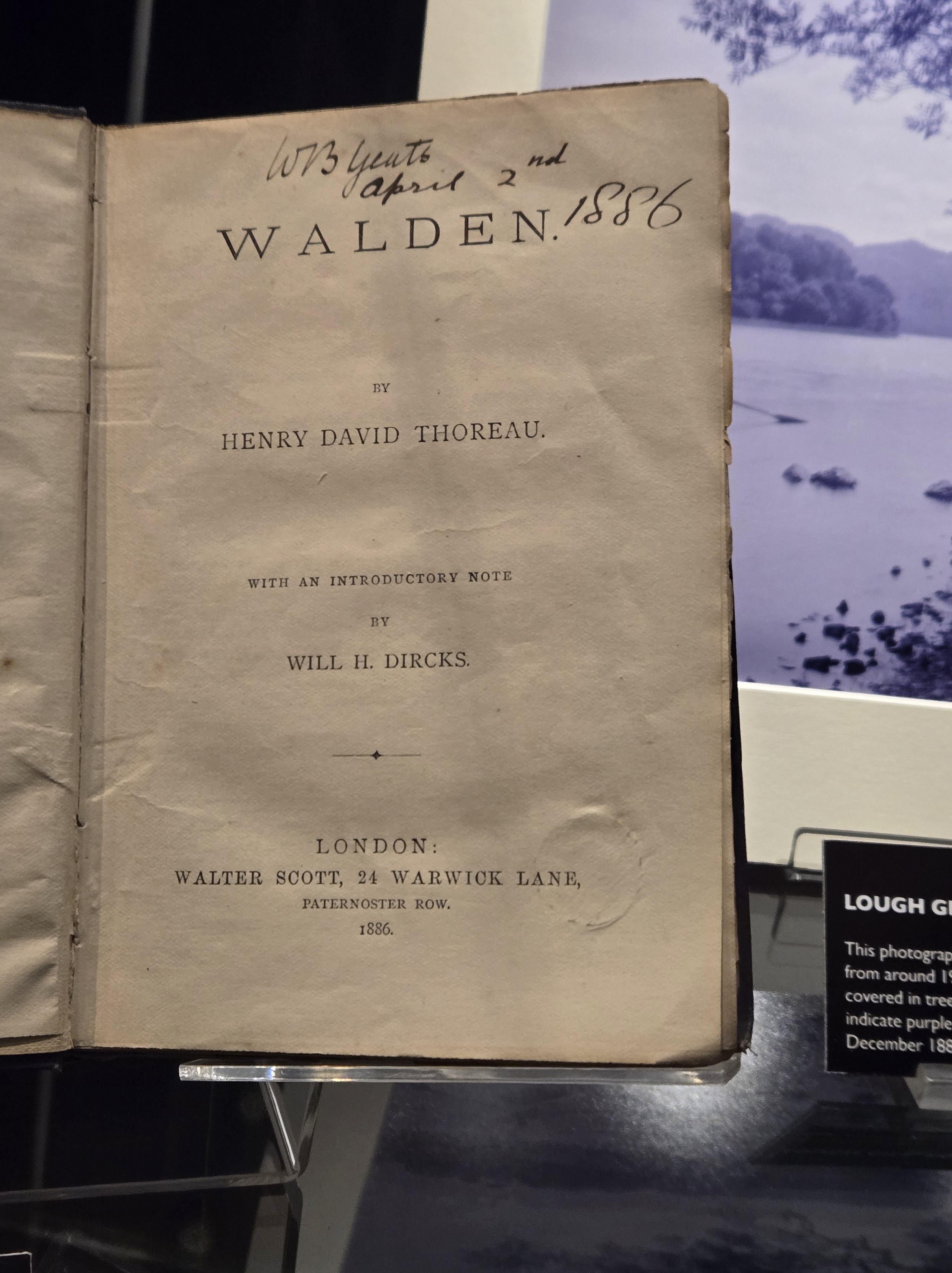
Next door to the museum is the National Library, which offered a free exhibit on William Butler Yeats, one of my favorite writers. We saw his copy of “Walden” and learned more about Maud Gonne, his muse who refused to marry him several times. I also learned that Yeats was heavily into spiritualism (think seances). I had not known that before.

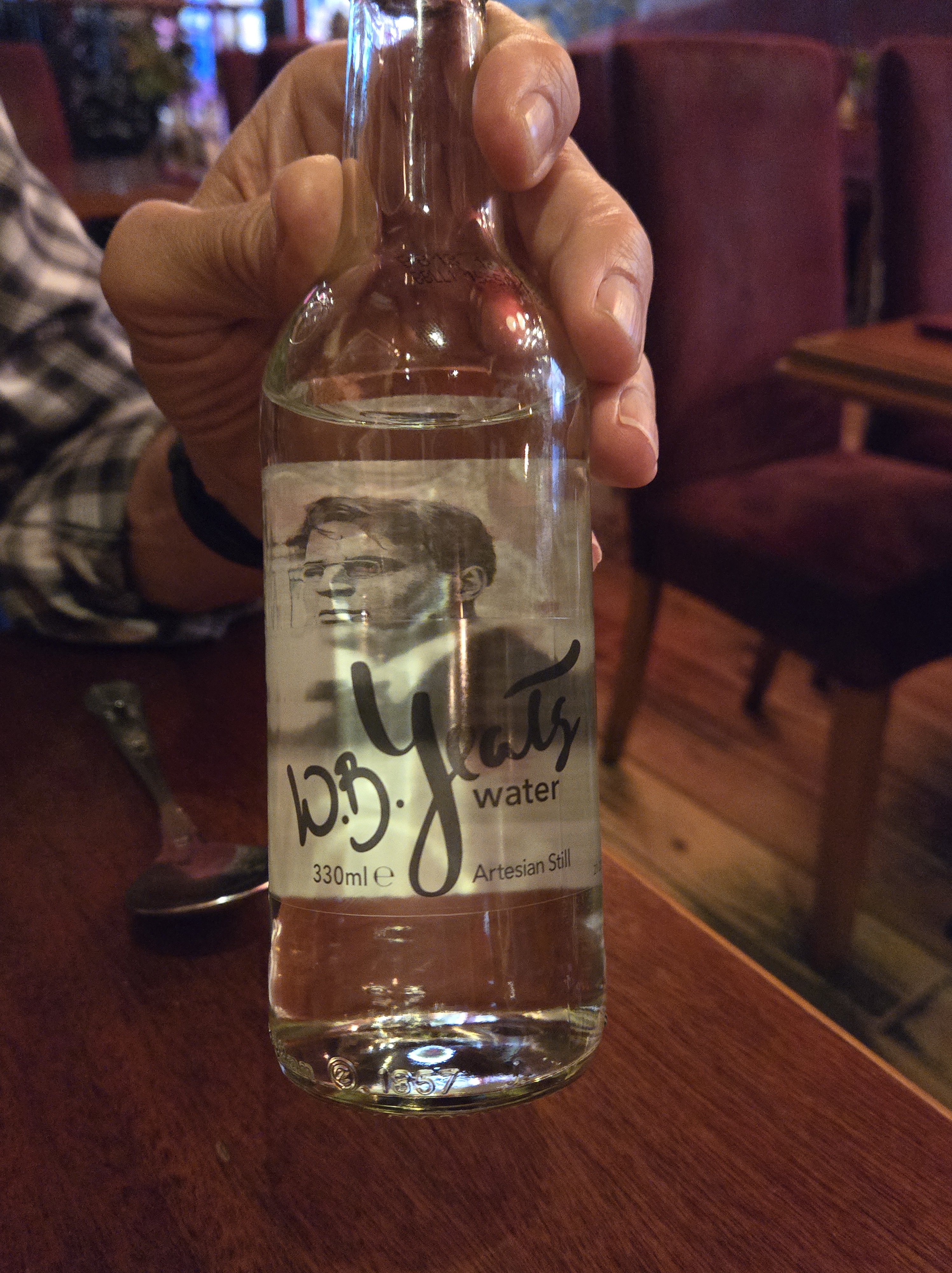
In an interesting coincidence, later that day, I ordered water at a restaurant. It came in a bottle sporting Yeats’s photo. The brand name was W.B. Yeats water. Imagine, naming a commercial brand after a writer! We don’t do that enough in the U.S. I will happily sell my name and likeness to anyone who wants to use it for commercial purposes. 😊

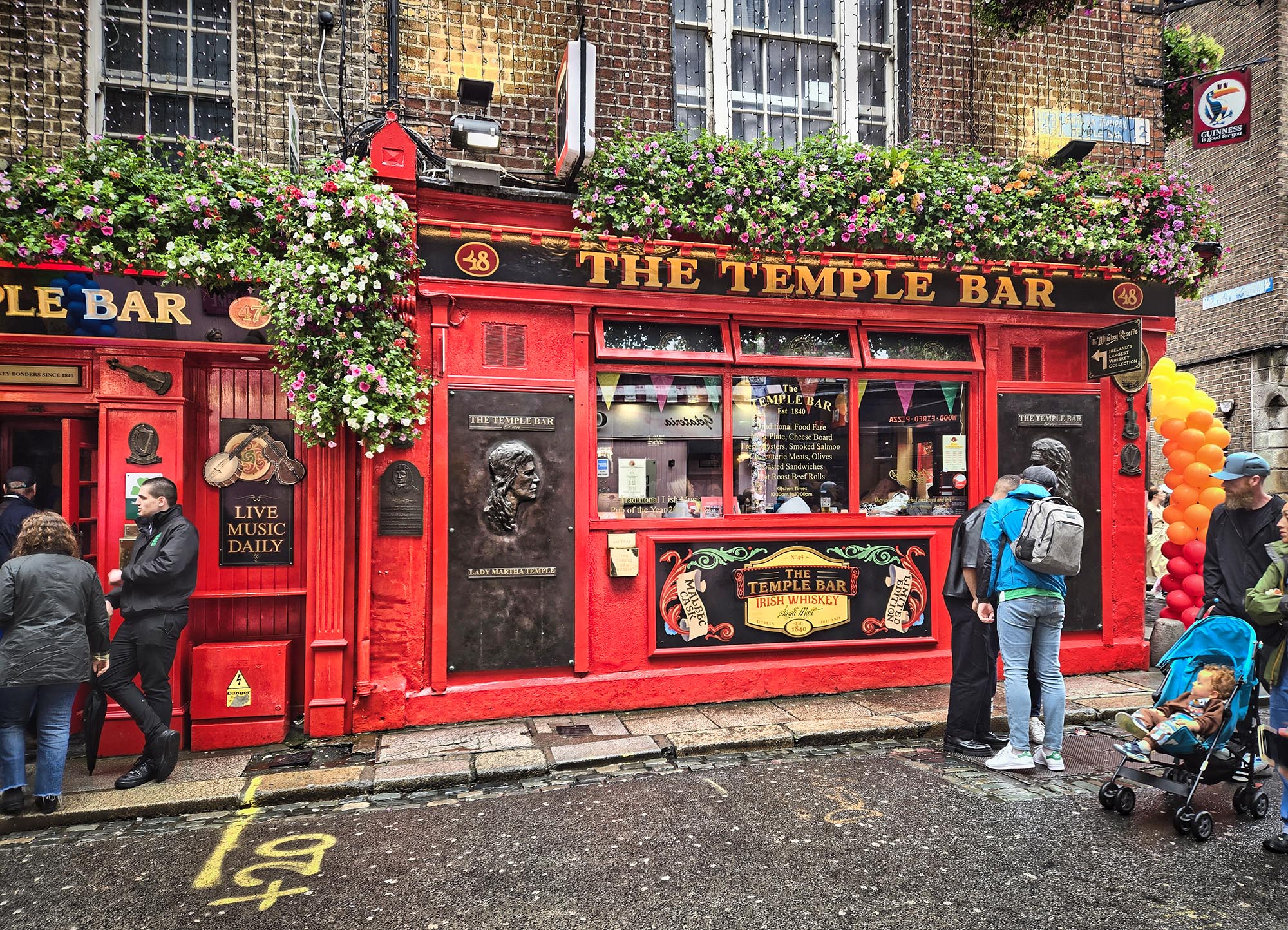
After touring the library, we walked through a drizzle to the famous Temple Bar. It’s known for its live music, ambiance, and large whiskey collection. It was too crowded and noisy, so we satisfied our curiosity with a mere stroll through it.

We had more Dublin adventures that day, but I’ll save them for the next post.

Ireland – Day 3: An Ancestral Tour

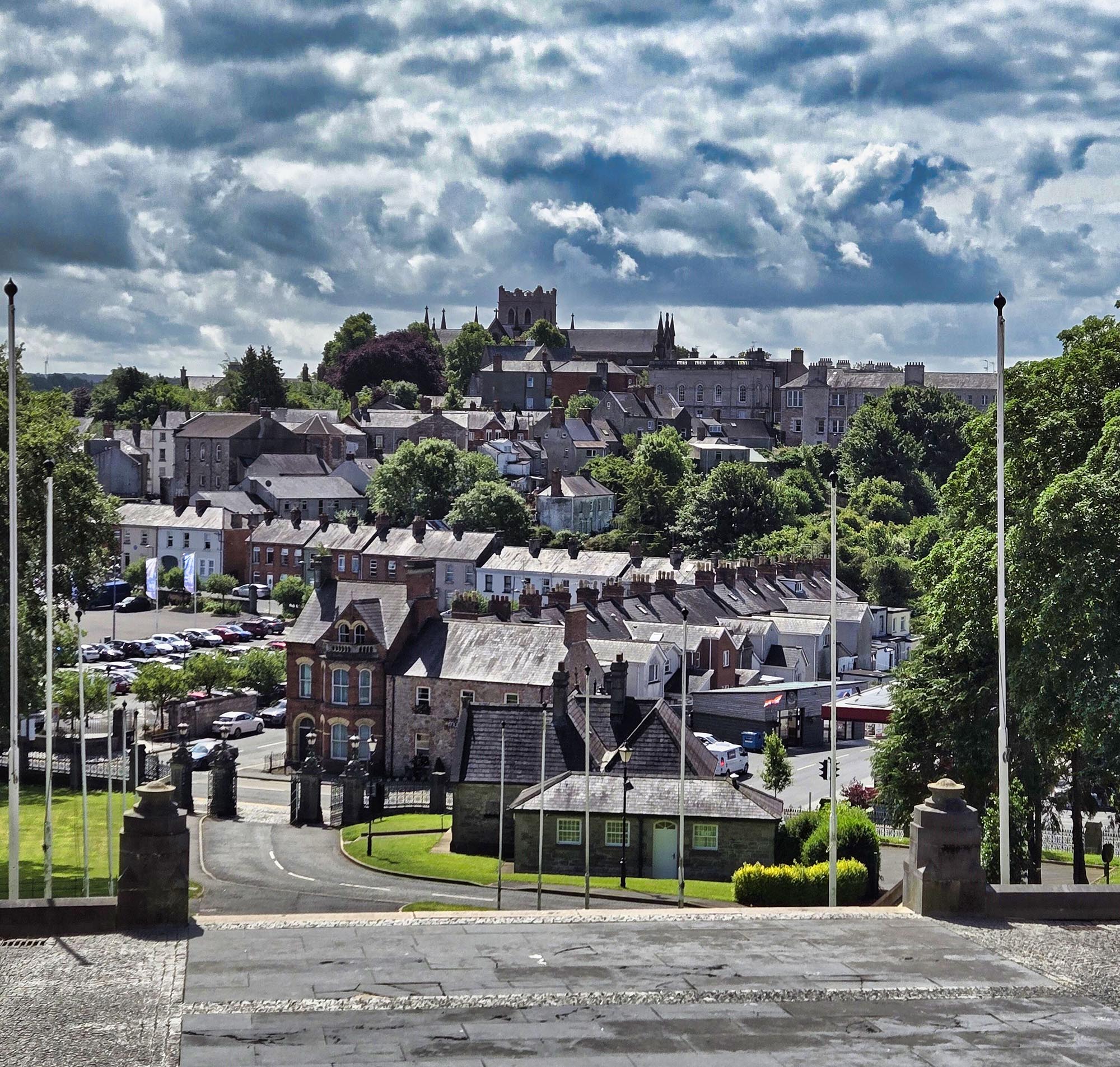
The town of Armagh and St. Patrick’s Church of Ireland Cathedral as seen from the steps of St. Patrick’s Roman Catholic Cathedral.

This day was a big deal for us. We’d been working for six months with My Ireland Family Heritage, a small, family-owned company that does genealogy research and tours. This was the day for our tour of the lands of Russ’s ancestors!

Our guide, Ian, picked us up from our hotel in Belfast. Our first stop was the small town of Armagh near where Russ’s ancestors lived. We had requested a visit to St. Patrick’s Cathedral there, but once we reached the town, we were surprised to learn that there are two of them! The oldest one (year 445) is Protestant and the more recent one (1840) is Catholic.

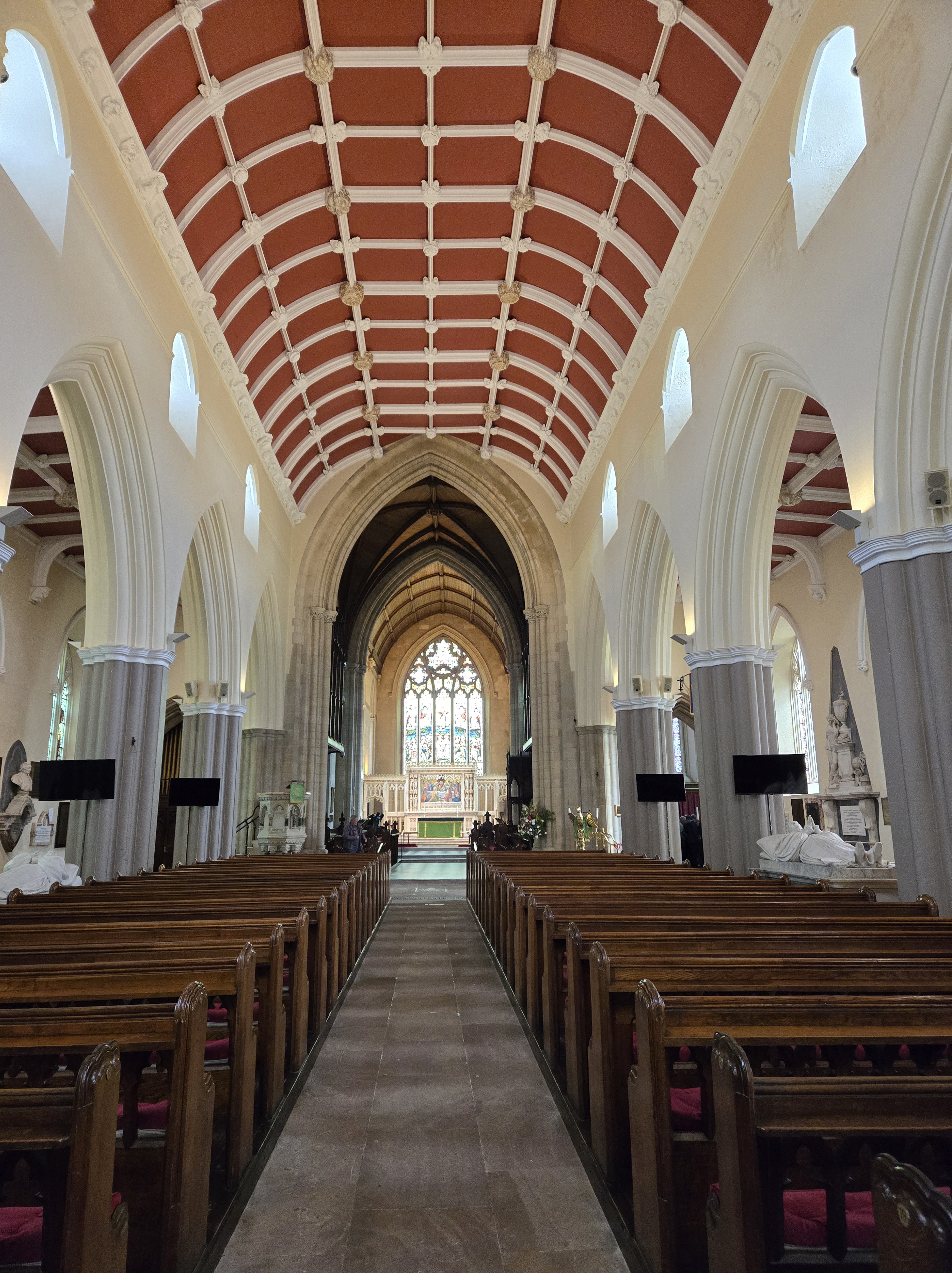
Armagh owes its association with St. Patrick to the old church, which is named St. Patrick’s Church of Ireland Cathedral. It stands on a hill overlooking the town. The hill (Ard Mhacha or Height of Macha) is where the city (Armagh) got its name. Before the church was built, it was a major ritual site and an ancient royal center. The Book of Armagh states that St. Patrick decreed that the Armagh church should have pre-eminence over all other churches and monasteries in Ireland, a position it holds to this day. The present structure was built in 1268 but it has been restored several times due to fires and worship needs.

Inside St. Patrick’s Church of Ireland Cathedral, Armagh.

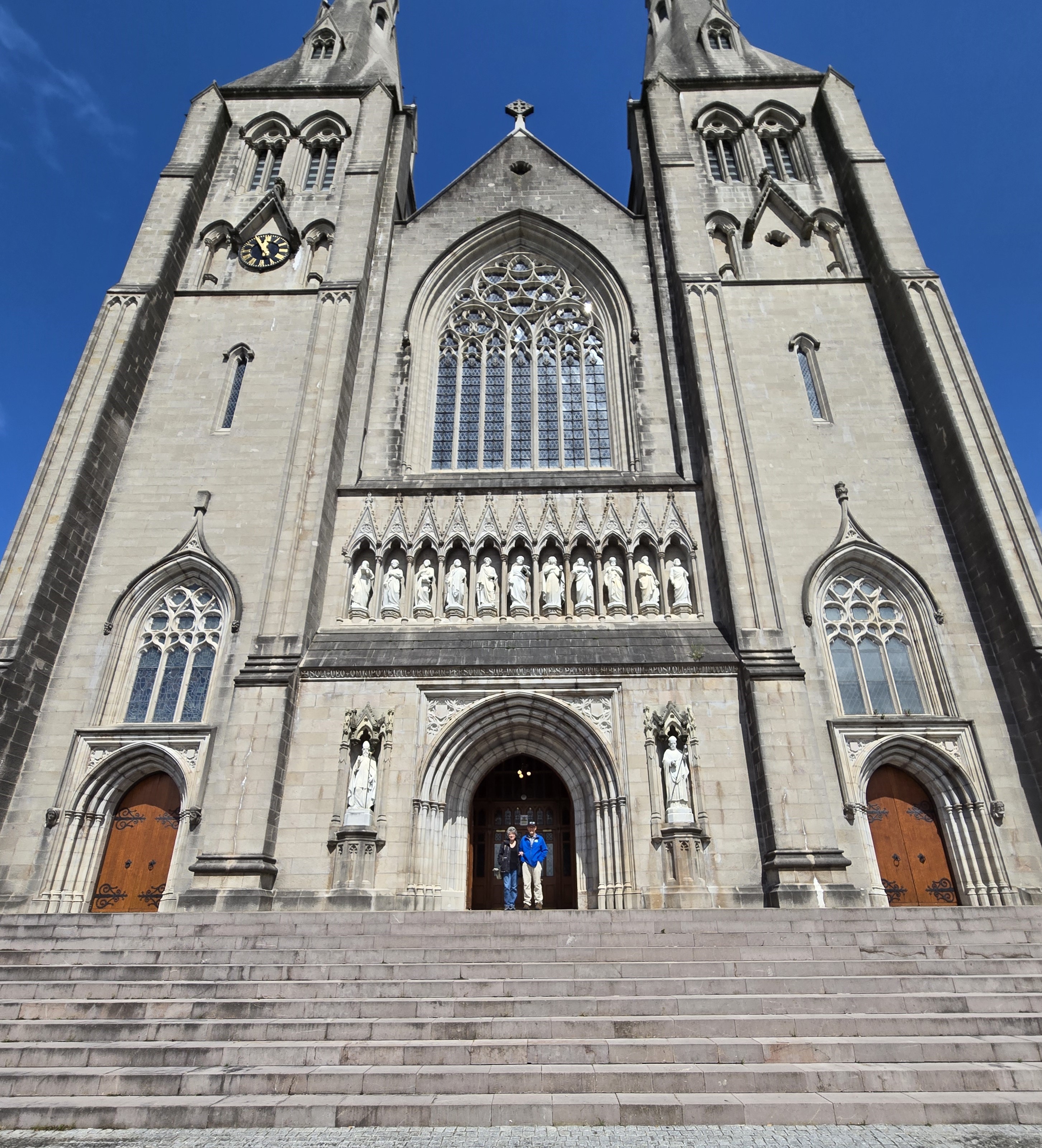
Across the way atop another hill is the other church, St. Patrick’s Roman Catholic Cathedral. It’s the seat of the Catholic Archbishop of Armagh. We could easily see it from the steps of the Protestant church. Of the two, the Catholic one is the fanciest, probably owing to its more modern construction.

Us at St. Patrick’s Roman Catholic Cathedral, Armagh.

Russ’s great-great-great grandfather James Henry Thornton lived just outside of Armagh in the small township of Foybeg. He came to Ireland from England with the unenviable job as a tax collector for Lord Lurgan (Charles Brownlow or Baron Lurgan), an Anglo-Irish politician who represented Armagh in the U.K. Parliament.

James Henry was married twice, but we didn’t know the names of either of his wives. James Henry had two sons, James and John, one with each wife. Besides being a tax collector, his occupation is recorded in church records as a farmer. Ian told us that Foybeg is known for the growth and weaving of flax into linen. It was the “cash crop” of the time, much like coffee is for Brazil today. So, he could have been a flax farmer.

His son James eventually moved to Australia. Russ is related to John, who was his great-great grandfather. He is described in family records as at least six feet tall. He loved horses, hunting and good whiskey, but hated work. He always carried a cane and had at least two dogs following him at all times. He was educated to teach school in Northern Ireland.

John married Jane Berry and they had eleven children. One of them was Russ’s great-grandfather, William John Thornton, who went by the name John Jr. After he emigrated to America, he married an Irish woman, Sarah J. Fox. She grew up near Foybeg.

Ian, our tour guide, outside St. Paul’s Church.

After lunch, Ian took us to St. Paul’s Church, which was where Sarah’s family worshipped and were buried. We saw lots of graves with familiar family surnames (Fox, Johnston, Berry) but did not come across anything significant. Inside, there was a “new” baptismal font on display. The old one was shoved underneath a spiral staircase. Could that have been used for Sarah Fox or her family?

The old baptismal font in St. Paul’s Church.

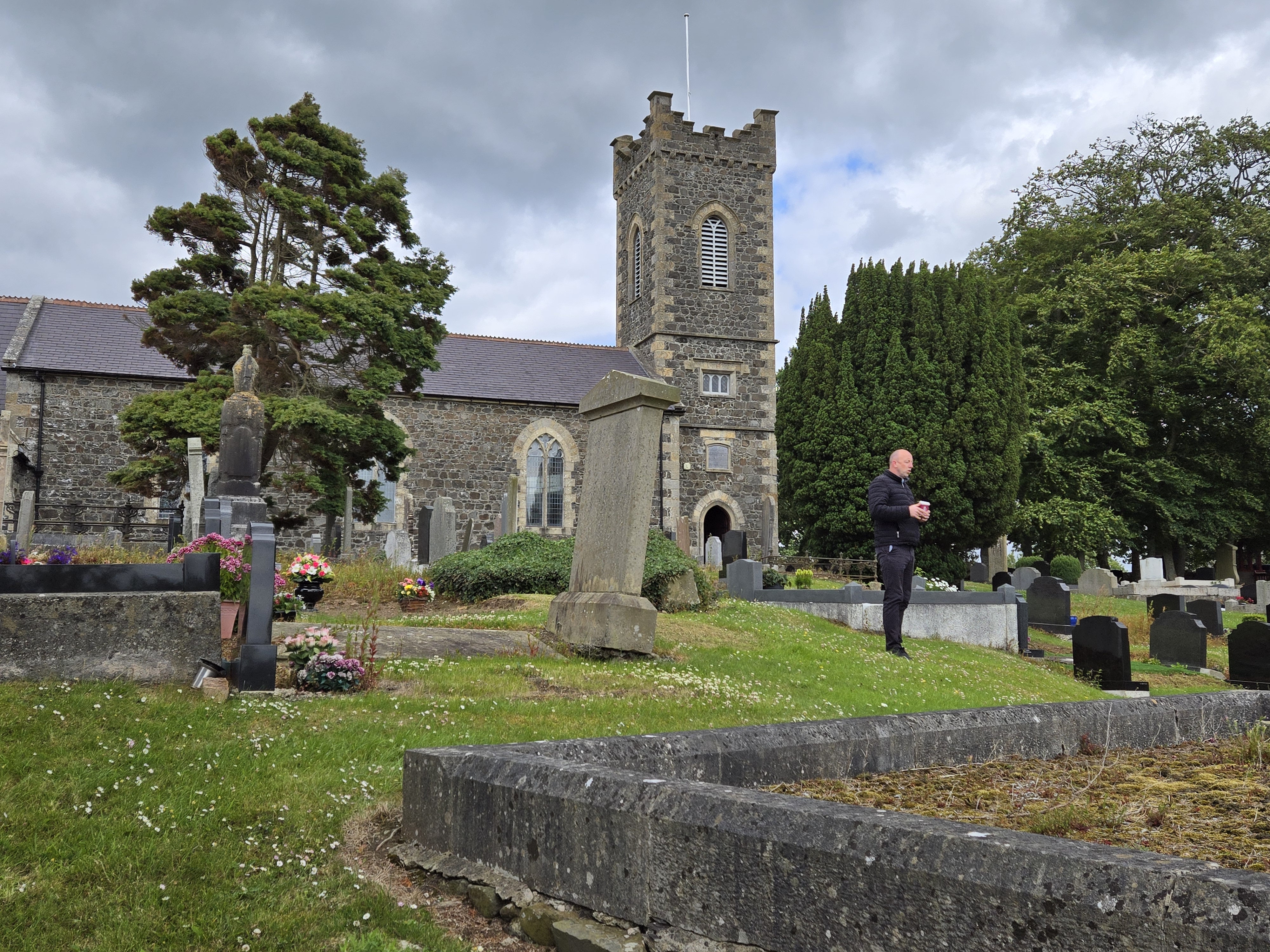
Our next stop was the Drumcree Church of the Ascension, where we hit the jackpot! This was the church (Church of Ireland denomination) where the Thorntons worshipped and were married/buried. The church is surrounded by cow pastures and apple orchards and even has an apple tree depicted in a stained-glass window.

The apple tree stained-glass window in Drumcree Church.

Besides the ancestral connection, Drumcree Church was significant during Ireland’s “troubles.” For several years in the 1990s, this Protestant church drew international attention as the scene of the Drumcree standoffs. Each year, the Protestant Orange Order marched to-and-from a service at the church on the Sunday before the 12th of July. Residents in the nearby Catholic district prevented the march from continuing through their neighborhood. Thousands of Orangemen and British loyalists gathered at Drumcree and violently tried to force their way through, but were held back by security forces, who built large steel and barbed wire barricades. These yearly “sieges” of Drumcree ended in the early 2000s.

Drumcree Church and graveyard

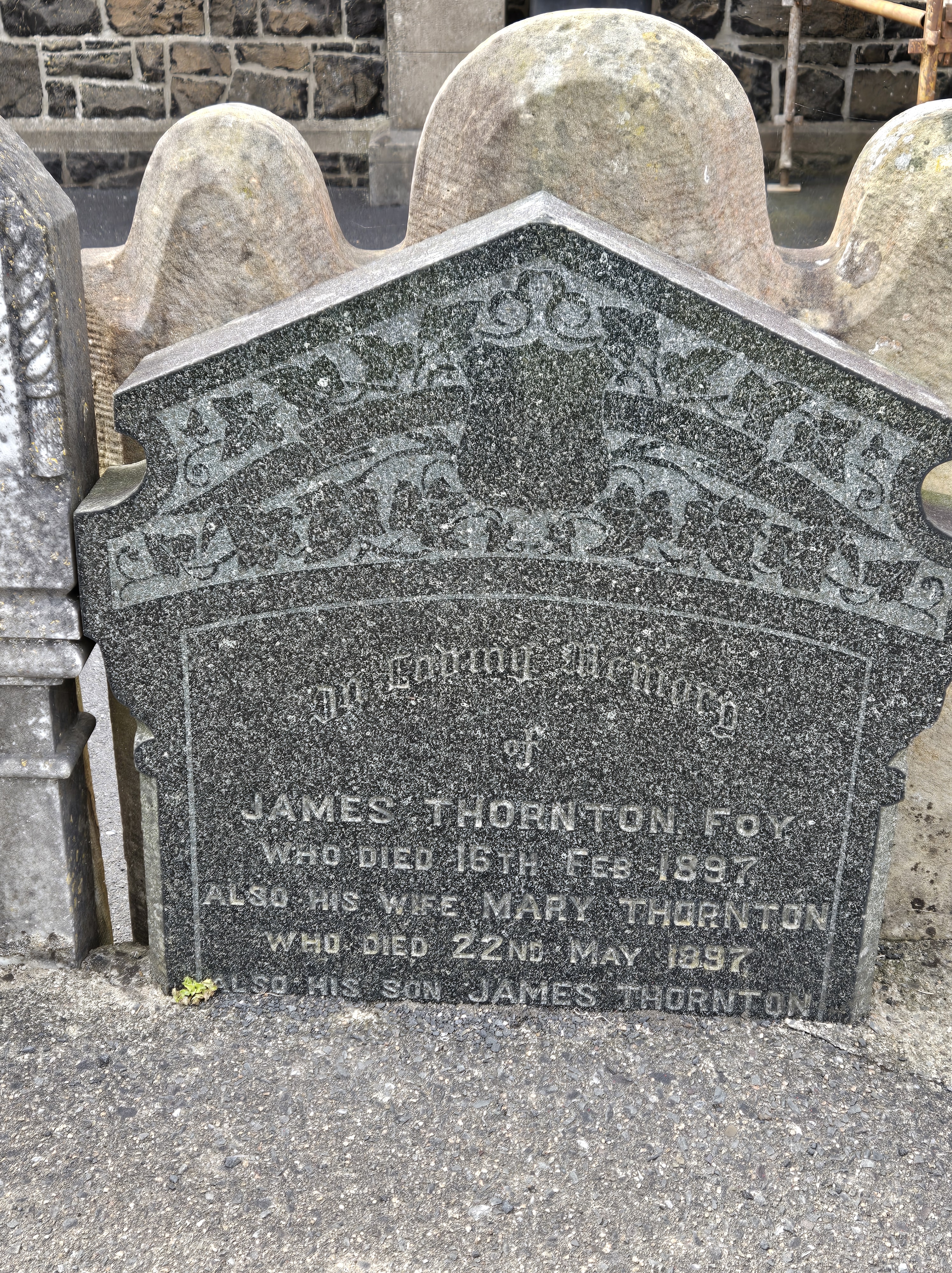
As we strolled around the graveyard, which smelled of manure from the cows nearby, we noticed a broken headstone propped up against the low stone wall that borders the yard. It was the headstone for James Henry Thornton and Mary. Mary must have been James Henry’s second wife! The last line on the tombstone says something about their son James Thornton, who was thought to have lived in Australia. Maybe he returned home to Ireland, eventually? The church member who let us into the building for a tour said that the stone must have been broken in the past, so that’s why it was leaning up against the wall and not over their gravesite. He said they do that instead of just getting rid of the broken ones.

Our exciting graveyard find!

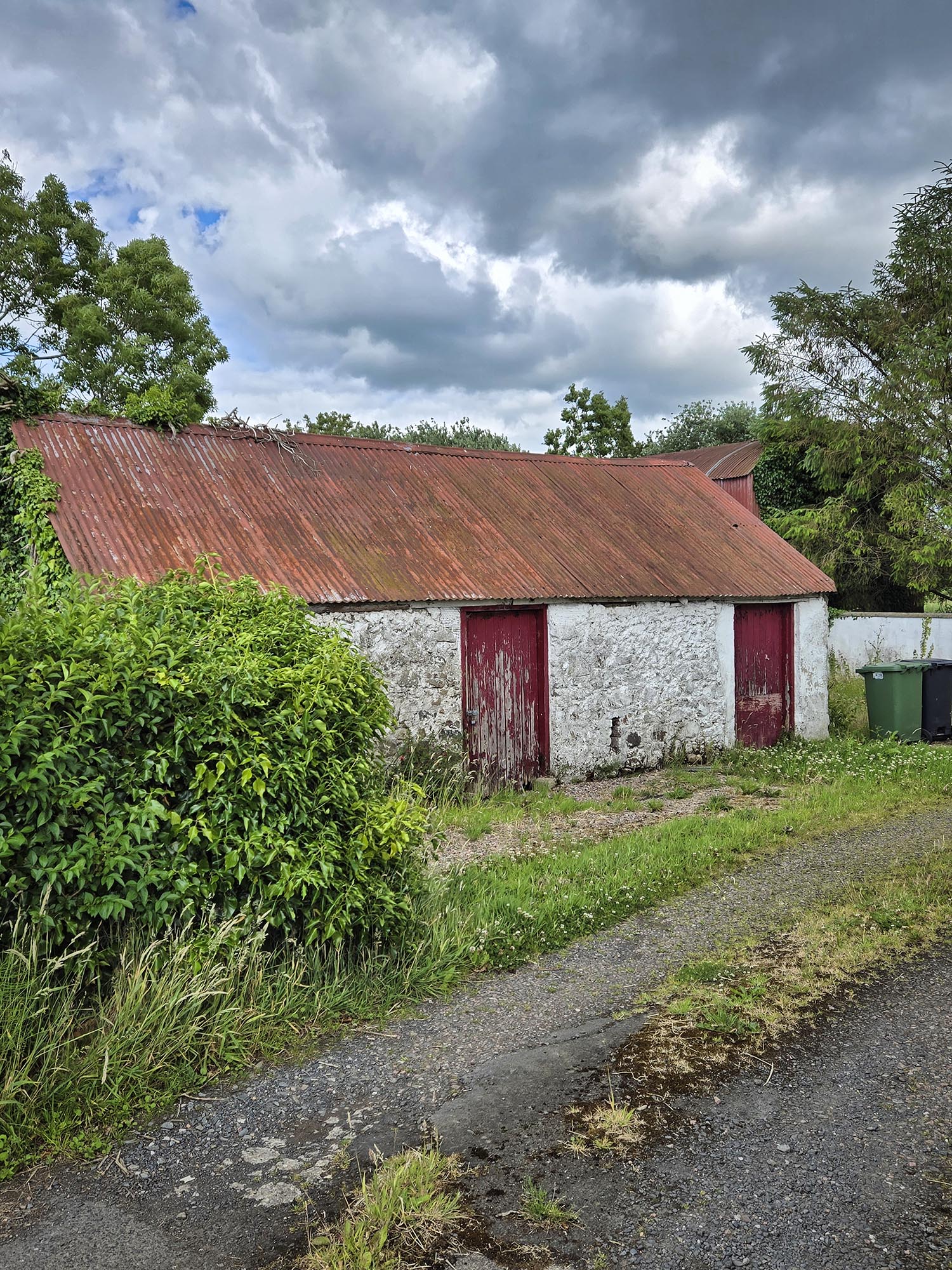
As if discovering this significant gravestone wasn’t enough, our talkative guide Ian next took us to the homesites of Russ’s ancestors. Two out of three weren’t accessible or there was nothing to see but an orchard, but the Thornton homesite was different! We peered down a driveway that led to a modern house. Between the driveway and the house was an old white building with red doors and a rusting metal roof. This was where Russ’s Thornton ancestors lived! It looked more like a shed or a barn now than a home.

The Thornton Family home in Foybeg Township, Ireland.

We only had time to take a few photos before Ian wanted to leave. You see, he is a Catholic from the Republic of Ireland to the south. We were in Northern Ireland, which is mostly Protestant. He did not feel comfortable hanging out in rural areas for fear of a confrontation. (People can tell where he’s from by the license plate on the van.)

Once we were back in the van driving away, Russ said a lady had been out in the yard. I would have loved to have had the chance to speak with her to see if she knew anything about the past inhabitants of her place, but I did not see her when I was taking pictures of it. Russ took the geographic coordinates of the location, so perhaps, if we ever return, we will have more time to explore and chat. Russ said that this was his favorite part of the tour.

As the ancestry book that the tour company put together for us says,

What was once a home where children played a hive of activities stands quiet now, a home for spiders and field mice. In the corner of the eves an owl hoots every evening . . .  People lived and died in this cottage. Its walls could tell you stories, happy and sad. Children grew up here, some stayed near, and some traveled far and wide to the other side of the world. They packed their memories to start a new life, new beginnings, and new memories, leaving this little cottage to nature.

Russ’s great grandfather, William John Thornton emigrated to the U.S. He settled in Manchester Connecticut and married Sarah. They had four children. At the time of his marriage, William John was employed as a “velvet finisher.” He also worked as a coachman and a laborer later. Unfortunately, William John was an alcoholic. He died in 1917 from freezing to death in a drunken state in a roadside ditch. Sarah lived until a ripe old age, dying in 1964.

Tour over, Ian drove us to Dublin, the site of our next adventures!

Ireland – Day 2

The Titanic Museum, Belfast

Belfast was where the Titanic and its sister ships, the Olympic and Britannic, were built. We’d heard that because of this, the Titanic Museum was mainly about how the ship was built and not so much about the sinking, but we found this not to be true.

I was thankful for that because, of course, the sinking is what the Titanic is known for. Although I don’t care to watch the movie version of the sinking ever again (all that death made me ill!) I was interested in seeing the museum version of the tragedy.

A model of the Titanic in the Titanic Museum

The museum was well worth the entry price. Pre-booking of tickets is required. The displays were built in various ways that appeal to all types of learning: audio, visual, reading, entertainment, experiential, and probably a few others I don’t know about. Talking holograms of passengers and crewmembers offered interpretation along the way. There were models of the Titanic, and even a ride in these funky, boxy cars that took visitors through the experience of building the ship. Outdoors, the yard where the Titanic and other ships were built is visible from the museum.

A replica of a first-class state room on the Titanic, complete with hologram passenger and staff member.

My favorite part were the displays that dealt with discovering the ship’s resting place at the bottom of the North Atlantic. Visitors can walk over a glass floor that simulates walking above the wreckage on the ocean’s bottom. That was so cool!

Marie, striking a typical Titanic pose.

After our tour, we popped into the museum’s Galley Café, which had food just about a delectable as a first-class passenger’s on the Titanic. I ate a wonderful chowder and topped it off with trifle for dessert. Trifle is a parfait made with cake cubes, vanilla pudding combined with whipped cream, and interspersed with berries and peaches. The café’s trifle was not as good as the one I make, but I wasn’t going to complain. I was impressed that they even offered it as I’d never seen it on a menu before (especially in the U.S.).

Afterward, we meandered outside and toured a ship in dry dock called the Nomadic. Like the Titanic, it was built by the White Star Line and was the tender ship for the Titanic. This means it ferried passengers and supplies to it. The Nomadic is the only surviving White Star Line ship left. Entry onto it was included in our ticket price for the museum. That was fascinating to see, especially a few pieces of original oak paneling that are left in the women’s bathroom sitting room, and how the various classes of passengers were kept separated.

The Nomadic, Titanic’s tender ship.

After that, we hopped onto the Maritime Trail in a light drizzle. It goes right past the museum, so a stroll along it was a no-brainer. In addition to interpretive signs about the city’s maritime history, there were “Game of Thrones” stained glass displays. The TV series was filmed in Ireland.

A cute seal that was on the Maritime Trail. Look at those eyes!

As the drizzle increased and our feet got sore, we tried to order a cab to take us back to our hotel but had no luck. The problem was Shania Twain. The singer was in town and all the cabs were booked by her fans. We trudged back to the Titanic Museum and were able to nab a cab that was waiting in front for passengers. Our driver said that Shania is of Irish descent, along with Taylor Swift and Mariah Carey, so they’re all big deals in Ireland.

The main reason we decided to visit Ireland was to explore Russ’s heritage. Like the famous singers, Russ is of Irish descent (as well as French and German). His great-great-great and great-great grandfathers and grandmothers lived there, and the female line goes back even farther. In the next post, I’ll describe what happened on Day 3, which involved a genealogical tour to his ancestral homelands outside of Belfast.

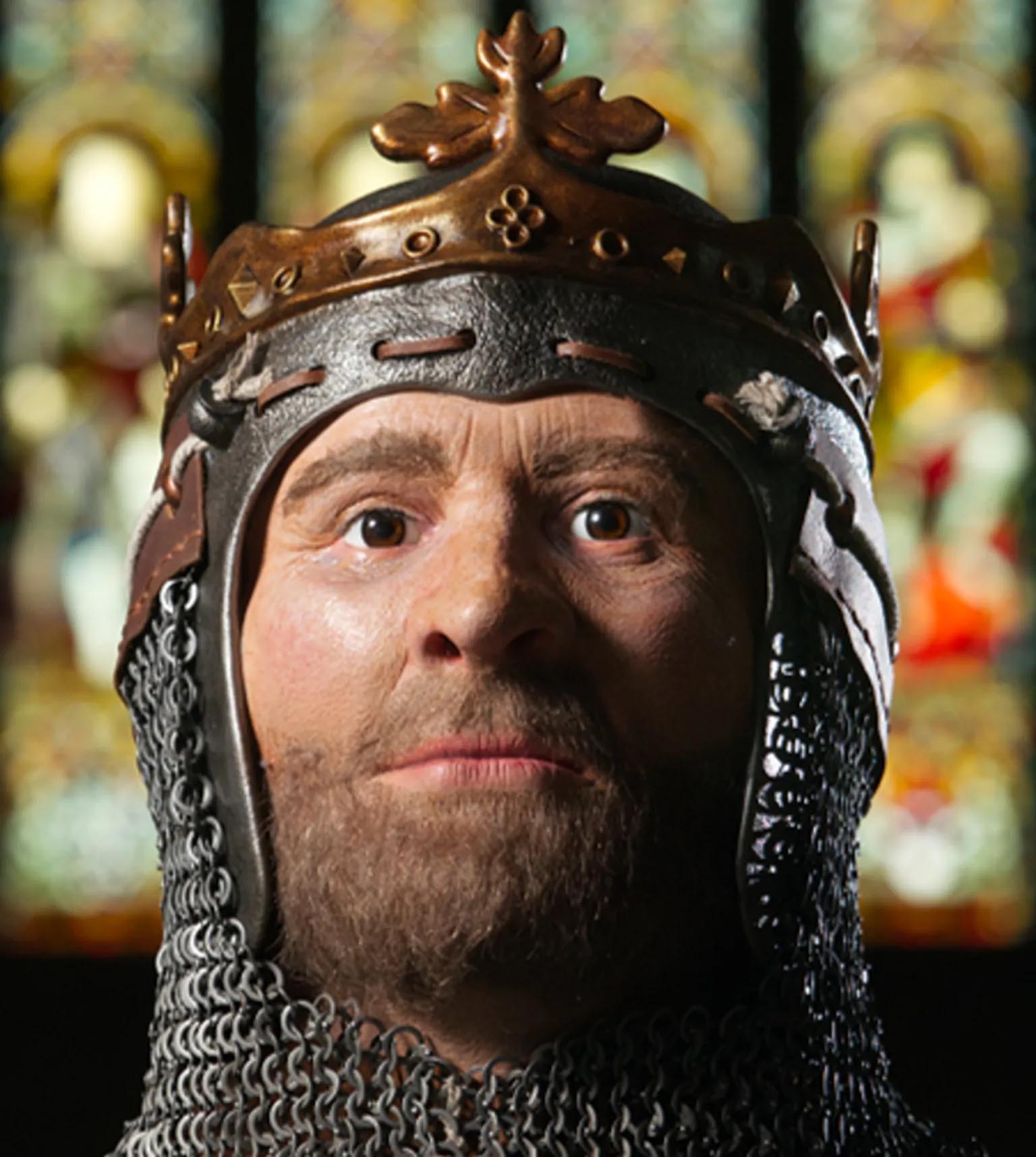
Also, one of the main reasons we were visiting Scotland later on our trip was to investigate my ancestral heritage. Since the last time I was in Scotland eight years ago, I discovered (thanks to my cousins) that we’re related to Robert the Bruce, first king of Scotland. (He is my great-grandfather to the 21st power.) While we were backtracking to the museum in the rain, one of our plans on that account came to fruition. I’d been trying for months to book a tour of Broomhall House outside of Edinburgh, which is the family home of the Bruces, and it was only recently opened for public tours.

We got news that those plans were a “go!” That lightened the misery of walking with tired feet in the rain. We only hoped that our luggage would finally arrive so that we’d have something nicer to wear than blue jeans and stinky underwear to Broomhall.

We capped off our evening with supper at Ryan’s Pub. This was a second visit for us because it was within walking distance of our hotel and the food and drinks were grand! I was introduced to a whisky sour there (topped with a sprig of mint), and it has quickly become one of my favorites. As if that weren’t good enough, when we arrived back at our hotel, our luggage was waiting for us!

Ryan’s Pub, Belfast

Day One in Ireland

To travel hopefully is a better thing than to arrive, and the true success is to labor. — Robert Louis Stevenson

A typical street in Belfast

I’ve been radio silent for a while. That’s because Russ and I have been meandering around Ireland and Scotland for three weeks. Like Stevenson’s quote above (which I came to learn on this trip), our travels involved a lot of labor and lost baggage, but we remained hopeful and didn’t let it get us down. The good experiences we had far outweighed the difficult.

Belfast was the goal of our first travel day. Alas, we only made it from Duluth to Minneapolis. We boarded our Belfast-bound connecting Delta flight in Minneapolis, giddy that our long-awaited trip was finally happening.

After we backed away from the gate, the pilot announced that one of the engines was doing something weird. He ran some tests and then needed a new part or a sensor, so we got off the plane until that arrived. The clerks kept saying we’d reboard in the next half hour, then it was the next half hour, then the next. By this time, it was past midnight. Suddenly, the announcement came that the flight crew had timed out, so we weren’t going anywhere.

After spending an hour in line to get rebooked for the same flight the next evening, making a reservation at one of the hotels Delta recommended, and then being denied our luggage because the baggage handlers had all gone home, we caught a hotel shuttle. We flopped into bed, bedraggled and bemused at 2:30 a.m.

The next day, we arrived back at the Minneapolis Airport in plenty of time. We explored the shops and probably walked down every gate there was just for some exercise. We even discovered we could have slept overnight in the airport had we wanted. On the second floor, there’s a “Quiet Room” with sleeping pads and cushions. Good to remember should we ever find ourselves in a similar situation! But I’m glad we had a hotel room.

Once we arrived in Belfast, our luggage was missing. After filing a report, we made our way to our hotel, even more bedraggled and more sad than bemused. Little did we know, it would be two more days before our luggage showed up.

We felt like we needed to make up for lost time, so our first day in Belfast was very active, despite jetlag. Our first stop was the Botanic Gardens, a free activity that we could walk to from our hotel. A statue of Lord Kelvin greeted us once we passed through the gate. He was born in Belfast and is best known for his discovery of absolute zero. The gardens have a Victorian feel to them and offer several greenhouses to walk through, and even a Ferris wheel to ride.

On the edge of the gardens is the Ulster Museum, another free venue. If you’re not aware, the term “ulster” translates as ‘Land of the Ulaidh,’ the ancient kings and their people that ruled over most of the north of Ireland in pre-Norman times. The region of Northern Ireland is known as Ulster. Its proximity to Scotland made it relatively easy for many Scots to migrate there.

The museum explores the past, present, and future through art, natural science and history. It sported huge wicker dragons, a replica of an extinct Irish elk, and two famous paintings by Caravaggio. Apparently, pick pockets patrol the room where patrons are distracted by these paintings. The docents asked us to put our backpacks on the front of our body to discourage theft.

Back at our hotel, we booked a cab to Belfast Castle, which is situated high on a hill overlooking the city. Unfortunately, we couldn’t go inside it because the castle was booked for a private event, but we were satisfied to walk around the grounds and eat scones for lunch in the cellar café.

Belfast Castle

One of the blogs I follow offers great information about the castle, if you’d like to learn more. It also features a photo of the interior. We loved the cat-themed garden.

Back at our hotel again, we asked the concierge about booking a Sectarian taxi tour. These tours take you into the heart of the parts of Belfast where “the troubles” erupted in the late 1960s and lasted until the late 1990s. Both Russ and I had read, “Say Nothing,” a book about the troubles and were interested in seeing the areas described in it.

The concierge said she knew someone who could take us and that he had “a very nice van.” And that he would answer all our questions. He did, indeed, have a very nice van (a Mercedes) but his presentation was a bit jumbled. It didn’t help that he had a food smudge on his cheek the whole time and that spit balls gathered on his lower lip. That made it hard to listen to him, but he did tell us many personal stories about growing up in those times and he took us to all the different areas: Protestant, Catholic, and Loyalist. He also told us that everything he said was “deniable,” so, it was hard to know how seriously to take him.

The Peace Wall in Belfast, one of the sights on our sectarian taxi tour. The wall separates Protestant and Catholic neighborhoods in the city.

Back at the hotel again, we walked down the street in search of some supper. The place we chose was right across from the Belfast Police Department. The police are housed in a very impressive structure. All it lacks is a moat. I’ve never seen such a well-fortified modern building! But, of course, they’ve needed the security with all the conflicts of the past. There’s peace now, but as our tour guide and several other people told us, it’s an uneasy peace.

Whew! That was quite a first day in Ireland. Next up: The Titanic Museum and the Maritime Trail.

The Belfast Police Department Building

Spring and Newton’s Apple Tree

I traveled to Madison, Wisconsin, this week for a water symposium on the university campus. As I walked back to my hotel from the event, I passed the university’s botany garden. On a whim, I meandered off course a few steps and entered.

Although it was too early in the season for everything to be blooming, enough flowers were showing to keep me moving through. Sculptures with botany themes were scattered throughout the small but pretty garden.

One plant and plaque stopped me in my tracks: a picturesque apple tree surrounded by a fence. The tree sported white blossoms and looked older than its 23 Years. Reading the sign, I learned that the tree, planted in 2001, is a direct descendant of the original tree that bore the fruit which inspired Sir Isaac Newton’s Theory of Gravitational Forces.

Huh. I always assumed that the whole apple falling on Newton’s head thing was a myth. But now here was living proof that the tree from which said apple fell not only could be identified, but its offspring was living in Madison!

The plaque said the original “Newton Apple Tree” grows on the grounds of the National Institute of Standards and Technology. But that institute is in the United States (in Maryland). I thought Newton made his discovery in England.

So, in writing this post, I did some digging. The institute tree the Madison tree is grafted from was a clone. Alas, the clone fell over and died about a year ago “due to unknown reasons” according to Wikipedia.

Tulips and a crabapple tree were in bloom in UW-Madison’s Botany Garden. The person in the image is taking a picture of the tulips from below.

The actual original Newton tree grew in the 1600s on the grounds of the English manor where Newton was raised. The Woolsthrope Manor tree has died, but its descendants and clones live on at the manor and many other places around the world.

The story of the apple inspiring Newton’s theory gained public visibility when Newton’s niece related it to Voltaire, who included it in an essay. The apple, however, did not fall on Newton’s head. That is a silly myth.

The Madison tree was planted in honor of F. James Sensenbrenner, chair of the U.S. House of Representatives Committee on Science (1995-2000). Sensenbrenner was a Republican congressman from Wisconsin and a graduate of UW-Madison. From the plaque text, it sounds like Sensenbrenner presented the tree to the university himself in hopes that “the fruit of this descendant inspires others to partake in scientific discovery.” This strikes me as rather self-aggrandizing, but it was a nice gesture, no doubt accompanied by some additional funds.

As if having a copy of the Newton tree isn’t enough, the UW-Madison Botany Garden was the first in the world to be based on the new Angiosperm Phylogeny Group system of molecular classification of plants. I don’t really know what that means but if you visit the garden’s webpage, there’s a chart about that.

As I continued my walk through the garden, I envied the Madisonians their warm breezes and blooms. In northern Minnesota, our daffodils are just beginning to show. It will take us about three weeks to catch up to the plants in Madison. Sigh. But this way, lucky me experiences two blooming seasons and that’s just fine.

I exited the garden, glad for my little educational and botanical detour and that I’d have something to share with you. And now you know more than you probably ever wanted about Newton’s apple tree!

Artist’s Point, Grand Marais MN

When last we met, Russ and I were in Grand Marais along the shores of Lake Superior for an afternoon photo reception at their local health facility. We decided to stay overnight after the reception and take a little photo expedition the next morning to a scenic spot on the harbor.

As we ate supper at the Gunflint Tavern, I came up with the bright idea to do a reconnaissance mission to the spot to prepare for the next day’s shot. I hadn’t been to Artist’s Point in several years and wanted a refresher. The sun was still up so we’d be able to see okay to walk along the break walls and rocky coast.

I must admit that I had a glass of wine with supper and then for dessert, a brandy old fashioned cocktail. Although the food at the tavern was lovely, that cocktail was truly memorable! A brandy old fashioned is made with muddled (smashed) maraschino cherries and orange slices. (For a photo, see this post.)

I don’t know what kind of cherries the tavern used, but they took the drink to a whole new level! They were dark maroon and tasted divine. I know they weren’t Amaro-soaked cherries because I’ve had those before. I wish I had asked our waitress what they were, but I didn’t.

Thus fortified, and wearing high-heeled boots, I ventured with Russ to the harbor. I didn’t even have my Nikon along (that was back at our inn), only my cell phone.

I clambered up on the break wall, but Russ refused. He’d had a drink with dinner, too, and didn’t trust his balance enough to join me. I, however, found that my dessert made me not really care that I was up on a rocky wall in high heels. Plus, the views! I immediately became inspired and started snapping away on my phone, wandering this way and that for the best views.

What was intended as a simple reconnaissance turned into a photo shoot in its own right. Here’s a gallery of my results.

I clambered off with wall none the worse for wear and we headed to our inn for a rousing card game. We slumbered until Civil Dawn – that time just before the sun rises. In our case, that was 5:30 a.m., much earlier than we usually wake.

We quickly dressed in gear appropriate for temperatures in the mid-40s. I gathered my tripod and camera and we drove down the hill a short way to Artist’s Point. The area is named for its picturesque views. Painters can often be found there.

The sky over Lake Superior began turning a light orange as the sun prepared to make its appearance. Songbirds were singing, mallards quacking. Shorebirds flitted from rock to rock in front of me on the beach. The air was calm.

The sun wasn’t rising close to the island where I hoped it would be, so I set up my tripod on the beach and started taking photos. As the sunrise progressed, I found some large rocks and old wooden pilings that made for an interesting foreground. I crouched for the best angle.

I stepped away from my camera a few times to enjoy the sunrise in its own right, without a viewfinder in front of it.

Then I made my way out to the point and the break wall. Russ stayed back again. By this time, the sun climbed higher, but it was too bright for a good photo against the island. Instead, I focused my efforts in the opposite direction — on the lighthouse in the harbor, which was lit by the reflection of the rising sun. As I shot, a gray fishing boat left for the deeps of the lake with a raucous chorus of gulls following in hopes of sharing the bounty to come.

As I was finishing, I noticed a man off to the side on the harbor shore. Was he a photographer, too? Was he seeing something I wasn’t? (Every photographer’s nightmare!)

Then I noticed he wasn’t holding a camera, but a fishing rod. Just an angler out catching breakfast before work.

My cold fingers told me it was time to stop taking photos, so I clambered off the wall and met up with Russ. We returned to our cozy inn, peaceful, inspired. Happy.